


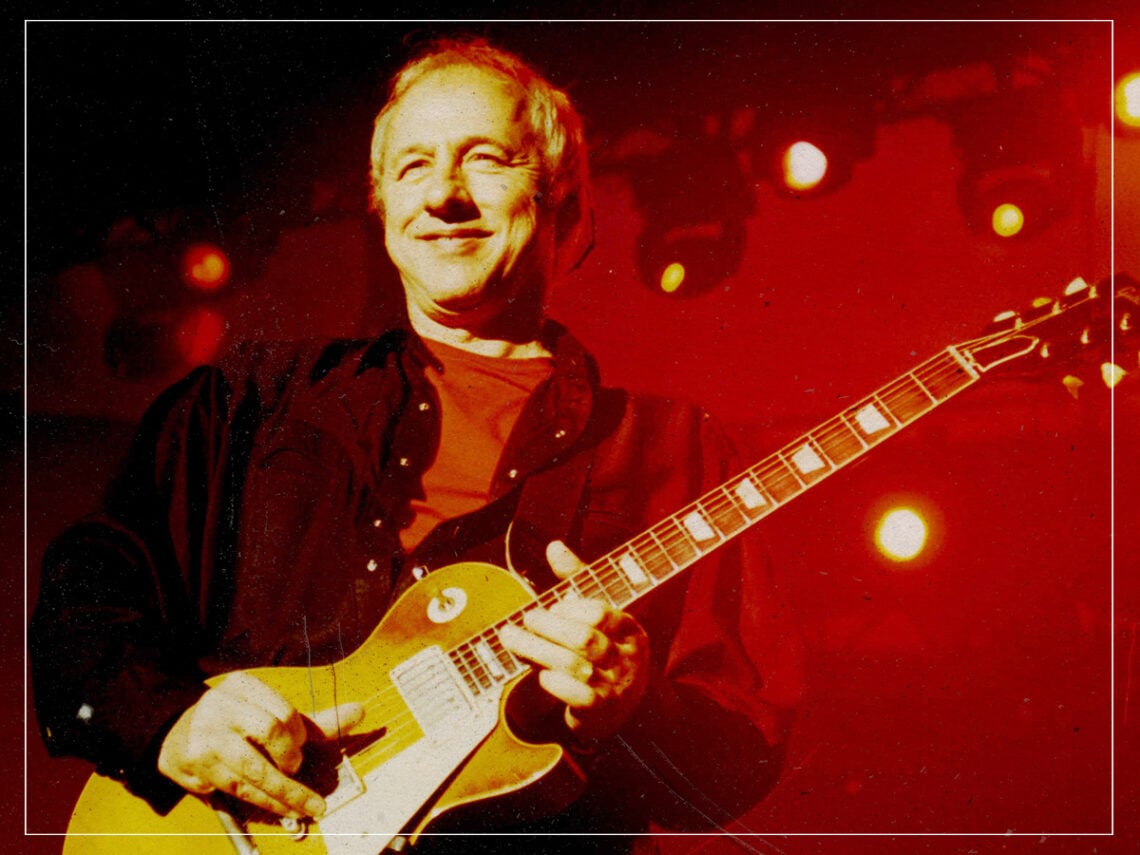
“So different”: The guitarists Mark Knopfler always wanted to be

When you’re a child who’s into discovering music, there’s almost always a phase where you want to grow up to be just like the artists you idolise. Whether you’re enthralled by the draw of being a frontperson, laying down a rhythm or shredding on the guitar, it’s almost inevitable that you’ll have a period where you’re constantly working towards being just like the musicians you look up to, pulling poses in the mirror or spending hours honing your craft to be as good as they are. For a young Mark Knopfler, things were no different.
Born in 1949, the Dire Straits guitarist and vocalist would have been in his formative years at the height of the 1960s when popular music was going through something of a seismic shift. The birth of pop, rock and roll and psychedelia were all taking hold of impressionable young people, and Knopfler knew from a young age that this was exactly what he wanted to pursue as a career.
He would begin playing as a session guitarist at the age of 16, performing with a number of local acts in his the Newcastle area where he was raised, but he wouldn’t make it as a successful guitarist during this early period. He still had plenty of a way to go in order to be able to emulate the success of his heroes, and he’d continue to push himself throughout the decade and into the 1970s.
When he formed his group, Dire Straits, in 1977 alongside his brother David, things began to take off after a gradual period of quiet, and they’d reach incredible levels at the tail end of the decade and throughout the 1980s with hits such as ‘Sultans of Swing’, ‘Walk of Life’ and ‘Money For Nothing’. Dire Straits would go on to become a multi-million record selling group beloved by many, and it would have been partially thanks to the strict pursuit of following his dreams that Knopfler had followed from a young age.
But who were his primary influences, and how did they begin to shape the style that he later adopted and saw himself emulating when at the peak of his success? During an interview with Absolute Classic Rock, he was asked to name some of the figures that he looked up to in his youth when he first picked up a guitar, and the trio of names that he selected are all among the greatest in blues and rock history.
He didn’t have the easiest time narrowing down to one particular guitarist on account of the fact that “they’re all so different”, but would first name Eric Clapton as being a hero of his. “I grew up wanting to be in a blues band like Eric, with John Mayall’s Blues Band,” he told the radio station, before singling out another player from the group in Peter Green. While these two are undoubtedly clear influences that have presented themselves in his own songwriting and playing style, he would also note another icon. “I must say,” he continued, “Jeff Beck, he’s a tremendous loss.”
While the passing of Jeff Beck left a gaping hole in rock music, his legacy, along with those of Clapton and Green, remains strong, and the evident influence that they all passed on to future generations still continues to this day.
