


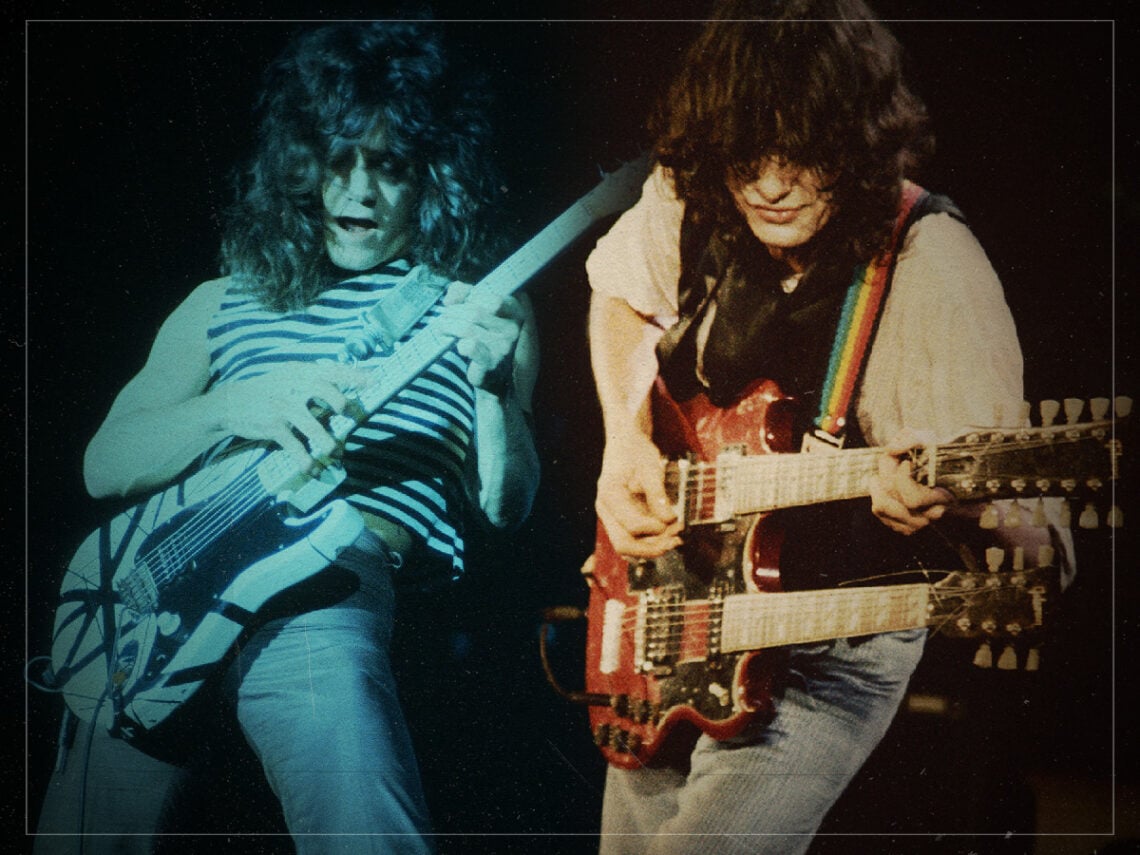
The guitarist Jimmy Page thought was a level above Eddie Van Halen: “I understand”

The phrase “never meet your heroes” fits best in the world of music.
Musicians, and great ones at that, are famously mercurial and aloof, and so going beyond their work to get to know them as a person presents an unpredictable outcome. But within each instrument, be it guitar, drums or bass, there is a sort of union between the players.
A mutual respect exists between musicians within their own instrumental group, and so when it comes to meeting your heroes within that space, any shortcomings in conversation can quickly be resolved by a jam session. Because great musicians, as Steve Lukather found out, interact through their art.
Because in the 1980s, as a guitarist, there was perhaps no one more iconic than Jimmy Page. Sure, Jimi Hendrix, Eric Clapton and Jeff Beck would be suitable names to throw at me in a rebuttal. But to many, Page embodied this sense of virtuosic and charismatic rock and roll that would put many on edge when simply sharing a room with him.
Then, in the 1970s, he changed the course of rock and roll with Led Zeppelin. When that came to an end, and the 1980s rolled in, he didn’t hang up his plectrum and sit on a throne of assumed entitlement; instead, he continued to collaborate with as many musicians as possible, much like he did in the 1960s blues scene, where collaboration was the key to innovation.
Ultimately, this put him in rooms with many iconic guitarists. In that decade, there were perhaps none more famous than Eddie Van Halen and Stevie Ray Vaughan. But it wasn’t those two that Page heralded as the ones operating on a level above. It was a more understated guitarist who emerged between the cracks of those two titans.
Steve Luthaker didn’t think he would come out with that title when he went to meet Jimmy Page, but ultimately he did. “I went over to this Guitar Centre thing honouring Nigel Tufnel from Spinal Tap,” he explained.
“In fact, I ended up producing four tracks on their next record because of that night. I showed up with Eddie [Van Halen] and my boys,” he recalls. “Hey, we’re going to meet Jimmy Page, a big deal, right? Jimmy’s standing there greeting everyone. He points at me.”
Adding, “I think he’s pointing at Ed, of course, but it’s me, and he motions for me to come over. He said, ‘You have something that these other guys here don’t.’ And I go, ‘What’s that, Jimmy?’ He said, ‘You understand, and I understand, but those other guitarists don’t. We were studio players. They don’t know what that means.’”
What Page perhaps recognised in Luthaker was a skill that had become lost in the growing opulence of 1980s stadium rock. The skill of humility and serving the song, as opposed to dominating the spotlight and cascading into unnecessary solos. Maybe there were more technical guitarists than Luthaker, but he had a soul about his style that Page noticed.
