


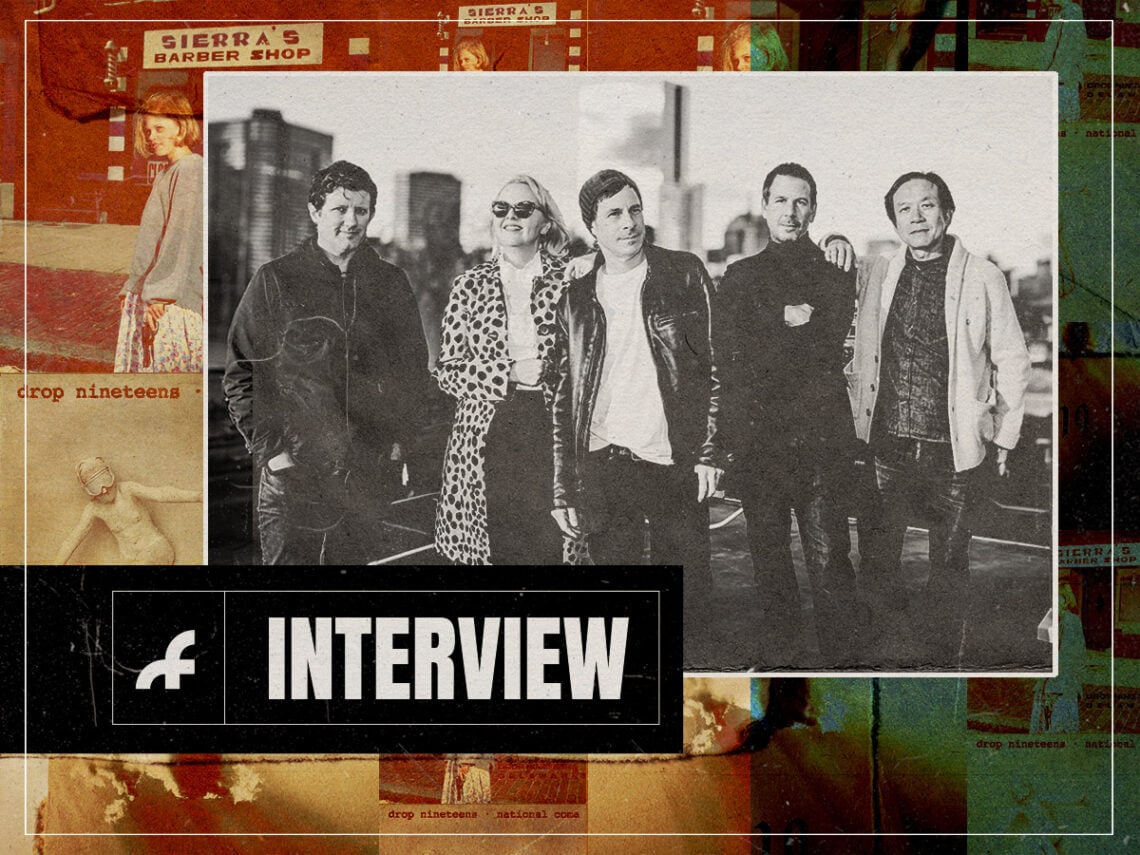
Greg Ackell of Drop Nineteens reflects on the “waking dream” of a return 30 years in the making

After a slight mix-up, owing to us residing in different time zones on either side of the Atlantic’s expanse, I sat down with Greg Ackell, the leader of shoegaze icons Drop Nineteens. As if it were to pan out in any other way, the exchange was coloured by his unique insight, humility, and, at points, genuinely emotive concessions. This insight goes a long way in painting a picture of the man behind one of alternative rock’s perennially influential groups.
I’m always loath to follow the traditional route of interviews, but this time, my hand was forced, and there was only one question to kick things off: how does it feel to be back? After all, Drop Nineteens reunited in 2022 and released their third album, Hard Light, in November last year after 30 years away. Now, their consequential first chapter’s interpersonal and musical friction has all but been put to bed.
The band rose meteorically after forming in Boston in 1990. Active until 1995, after the release of their revered debut album, Delaware, the group experienced significant personal strife and resulting lineup changes, which included the departure of vocalist Paula Kelley. This meant that when it came to making the follow-up, 1993’s National Coma, Ackell was the only founding member left. However, his sophomore effort was not well received, and even exciting opening slots for Blur and PJ Harvey were not enough to stop him from calling time on the band in 1995. He was done with music. Premature success was the proverbial P45.
“It feels strange and not strange at all,” he explains. “Which is to say that I’ve been here before, but it was a very long time ago. And so it’s a little bit like a waking dream, and I don’t even mean that in a necessarily positive way. Waking dreams can be scary. They can be happy. They can be sexy. They can be whatever the fuck, but there’s always kind of an unsettling feeling about them. Because are you awake? Or is it a dream? And not to quote My Bloody Valentine, but that’s how I would describe it. It’s unsettling because it’s not new territory.”
“It’s unsettling because it’s like reliving something,” he expands. “My experience in life so far is that doesn’t really happen. You really can’t ever go back. I mean, people try. They get nostalgic, and they’ll go back to their high school or hit up an ex-lover and try to go back, but my experience with that in life is it’s not always a good idea. And there’s always something strange about it. And it usually doesn’t work out; you can’t go back. Yet, here we are going back.”
Despite all of the apparent allusions to the hurt of the past, he asserts: “We’re better people, and I don’t even know if that makes us a better band.”
Not done with describing the complex emotions of returning to Drop Nineteens after so long and so much history, Ackell persists: “This band experienced turmoil. Anyone who knows our brief history is aware that there was a lot of coming and going. We were particularly young when we started. I have friends who got married early, for example. And for many of those friends, the marriages also ended early; it’s a little bit like that. It’s almost as if we got stuff out of our system by going through that.”
He adds: “And so we come at this later in our lives, just much more prepared for each other. And it’s not something I planned on; I didn’t know it would be like that until we got together. And now that we are together, the surprising thing is how much fun we’re having. It wasn’t fun before. We like each other. We did start out as friends in the early ’90s – late ’80s, actually – but stuff got dark, and it’s just good to be back with each other and be treating each other with so much more respect. That was probably more on my part than anybody.”
Looping back to what it’s like to have returned and providing another contrast to the old days, Ackell says candidly: “So, you’re asking what it’s like to be back. Well, this is another aspect of it. People ask if I have any regrets, and I’d never have regrets about the music and things like that. Yeah, I would do it differently if I could, but I don’t know what I would change it to. So I don’t get hung up on that kind of stuff. But, during my life, I have stumbled at moments thinking, ‘I wish I treated people better than I did’. And to have a second bat at treating people like they deserve to be treated has been a boon for me personally.”
This has evidently becalmed the music, too. Hard Light may well be the most distilled version of Drop Nineteens, yet some elements appear like spiritual ancestors to Delaware. For instance, the single ‘Scapa Flow’ recalls those heady days in the early 1990s with the interplay of the droning guitars and driving, melodic bassline. Yet the scope is expanded on the titular track, and the closer ‘T’, points to a different direction that is not necessarily from the realm of shoegaze. It’s something more unique and personal.

This personal depth is corroborated in the lyrics. I put it to Ackell, albeit tentatively, that a friend of mine had queried whether someone in the band was terminally ill, as the title track opens with the line, “Time is of the essence”.
“That’s great; I love hearing that,” he somewhat comically responded before warping my brain by explaining, “Because it’s not a take that I’ve heard. As far as I’m concerned, words can’t mean anything you want them to mean, but they can mean anything they mean. See what I say? There’s a difference here.”
Ackell continued philosophically: “It annoys me when people say, ‘Oh, it’s whatever I want it to be.’ No, it’s not whatever you want it to be. It’s whatever it can be, based on the words. I love hearing that interpretation because it is a legitimate interpretation. It could mean that, which means it does mean that as far as your friend is concerned. But I will talk about that line. And I’ll talk about it in two ways.”
Like a magician keeping an audience on their toes, I wondered what the frontman had under his sleeve, or indeed, under his beanie, which was perched on his head à la the skate community that he grew up in, and who the band have always been loved by.
“The first,” he explains, is how it came to fruition. This was through texting his friend while selling his Connecticut farmhouse. Ackell was at a juncture in his life where he realised he couldn’t hold onto everything, so he was having a clearout. It was as much a mental as a physical reset. Consequently, he sent photographs of things in his old property to friends and asked if anyone wanted them. His friend, Celeste, reached out and claimed the fruit bowl. In response, the Drop Nineteens leader said he’d send it to her, but she said no. She wanted to collect it in person, as it gave them a reason to hang out. In that case, Ackell told her he’d even throw in the apples in the bowl and said, “Time is of the essence”.
Going ever deeper into the mind of the Drop Nineteens leader, he picks up with the “second thing”. He admits that he had to seriously consider the line’s future as it did dawn on him that it might be a little too on the nose. Despite questioning whether the line was a little too overstated, it ultimately made the cut thanks to the help of Kelley and Zimmerman.
Ackell didn’t want to belabour the point but also said that the line “time is of the essence” is about the future of Drop Nineteens and pondering whether they stick around this time or disappear once again. Using the Delaware classic ‘Winona’ as an example of a song he wrote as being on the nose, which he defines as a story about the band, he says that over the years, it became clear to him that “what things are at their moment and what they become are different things.”
And that’s an apt motif for where Drop Nineteens now reside. Over 30 years on from their debut they have produced an album that sets a different course. While Hard Light is inextricable from what came before it, the lessons learned and the lives lived have produced a band and a sound for the contemporary era with its own significance.
Listen to Hard Light below.
