


At the Wallace Collection: How Grayson Perry continues to challenge gender norms

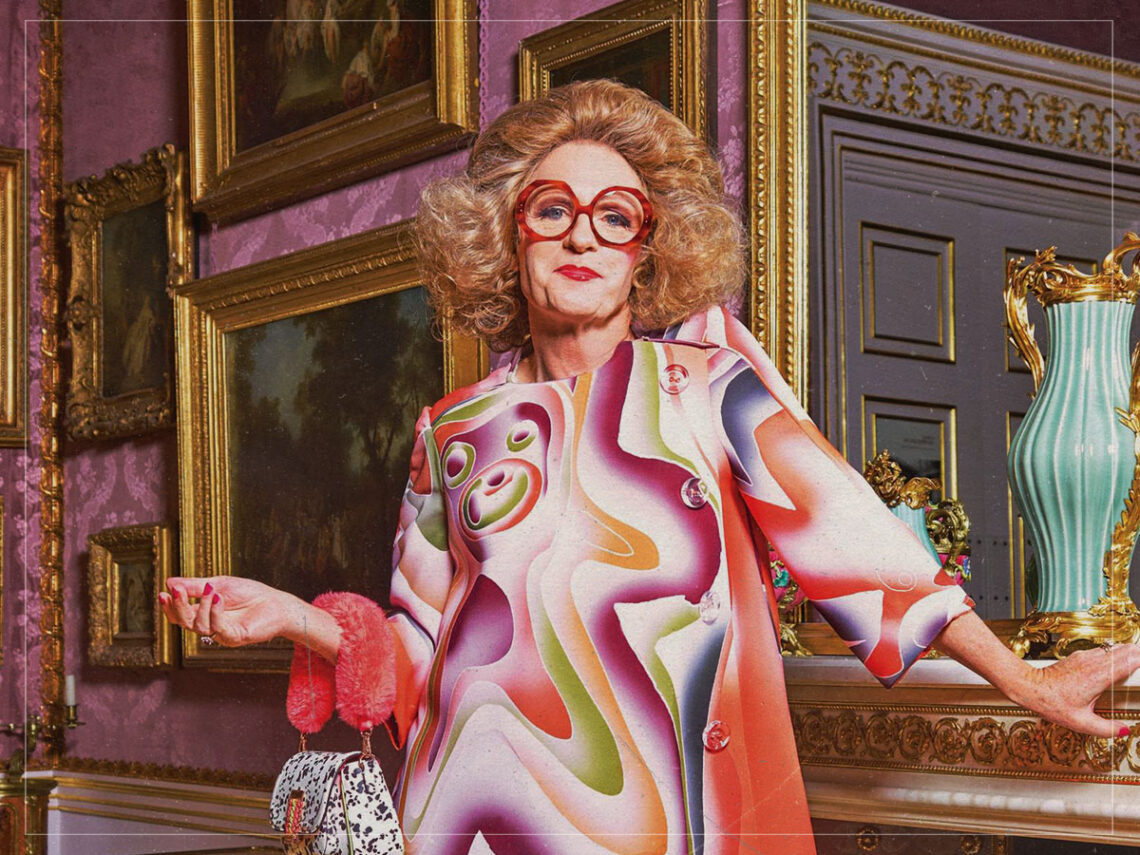
If you’ve happened to walk past the Wallace Collection in London recently, you might have noticed huge photos of Sir Grayson Perry wearing a marvellous Pucci-esque dress, a 1970s blond wig, and Professor Trelawney-style glasses.
What might such an extravagantly camp artist be doing at the traditional and deeply conservative Wallace Collection, you might ask? A new exhibition, Delusions of Grandeur, has opened, centred around Perry reinterpreting and imagining famous works from the collection.
The works of the collection and those by Perry could not be more different. The former are mostly French and British Rococo paintings of voluptuous women preoccupied with looking pretty while playing in gardens, while their husbands are diplomats working on supposedly more important societal matters. Now, if you are not familiar with Perry’s work, just imagine the exact opposite of this hyper-heteronormative, old-fashioned way of living. Perry is a cross-dresser who identifies as a straight male. He has dedicated his career to exploring society’s imposed gender binaries, fashion and sexuality, and subverting all of it.
Having said all of that, you can just imagine how Perry went about this exhibition, poking fun, questioning and critiquing everything that has been on display at the Wallace Collection. However, it’s important to note that Perry doesn’t criticise the collection per se, but takes a look at the problems with European ways of thinking during the Rococo period.
But this article won’t be a dive into what is in that exhibition, because the curators do a very good job at that. Instead, this is taking a look at Perry’s first works, the ones that catapulted him into fame and led us right here.
The Chris Huhne Vase is perhaps the best place to start. Chris Huhe was an energy and climate consultant and former member of the Liberal Democrats in the early 2010s. However he brought a scandal – and terrible reputation upon himself – when he used his power and status to circumvent the law during a speeding case in 2003. His wife took the blame for him, falsely admitting that it was she who was driving the car, and lost her penalty points. Things got even worse when it came out Huhne was having an affair with a colleague and shortly after left his wife. The poor woman…
Being the artist and person he is, Perry absolutely despised Huhne and his hypocrisy and consequently made him the subject of a vase. According to Perry, Huge is the stereotypical “default man”, a label Perry invented to categorise white middle class men who are self-destructively heretosexual and behave as the reference point from which all other social values are judged.

The vase is very much Greek-inspired in shape and motif, with different registers of repeated patterns and symbols. We can see a phallus, the Liberal Democrat logo of the bird, a licence plate and an image of his wife among others – all images that form parts of his identity and downfall.
Unlike Perry and many of his other works, this vase is glaringly monochromatic and simple in colour scheme. This is because, according to Perry, part of the “default man” package was that they only wore neutral colours, because god-forbid looking slightly camp.
However, the symbols on the vase have been interrupted by different cracks in the ceramic as it seems to have been smashed and then pieced back together. The cracks have been filled with gold which viewers have interpreted differently. Some see the gold as symbolising Huhne’s wealth and how the dirty politician attempted to repair his broken status by exploiting his wealth and power. Perry says that the gold cracks symbolises Huhne’s fragile masculinity, because after all, “what symbolises vulnerability better than a pot”…
Perhaps the antithesis to this work, is Perry’s Claire’s Coming Out Dress which is essentially the outfit worn by Claire, Perry’s alter-ego when he cross dresses. Claire has been a recurring persona in his work, through which he explores his identity and subverts gender norms.
Since he was a child, Perry experimented with cross-dressing as it unleashed his creative drive and allowed him to explore his underlying eroticism and psycho-sexual identity more freely. In fact, he describes dressing up as “the herald of my subconscious”. But Claire is not a regular woman; she is a Little Bo Peep, a hyper-feminine caricature that embodies all the opposite qualities of the “default man”. Simply put, she is “the crack cocaine of femininity”.
In order to introduce her into society, Perry decided to throw a coming out party for her and make her a specific dress to don at the Laurent Delaye Gallery in which it was being held. Like the vase, the dress is covered in embroidered images that recall a part of Claire and Perry’s personal story.
Perry’s clever use of the dress as a medium allowed him to explore another form of art that also suited the discourse of gender he was critiquing really well. On the dress we see an embroidery of Alan Measles, Perry’s childhood teddy bear that became a mascot for him growing up.
As a child, Perry was emotionally abused by his stepfather and so the image of Alan Measles as a protecting masculine figure was created to help him feel safe and team up with. There’s also an intersex butterfly which is Perry’s supportive message to this community of people and his empathy for them.
The coming out party was in the format of a debutante ball, a customary traditional celebration of a girl entering adulthood among European elites. Once again Perry is exploding stereotypes and creating awkward pairings by taking a coming out, which is usually an intimate and lowkey affair, and turning it into something much bigger and pompous to subvert all stereotypes.
