


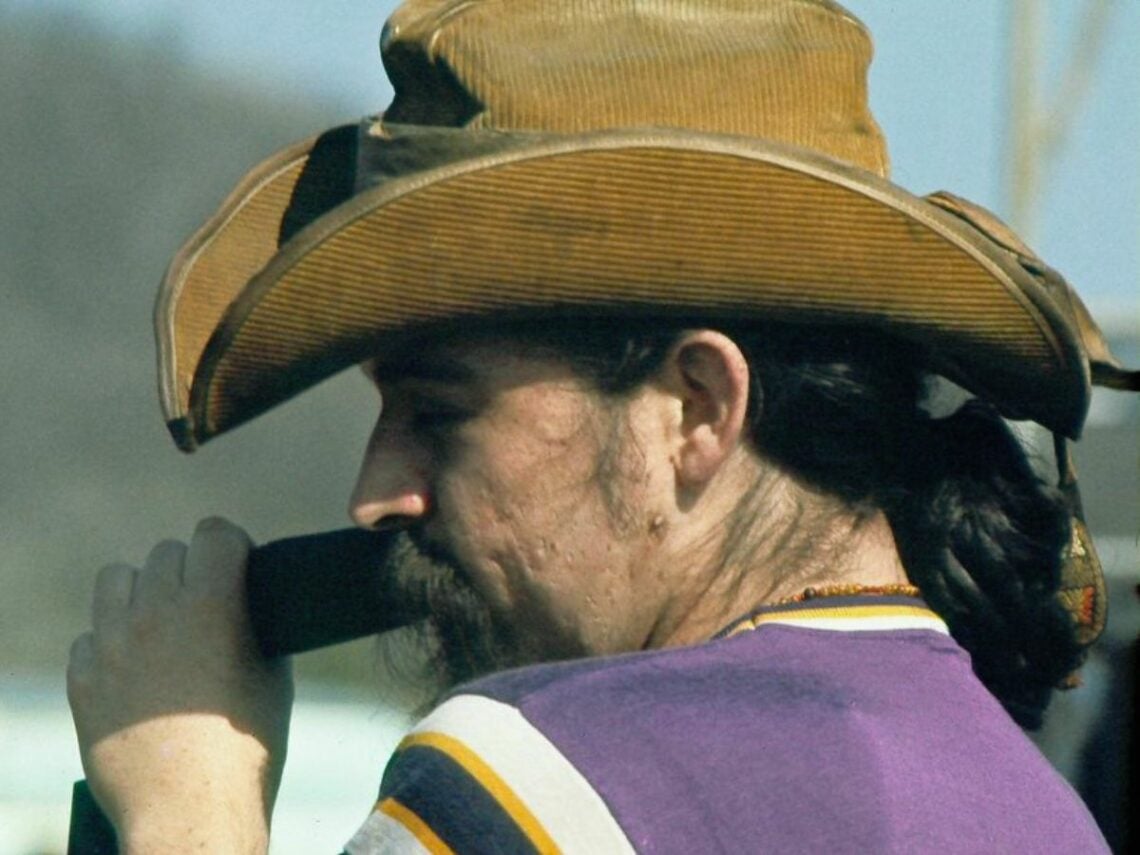
What was Grateful Dead member Ron ‘Pigpen’ McKernan’s first instrument?

Even before the Grateful Dead started out in 1965, Jerry Garcia, Bob Weir and songwriter Robert Hunter were in thrall to ‘Blue Ron’ McKernan’s knowledge and appreciation of the devil’s music. What’s more, Garcia was so taken with his childhood friend’s talent as a vocalist that he put him forward as the first real lead singer the group ever had.
As ‘Blue Ron’ transitioned to his new role as ‘Pigpen’, the slovenly but loveable multi-instrumentalist and occasional vocalist in the Dead, his blues roots began to take more of a backseat in the band’s eclectic sound. Garcia became more and more set on making psychedelic Americana, thrilling the scores of acid-tripping fans who would flood to see them up and down the United States.
There was still room for Pigpen, though, as tracks like the blues standard ‘Next Time You See Me’ from the band’s self-titled debut studio effort demonstrates, and it’s impossible to imagine the early sets performed by the Dead without him. But by 1968, his primary instrument was off the table completely. He’d turned into an organist and percussionist par excellence, but even his lead vocal performances were becoming increasingly rare. In fact, his contributions to his third studio album, Aoxomoxoa, are barely noticeable at all.
Yet a turning point came in 1970, when he returned to form on Workingman’s Dead, going back to his original instrument for the first time since the group’s first record. This album began a run of seven consecutive records on which Pigpen appeared to be back to his old self again, not least on the LP that arguably marked his highpoint in the Dead, the masterpiece of psychedelic country rock that is American Beauty. Pigpen helped to give the record its bluesy edge, particularly with his instrumental solo on the song he’d penned himself, ‘Operator’.
So, what instrument was he playing?
From the moment Garcia hauled Pigpen on stage at Dana Morgan’s Music Store in Palo Alto for a jam during the early 1960s, he was a natural blues harmonica player. He excelled at the instrument in technical terms, far beyond the capabilities of more famous contemporaries in the pop charts at the time, such as John Lennon, Mick Jagger, Bob Dylan, and Little Stevie Wonder. And his love of the blues meant he bent notes out of shape with the feel of a true Delta bluesman.
He might have hailed from northern California just like most of the Dead, but his heart was somewhere in the deep south, the home of the blues throughout the first half of the 20th century. Pigpen loved what he did, but more than anything he loved the music itself. Which explains why he was perhaps reluctant to adopt the more professional mentality Garcia and Weir tried to coax out of the band in the late ‘60s.
Still, from the moment he sadly departed this world far too early in 1973, the rest of the Grateful Dead lost the only bandmate they had who could sing the blues and play the harmonica from the depths of his soul. And they never replaced him.
