


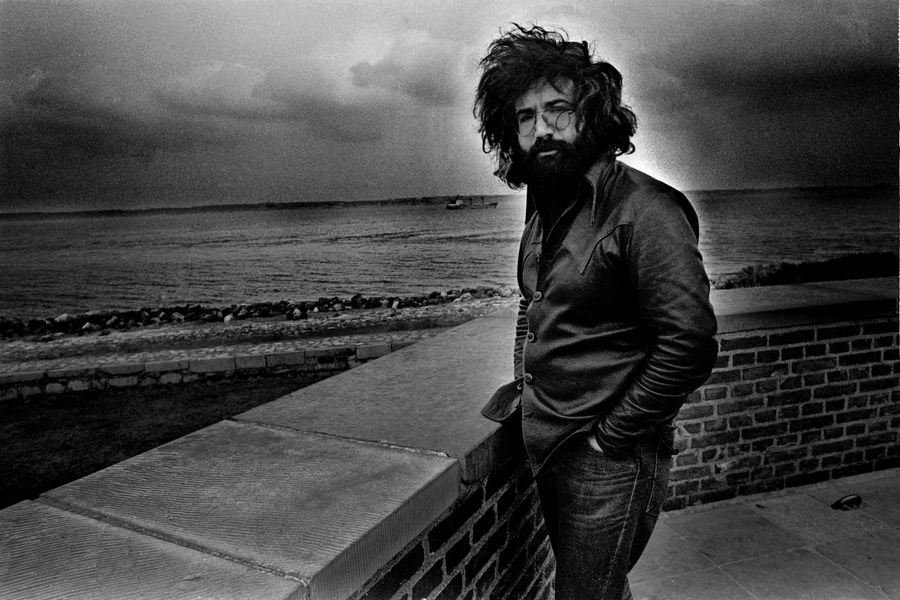
Why did Grateful Dead leader Jerry Garcia hate The Doors?

Jerry Garcia was a famously easygoing kind of person. The Grateful Dead guitarist was often seen as a warm and welcoming personality, from the very first days of the band’s residencies at pizza parlours to his final days as a hippie demigod. Garcia never enjoyed the spotlight or pedestal that Deadheads often put him on. In reality, Garcia’s only real concern was playing music.
Enthralling enough to hold a room and intimate enough to talk one-on-one with anybody, even cops that were trying to shut the band’s shows down, Garcia gained a number of fans in and around the music world. But Garcia himself wasn’t always quick to dish out that same love. For every player like Django Reinhardt, whom he admired, there was an Eddie Van Halen that he didn’t quite see eye-to-eye.
One of Garcia’s most notorious dislikes was toward fellow 1960s psychedelic pioneers The Doors. Chalk it up to an in-state rivalry or perhaps a lack of shared ideals, but Garcia wasn’t fond of Jim Morrison and the rest of the band. Although the Dead would often cross paths with The Doors, including running into the post-Morrison configuration of the band while on the Europe 72 tour, Garcia wasn’t very complimentary toward the band.
“I never liked The Doors,” Garcia told Blair Jackson in the book Conversations with the Dead. “I found them terribly offensive…when we played with them. It was back when Jim Morrison was just a pure Mick Jagger copy. That was his whole shot, that he was a Mick Jagger imitation. Not vocally, but his moves, his whole physical appearance was totally stolen from right around Mick Jagger’s 1965 tour of the states. He used to move around a lot, before he started to earn a reputation as a poet, which I thought was really undeserved. Rimbaud was great at eighteen, nineteen, and Verlaine – those guys were great. Fuckin’ Jim Morrison was not great, I’m sorry.”
“I could never see what it was about The Doors,” Garcia added. “They had a very brittle sound live., a three-piece band with no bass – the organ player (Ray Manzarek) used to do it. That and that kinda raga-rock guitar style was strange. It sounded very brittle and sharp-edged to me. Not something I enjoyed listening to. I kind of appreciated some of the stuff they did later, and I appreciated a certain amount of Morrison’s sheer craziness, just because that’s always a nice trait in rock ‘n roll.”
Jackson asked if Garcia had ever encountered Morrison offstage. “No, I never knew him, but Richard Loren, who works for us, was his agent and had to babysit him through his most drunken scenes and all the times he got busted and all that crap,” he claimed. “He’s got lots of stories to tell about Morrison. I was never attracted to their music at all, so I couldn’t find anything to like about them. When we played with them, I think I watched the first tune or two, then I went upstairs and fooled around with my guitar. There was nothing there that I wanted to know about.”
“He was so patently an imitation of Mick Jagger that it was offensive. To me, when The Doors played San Francisco they typified Los Angeles coming to San Francisco, which I equated with having the look right, but zero substance,” Garcia concluded. “This is way before that hit song, ‘Light My Fire’. Probably at that time in their development, it was too early for anyone to make a decent judgement of them, but I’ve always looked for something else in music, and whatever it was, they didn’t have it. They didn’t have anything of blues, for example, in their sound or feel.”
Of course, that would change as The Doors began compiling material for their final album with Morrison, L.A. Woman. By the time the Dead were refining their own sound in the early 1970s, Morrison was already dead and gone. Garcia certainly didn’t feel any love lost in Morrison’s death, so it’s no surprise that there isn’t a bigger Doors-Dead connection.
