


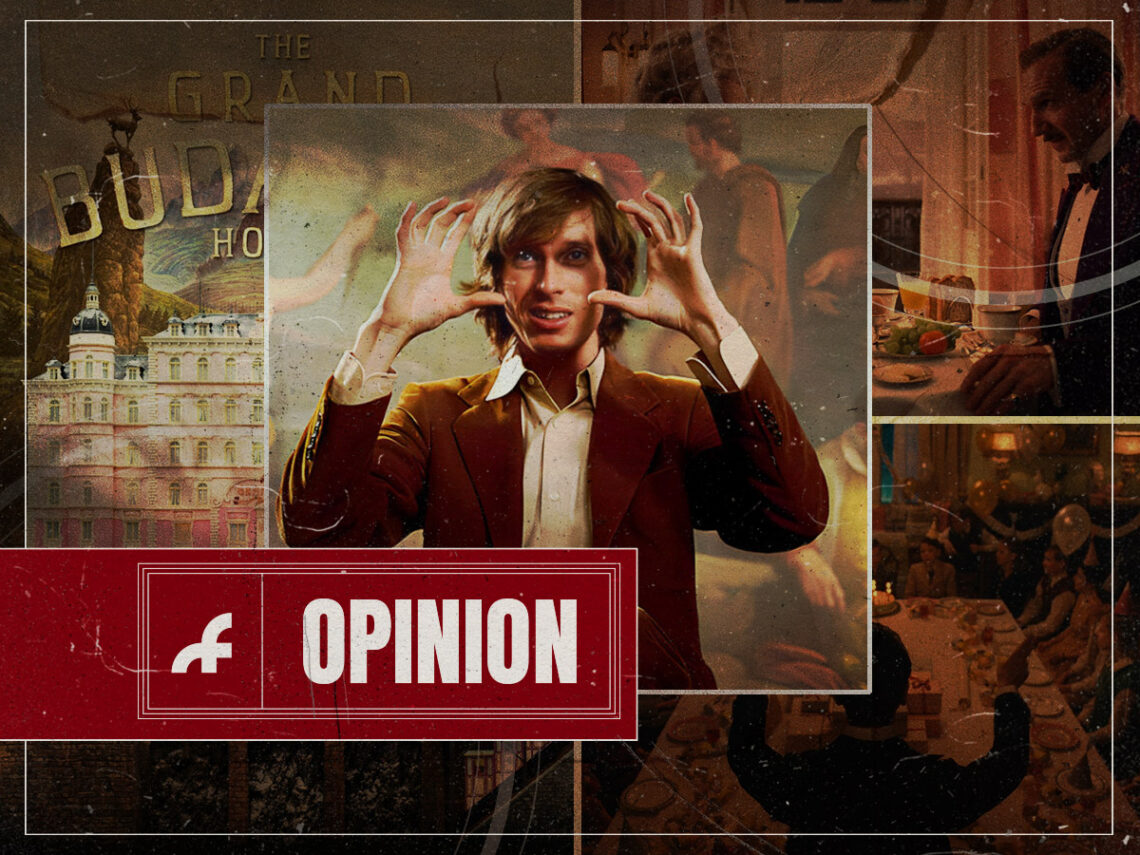
Why ‘The Grand Budapest Hotel’ remains Wes Anderson’s magnum opus

A delectable filmmaker who enjoys flinging the toybox of cinema into the air before meticulously sorting each element on the colour chart, Wes Anderson is one of cinema’s great post-modern artists. With painstakingly close attention to detail, Anderson has long treated each of his projects as sentient objects, stuffing them with so much love and eccentricity that their freneticism can’t help but seep through the pores.
Recognised as one of the new millennium’s most promising young filmmakers upon his 1996 debut Bottle Rocket, Anderson steadily developed his careful style from one film to the next. Developing a knack for working with grand ensembles, which only built in size and majesty from project to project, Anderson also became one of the industry’s most proficient character writers, crafting such three-dimensional protagonists as Steve Zissou of 2004’s The Life Aquatic, who would later become one of the filmmaker’s most signature icons.
Yet, few characters and, indeed, art styles can compare to Anderson’s 2014 opus, The Grand Budapest Hotel, a four-time Oscar winner that elevated the filmmaker’s craft to the point that every film previously was eclipsed by its beauty. A grand behemoth of pure, frenetic cinema, The Grand Budapest Hotel is the perfect expression of Anderson as an auteur.
Sitting on the alpine mountains of the fictional town of Zubrowka, set somewhere in Eastern Europe, stands the titular Grand Budapest Hotel, a vast pink salute to Art Nouveau that houses some of the continent’s strangest inhabitants. Hotel concierge Monsieur Gustave H (Ralph Fiennes) is Anderson’s master of ceremonies and the building’s desperate preserver of standards, looking after particularly his older guests with almost a little too much tender affection.
Such leads the camp concierge to form quite the close bond with the elderly Madame D. (Tilda Swinton), so much so that the latter leaves a priceless painting to Gustave in her will, much to the disdain of her greedy surviving family members. Suspected of seducing and then killing the woman, Gustave and his trusty lobby boy Zero (Tony Revolori) are then pursued by law enforcement and a host of other cartoon villains, taking them in, around and in between the beauty of the Grand Budapest Hotel.
It is in this protagonist of Gustave, and namely the performance of Fiennes, where the film truly thrives, with the character becoming a direct mouthpiece for the wit and artistic flamboyance of the director himself. Bizarrely missing out on an Oscar nomination for his stellar comedic performance, Fiennes demonstrates just why he is Anderson’s greatest protagonist to date, twirling the role around his little finger as he effortlessly slipped into the camp persona with the same zest and verve as the snappy screenplay.
Based, in part, on the work of the humorous pessimism of Austrian writer Stefan Zweig and his novels Beware of Pity and The Post Office Girl, among others, Anderson’s colourful comedy crime caper is a work of complete artistry, with its fingers in so many different pies of cinematic tradition and artistic style. Yet, it does all this while avoiding the ‘pretentious’ tag that some often slap onto an Anderson release, being a phantasmagoria of vivaciousness and an irresistible trip into a painstakingly well-realised fantasy world.
However, there is an aspect to picking apart Wes Anderson’s opus that doesn’t feel all that dissimilar from dissecting a frog, with the artistry of his work being best consumed by simply bearing witness to its splendour. Sure, the auteur’s trademark cinematic symmetry makes every frame a masterwork, and Alexandre Desplat’s soundtrack gives the film its rhythmic bounce, but it’s the seamless marrying of each of these elements that allows The Grand Budapest Hotel to thrive.
Underlined by the lack of even a speck of dust on the hotel’s plush red carpets, Anderson’s immaculate hotel is, quite simply, outstanding.
