


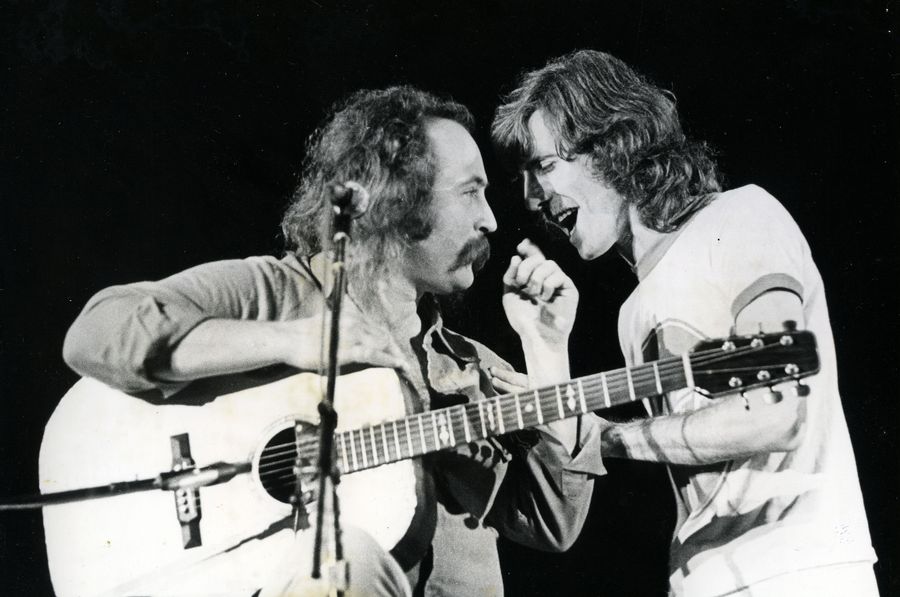
‘Graham Nash, David Crosby’: The album that defined David Crosby’s artistry and antics

Recorded decades before their infamous feud erupted, the joint debut of Graham Nash and David Crosby contained a prophetic look at the fractured relationship the pair would one day have. It remains the album that defines the duality of David Crosby.
Tucked away in the massive discographies of Nash and Crosby lies a discordant portent. It appears long after their respective stints in The Hollies and The Byrds, and just after their seminal work together in Crosby, Stills, Nash & Young. Their 1972 release, the eponymous Graham Nash David Crosby album, held in it the biggest hint of all that their artistic partnership was doomed to fail but destined to briefly flourish.
The first seeds were sewn in San Francisco. As the poets and hippies ushered in the Summer of Love in 1967, the Bay became a bohemian mecca. The air was thick with hash and the iconic San Franciscan sound. You could hear it floating out of the windows of cheap student housing at noon, heat suspending the songs mid-air while turntables crackled. Turning away from the student quarter, you could walk the corner of California and Mason, and take in the bizarre layout of San Francisco’s streets. Fittingly for a place that rejected the orthodox, rather than have the roads contour around the winding hills – San Francisco’s streets went bullishly straight up and over them.
Down those steep streets, that same sound would fizz in the air. Alongside the likes of Creedence Clearwater Revival and Country Joe and The Fish – Crosby, Stills Nash & Young managed to capture a sound and message that spoke to the frustrations of the burgeoning anti-Vietnam war movement. Their music was rich with melody and cosmic guitar riffs, a frenetic mixture of rock, blues and folk. The second studio album the quartet released in 1970 would become one of the most lauded rock albums in history, with Deja Vu not only producing three Top 40 singles, but amassing 8 million album sales worldwide.
Speaking to The Guardian, Crosby explained that there was a time in the band when they felt “everything was going to change next week. We thought the war was going to stop and we were going to get equality for people in this country.” That spirit is what Deju Vu captured, the urgency of flower-power idealism, wrapped up in four-part harmonies. From Golden Gate Park’s panhandle, to the coffee shops dotted along Haight Street, hippies dutifully nodded along to their cover of Joni Mitchell’s Woodstock: “Gonna join in a rock ‘n’ roll band / Got to get back to the land / Set my soul free.”
Freedom came quickly and suddenly. In the same summer, Deja Vu went seven-time platinum, Crosby, Stills Nash & Young split. The usual culprits were to blame: an excess of talent and chemicals. Speaking to Rolling Stone, Neil Young explained: “The thing is, everybody – especially David – is a controversial character. Everybody has an opinion.”
Tales of creative tensions were rife long before the breakup was announced and seemed almost inevitable given their meteoric rise to fame following their break-out set at Woodstock. Peter Doggett, the writer behind the ‘CSNY: Crosby, Stills, Nash and Young’ biography blames a climate of unlimited adulation coupled with unlimited self-regard. “All of this was being carried by four very young men who were, by their very natures, sensitive and wounded,” he explains. “It was a recipe for disaster from the start. In retrospect, it’s remarkable that any band of that era managed to survive for more than a couple of years under that kind of strain.”
Going the way of other doomed supergroups The Beatles and Cream before them, all four were cast adrift, triggering periods of deep artistic introspection and a slew of debut solo albums. The aftermath saw Stephen Stills form Southern rock outfit Manassas, and Neil Young reconnect with former collaborators Crazy Horse. Both Nash and Crosby would release debut solo albums in 1971, Songs for Beginners and If I Could Only Remember My Name respectively. Then, just one year later, compelled by the kind of mutual obsession that would later define their working relationship – they found their way back to each other.
Everything about the album felt like a clue that Nash and Crosby’s relationship was unsustainable. The choice to record their debut in Hyde Street’s infamous Studio C was one of the first. Steeped in a rich musical history, Jefferson Airplane were rumoured to have christened the studio before it even opened, Grace Slick’s shaking vibrato baptising the tracking room. Returning to San Francisco’s Studio C felt emblematic of chasing former glory—as if returning to the same studio where Deju Vu was made was somehow part of the formula. But by the time the pair decided to return in 1972, San Francisco had already become a place so invested in its cultural legacy that the present simply couldn’t compete.
“All the magic of the Summer of Love was gone,” recalls photographer Dave Glass. A life-long documentarian and street photographer of San Francisco’s Western Addition, Glass left the city in its heyday to avoid military service in Vietnam. Upon his return in 1972, he found the streets once lined with technicolour camper vans were now full of boarded-up storefronts. In the absence of CSN&Y, some persistent settlers from ‘67 attempted a renaissance, crowning the Grateful Dead as the new countercultural icons of the moment.
“When I got back to the US, I kept seeing this big caricature of a round yellow smiling face everywhere, with ‘have a nice day’ written below it,” he recalls. For the persistent Deadheads, it was a commandment as much as a mantra—a way of reassuring the hangers-on that the good times were here to stay. But in reality, it was a death knell for the Summer of Love and its musical legacy. The phrase itself is a farewell.
And yet it had just enough lure to ensnare Crosby and Nash to relish in the past once more. They enlisted support from new stars of the moment with The Grateful Dead’s Bill Kreutzmann, Jerry Garcia and Phil Lesh lending a hand. As the Dead’s lead guitarist, Garcia in particular shines on the album. Despite only appearing on two songs, the introduction of his pedal steel guitar served to elevate Crosby’s psychedelic sensibilities, as well as widening Nash and Crosby’s market appeal to the Dead’s ardent followers.
Accompanying Garcia in the backing band was The Section, comprised of some of the most in-demand session musicians of the time, having previously worked with the likes of Linda Ronstadt, Jackson Browne and Warren Zevon. “When I look at the names of all the guys on the record, it was the cream of the crop,” remembers Section bassist Leland Sklar. “It made it all that more eclectic to have so many names working on one album, it meant you’d have a couple of different flavoured rhythm sections and allowed us all to create such a unique sound.” Surrounded by a stack of guitars, Sklar speaks emphatically as he recalls working on the album, his ZZ Top-esque beard bobbing up and down over Zoom from his native Los Angeles.

Alongside Section bandmates guitarist Danny Kortchmar, Russ Kunkel, and Craig Doerge, he walked into Studio C feeling every inch the creative equal to Crosby and Nash. “Because The Section was such a unit, whenever we worked with people, it was treated like we were forming a band with the artist. We weren’t just hired help.” With Bill Halverson at the helm engineering the album, Sklar felt technically comfortable, having worked with him before on a number of projects. Halverson was also the mastermind behind blending the four vocals of Nash, Crosby, Stills and Young that appeared on Deju Vu, so enlisting him as a co-producer seemed the obvious choice in Nash and Crosby’s bid to recreate the magic of 1970.
There were no prescribed chord sheets when The Section arrived, and everyone was invited to sketch out ideas they felt resonated with the writing. “It was very collaborative; they [Crosby and Nash] might have had a few critical licks they wanted us to check out, but it was all very organic,” adds Sklar. “It certainly wasn’t laboured on. We’d head into the studio, and everybody was just so happy to be playing there together that the rest just followed. Their writing was so good that it was an absolute treat just to jump in and find parts on it.”
The real task wasn’t in the recording, which was wrapped up in less than two weeks (by way of comparison, Deju Vuwas recorded over a staggering 800 hours). This would suggest that there was either a natural ease in recording Graham Nash/David Crosby – or that something vital was missing, a hurdle not even attempted and creatively overcome. The real work began when trying to blend Nash and Crosby’s two very distinctive styles. This division was easier handled on Deju Vu, cowed into submission by the influence of Stills and Young. Without them, their musical differences became starker.
Having spent several years researching and interviewing the pair, Doggett explains that in artistic terms, they could hardly be more different. He describes Nash as “rudimentary for a musician, which suits his style as a songwriter. His trademark is directness, openness, honesty – the ability to conjure poetry out of extreme simplicity.” Crosby however, Doggett credits as the far more proficient performer. “You can hear in the early Byrds records what a good rhythm guitarist he was, even back in the early days. His music is much more subtle, and rooted in jazz. He would always shoot for an unexpected chord change or an oblique lyrical image. Whereas Nash was happy with the most basic of metaphors.”
Having worked with the pair in previous incarnations, Sklar was actually drawn to the diversity they showed musically. “To me,” he explains, “the disparate nature of the album highlights what makes them interesting as a duo. They’re both very different writers, sonically and emotionally. Their voices are so different. But I can see why some people look at that and want more continuity.” The mood in the studio would often change too, depending on what song was being recorded; because Crosby always favoured the modal, moodier introspective stuff, whereas Nash was a lot more effusive and open in his writing. Ultimately, those two styles proved hard to marry.
There was an off-kilter synergy in knowing their respective styles could never be blended, so Nash and Crosby simply alternated songs. Of the 11 tracks, Nash wrote six songs, and Crosby five. This afforded them the much-needed space to breathe. Nash opens the album with ‘Southbound Train’, the influence of Neil Young oozing into the bluesy Americana sound. Reminiscent of early Bob Dylan, Nash relies on a simple three-cord structure, lifting the song into folky heights with the addition of his harmonica. Crosby creates his own soundscape on tracks like ‘Whole Cloth’ and ‘Page 43’, which were tinged with notes of psychedelic jazz and replete with dreamlike rambles. They reside distinctly outside the southern-rock remit that Nash was most familiar with. Rather than coax each other out of their comfort zones, this album saw them retreat independently.
Though most fans delighted in seeing the two former CSNY powerhouses reunite in any form, some critics felt it created a disparate album, forcing two musical worlds together despite being so recognisably different from song to song. In the rare moments when their voices intertwined, like on ‘Games’, they got close to recreating the unmistakable harmonies that made Deju Vu a resounding success, but fall short in their absence. Ham-fisting their two distinctive styles into one album was divisive, giving the album a discordant feel. This was fodder for critics questioning the old guard.
Worse than being entirely panned by critics, the album was simply dismissed as being simply fine by fans. The pair’s previous contributions to CSNY’s single ‘Ohio’ resonated so much with the counterculture that Richard Nixon himself criticized it, this drew nothing of the sort. The issue wasn’t that Crosby and Nash had become bad musicians, it was that their output had become fractured and forgettable because they couldn’t co-exist on the same songs. With the peak years of countercultural resistance behind them and Nixon priming for his second term as US President, the album also lacked the strong political message that made Deju Vu so impactful.
Doggett, however, believes the album reflects more than the fragile artistic partnership of Nash and Crosby. He argues that while it failed to produce one coherent sound, it captured something else entirely. “It was the last offshoot of a remarkable period of musical cooperation within the San Francisco rock elite,” says Doggett. “It reflects a time when players from half a dozen different bands would lend each other their talents as if they were all part of one giant collective. It was a magical moment in rock history, never to be replicated again.” Crosby was a central cog in this collective machine.
The album cover itself was a celebration of a rare time in their own history, where the pair were in a rare of personal contentment with one another. Shot by photographer Joel Bernstein, the cover art sees the two floating amongst a sea of black, forever cementing them in a time where they could stand to be in the same room. Captured before all the personal strife took over, they stand smiling together. Nash appears to be waving goodbye in the picture, with David clinging to his shoulder. Life imitates art in some sense, as years later Nash would be the one to call time on their friendship, with Crosby making many highly publicised attempts to cling on and salvage it.
Outside of their turbulent friendship, romantic relationships had long dominated the creative process of both Nash and Crosby. Part of the emotional poignancy of Deju Vu stemmed from the band’s ability to capitalise on their own heartbreak, and when Crosby’s girlfriend tragically died in a car accident, all the anguish bled through into the music. The 1972 album is no exception to the influence of love, with the inside sleeve reading: ‘to Miss Mitchell’, a dedication to Nash’s then-girlfriend and muse Joni Mitchell, who also happened to be Crosby’s former partner, such was the way of things in the ‘60s.
It follows then, that the only public glimpse as to why Nash and Crosby finally cut ties would revolve around women. When an interview with Crosby surfaced in 2014, in which he called his ex-bandmates Neil Young’s wife Daryl Hannah a “purely poisonous predator,” it was the final straw for Nash.
Crosby attempted a public apology to Young on The Howard Stern Show. He quite dismissively said: “I’m really sorry I shot my mouth off about your girlfriend. I really am. But we’ve all been horrible to each other over the years.” Nash’s frustration at this weak response was palpable, and in an explosive interview with Dutch outlet Lust for Life in 2016, he sealed the fate on any potential reunions featuring Crosby. “David has ripped the heart out of Crosby, Stills, Nash and Young,” he said, making it clear they would never appear on stage in their original line-up if he was involved. He went on to explain that Crosby had been “awful for me the last two years, just fucking awful”.
Nash’s upset on Young’s behalf seemed genuine – but also coupled with convenience. Rumours of volatile creative arguments had followed the pair long before Crosby’s comments, and cryptically, Nash continued: “I’ve been there and saved his fucking ass for 45 years, and he treated me like shit. You can’t do that to me. I’m done. Fuck you.” Aside from weighing in on Crosby’s comments about Hannah, Nash has remained steadfast in keeping their disagreements private. He wasn’t forced to reveal all the intimate details and turmoil he and Crosby went through over the years, because Crosby had inadvertently provided the perfect excuse for him to nix any hopes of a reconciliation.
Over fifty years on from the original 1972 release of Graham Nash David Crosby, the inevitability of their fall-out is almost staggering. It seems strangely prophetic that they struggled so hard to musically co-exist, they simply couldn’t on their own debut album. Woven throughout the record are hints that the pair couldn’t get past their own differences. As Nash sings pleadingly on ‘Frozen Smiles’: “All the fakin’ of your friendship doesn’t make it anyway / Does it get you off to act so all alone?”, it seems it was obvious to him all along where he and Crosby would one day stand.
However, the record is still there to prove that the friendship once existed. That alone is a paradigm of the late David Crosby. He was paradoxically challenging and yet always striving for community and collaboration. In this sense he almost defines the counterculture movement—he was prickly beyond the art itself, but it was art that he was always concerned with, through it he found harmony and dissonance. As he put it himself: “Music is love.”
