


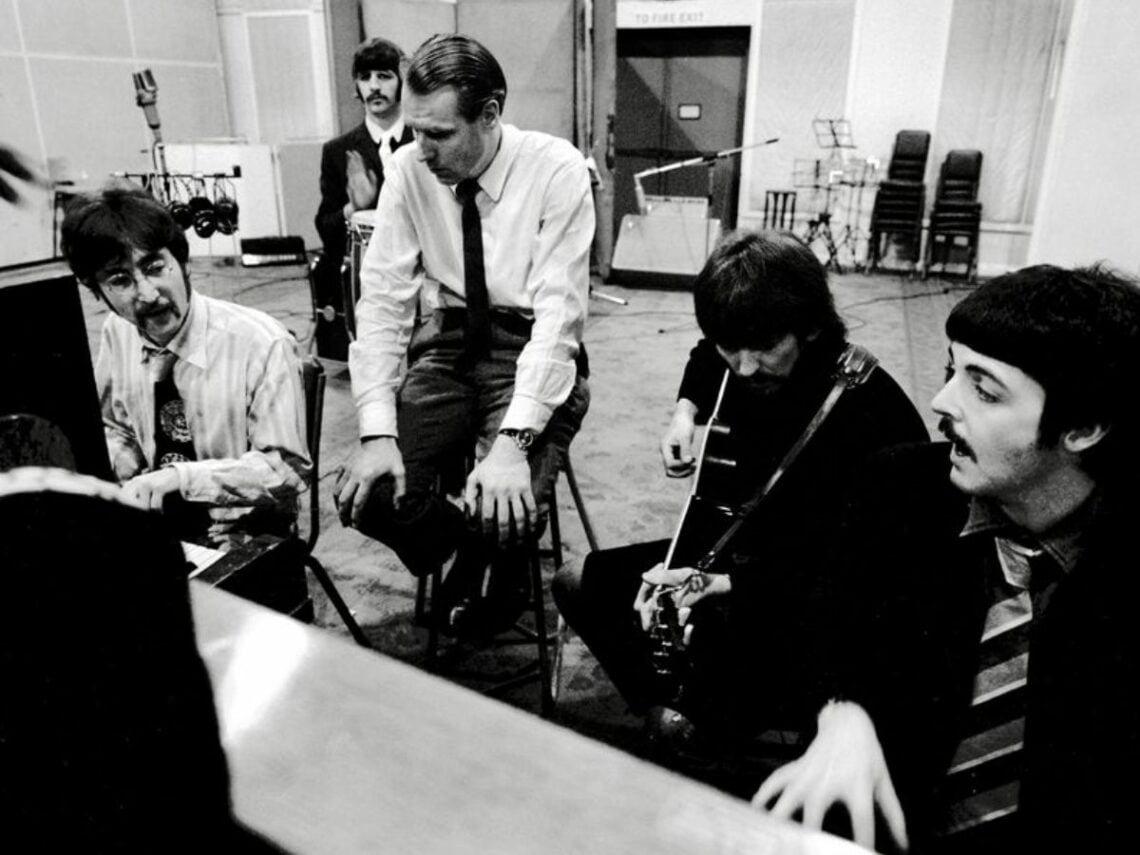
Was George Martin more than the fifth Beatle?

It could have been over before it started. When recording their debut single ‘Love Me Do’ back in June 1962, The Beatles didn’t initially impress their eventual longtime producer, George Martin. Unconvinced by Paul McCartney and John Lennon’s songwriting ambitions in the tin-pan alley vein that so inspired them and harbouring doubts about then drummer Pete Best’s place in the band, Martin was so nonplussed that he left the actual recording to his assistant Ron Richards.
Upon Martin’s return and feedback on how the band should “shape up”, the silver-haired producer asked if there was anything they didn’t like. “Yeah, I don’t like your tie,” quipped George Harrison, to a sharp intake of breath from the rest of the band.
“They were still fairly irreverent even in those days which I loved, I like a little bit of rebel in people,” Martin opined on 1995’s Anthology series. Warming to the band after a moment of audacious ribbing established a creative partnership and body of work that set a creative peak that arguably hasn’t been reached since. The suit and tie professional of EMI’s Parlophone label embraced The Beatles’ cocksure cheek, a resolute energy that chimed with Martin’s characterful embrace of artful unorthodoxy while firmly planted within the music establishment.
Martin’s chequered production history can be read as a blueprint for The Beatles’ future recording ambitions. From handling orchestral arrangements to skiffle, the emerging Merseybeat acts like Gerry and the Pacemakers, and even early electronic pieces in collaboration with the BBC Radiophonic Workshop, a keen embrace and experience of the many disparate hues and flavours of the contemporary music scene armed Martin with an arsenal of eclectic expertise that would elevate The Beatles’ restless artistic energy and thrust himself to the fore as an essential creative component of the band.
It’s hard to envisage McCartney’s eternal ‘Yesterday’ reaching hymn-like status were it not for Martin’s request to add a string quartet. This would sow the seeds for future pieces such as ‘Eleanor Rigby’, a major leap forward in creative composition, with Martin composing the studio octet directly and taking inspiration from Bernard Hermann’s score for Psycho.
Aiming for something “sensational” to segue Lennon and McCartney’s individual portions of Sgt. Pepper’s Lonely Hearts Club Band‘s celestial finale ‘A Day in the Life‘, it was again Martin who instructed the sceptical orchestra to commit to a scaling crescendo starting from the lowest note of each respective instrument, Martin recollecting “they all looked at me as though I were completely mad”.
Martin’s deft ability to marry creative dissidence with technical know-how was instrumental in ushering in the group’s ‘studio era’. By 1966, suffering from creative stagnation and fatigue from screaming fans overpowering their live performances, the band committed itself to being a purely studio project, wielding the studio as an instrument in its own right and freeing themselves to conceive songs unconcerned with the technical constraints of the era.
Martin’s history with the seminal comedy show The Goon Show, with its strange sound effects and audio trickery, enabled Lennon’s masterpiece of carnival psychedelia ‘Being for the Benefit of Mr. Kite!’ to enter uncharted, sonic territory. It was Martin himself who instructed engineer Geoff Emerick to assemble old audio strips of fairground attractions and splice them together randomly to create the desired trippy effect, a feat pushing the pop medium firmly into the avant-garde.
Martin’s creative authority and expertise are a major feature of The Beatles’ biblical hagiography. Still, beyond merely being a ‘fifth member’ he was a producer who never just merely recorded their creative genius, but actively raised their output and encouraged their artistic hunger. Coming from the ‘old world’ but never intimidated by ‘the new’, Martin could aid the group’s vision as essentially as any member of the Fab Four, shepherding not just a band to greatness but a rock ‘n’ roll revolution.

Never Miss A Beat
The Far Out Beatles Newsletter
All the latest stories about The Beatles from the independent voice of culture.
Straight to your inbox.