


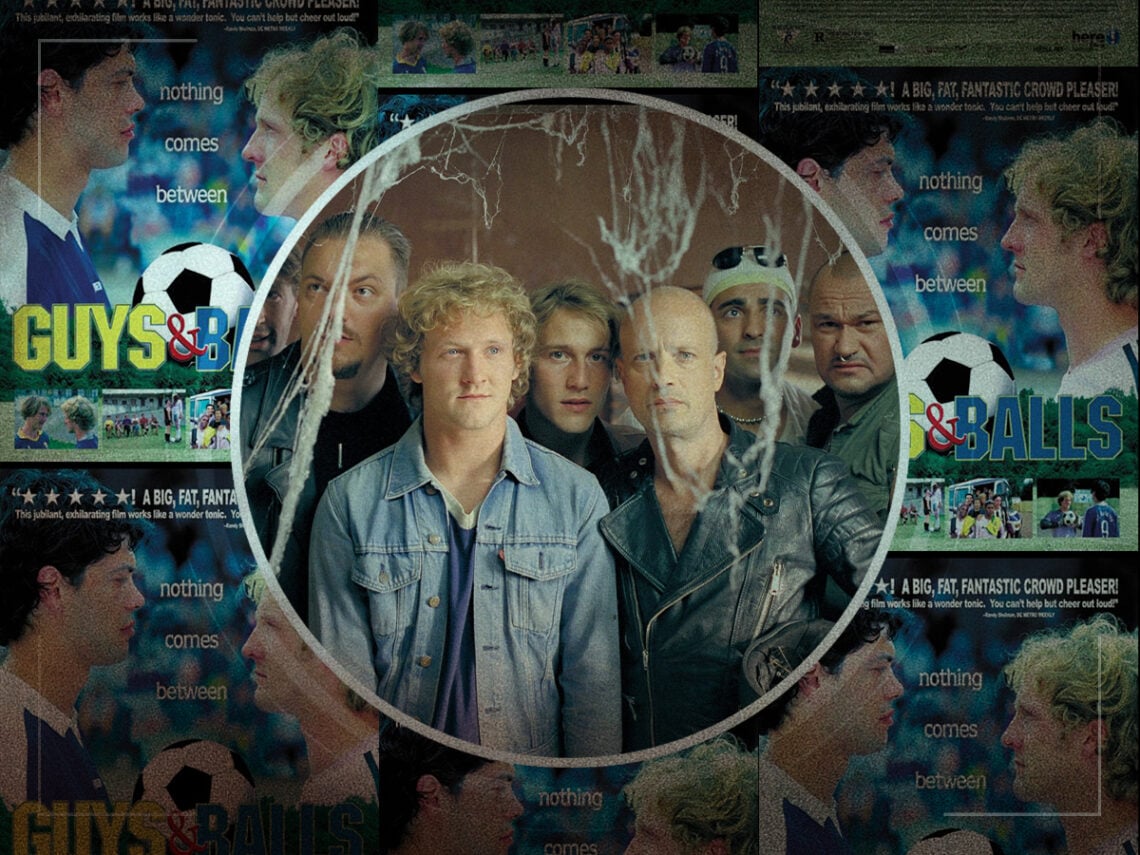
‘Guys and Balls’: the gayest football movie you never knew existed

Guys and Balls is like most other sports movies. There is an underdog team of scrappy misfits, a grizzled coach whose professional career was brought to a swift halt after a pivotal loss, and a tightly edited training montage. Inevitably, the plucky side is jeered at, dismissed, and reviled until they get the chance to play against a formidable opponent. The difference is that the scrappy team of misfits in this movie is made up of gay players.
Released in 2004, Sherry Hormann’s film (known as Men Like Us in its original German release) was remarkably ahead of its time, even if certain elements are a bit cringeworthy two decades later. Maximilian Brückner plays Ecki, a goalkeeper from a small town who works at his family’s bakery. He faces a personal setback when he fails to save a penalty kick, which prevents his team from getting a promotion to the district league.
Things only get worse when he misreads the body language of one of his teammates and tries to kiss him, not realising that other members of the team are watching. This turns out to be a greater offence than losing the match, and Ecki is unceremoniously booted from the squad.
Publicly humiliated and shunned by his own father, Ecki sets out to Dortmund, the nearest city, determined to put together a team of queer players to defeat the one that rejected him. Teaming up with his sister, he does the rounds at gay bars, distributing flyers specifying that all potential players must be gay. One of the bars turns out to be a regular sports bar, and Ecki is thrown out onto the street by a gang of homophobic football fans. Just as he’s picking himself up off the street, one of them comes back outside and surreptitiously takes a flyer.
Ecki ends up with a team that includes a Beckham-worshipping kebab seller, a threesome of leather-clad bikers, a trans man, a trans woman, two Brazilian phenoms, and a bookseller who is secretly straight. Ecki also meets a nurse at the obstetrics clinic where his sister works and strikes up a romance. Meanwhile, the washed-up old-timer glowering at the team’s progress from the sidelines begrudgingly offers to coach them to victory.
Guys and Balls is a feel-good comedy that follows a well-trodden formula, and it lacks the imagination and finesse to be a great film. However, on an emotional and thematic level, its cliches work. Ecki eventually has to choose between standing up to his father and losing his boyfriend. One of the players wins back the affection of his estranged young son. And the thugs who beat up Ecki at the sports bar eventually show up to the match to cheer on their now openly gay friend.

At times, the movie falls back on queer male caricatures and runs the risk of othering them, but at least it never tries to make homosexuality more palatable to homophobes by presenting only straight-coded characters. It is also doggedly pro-football, demonstrating how the sport can bring out the best in players and fans alike. In that respect, it is truly subversive.
There are currently no openly queer male players in the Premier League, even though 4% of men in the UK identified as gay or bisexual in the 2024 census. This is almost certainly an underestimation of the general population, since many people will choose not to openly identify. But if we take this number at face value, it suggests that there would be well over a dozen players in the Premier League who are not straight. The World Cup this year featured 1,248 players, suggesting that there could be several dozen closeted players representing their respective countries.
Most professional men’s sports have a homophobia problem, but even by those standards, football is shameful. A 2022 report found that 40% of online abuse aimed at the highest-profile professional male football players was homophobic, focusing either on the suspected sexuality of the players themselves or on their support for LGBT issues. Female players faced similar levels of homophobic abuse, but while there are many openly queer players in women’s football, there are none in the male ranks at the same level.
For young queer girls dreaming of becoming professional footballers, there are plenty of top-level athletes that they can look to as role models. For young queer boys, the opposite is the case – almost no openly gay role models in the sport and an overwhelming amount of homophobic abuse from so-called fans. You’d think that the entertainment industry might have tried to fill the gap over the years. Movies about underdog athletes are a dime a dozen, after all, and it’s a formula that works almost every time. But there have been precious few examples in the many decades that sport and cinema have coexisted.
Heated Rivalry, the Canadian romance series about male hockey players, has completely changed the narrative, of course. Hockey fans also have the unfortunate distinction of being profoundly homophobic, and having a show that so beautifully and successfully defies that narrative is enough to make you believe in humanity again. But what about football? As the most popular sport in the world, surely there is scope to highlight queer male players. The fact that we can’t even seem to do it in the make-believe world of movies is damning.
More than two decades later, Guys and Balls remains an outlier.
