


Fuck the Rich: Why 2022 is the year of cinematic social revolt

The bitter winter chill gets into your bones, piercing through puny thermal layers to subtly attack the humble employee forced to work from home in 2022. There is a reluctance to use central heating or a personal radiator thanks to the dire cost of living crisis, and sales of hot water bottles have trebled. Thick duvets have been dragged off the shelves of major retailers as individuals find cheaper ways to avoid spending a fortune on gas and electric bills, all whilst the likes of major energy companies SSE and Centrica make unprecedented profits.
When you look at the bare facts of economic politics in the UK as 2022 enters its twilight, it’s no surprise that people are turning their chilly discomfort into a fiery rage. They are spitting venom at the companies that have long purported to ‘be on our side’, only to gleefully hike up the energy costs and scrape a tidy profit off for themselves. Annoyance over energy companies is only part of the story, however, with the number of billionaires steadily growing year after year. Since many of these ultra-rich individuals economically benefited from the crippling Covid-19 pandemic, the disillusionment of the working class is at an all-time high.
While the rich get richer and the poor get poorer, audiences have increased their appetites for tales that cut the wealthy down to size, revealing the futility of their material obsessions and the vapidity of their personalities. Ever since the early 2010s, filmmakers and studios have heeded their call, with the 2011 movie – You’re Next – being one of the first to (physically and metaphorically) strike the rich before similar thickly-veiled criticisms reared their heads, such as Bong Joon-ho’s fantastical 2013 satire Snowpiercer.
Just over half a decade later, taking aim at the rich became much more pervasive in contemporary cinema. In 2019, Jordan Peele made his voice heard with his subversive drama Us, and Rian Johnson picked at the arrogance of the upper class in the modern murder-mystery Knives Out. Even the superhero genre took aim at the abhorrent affluent with Todd Phillips’ Oscar-winner Joker. The greed of corporations and individual billionaires was beginning to become a popularly-held belief.
Indeed, Bong Joon-ho’s 2019 movie Parasite couldn’t have been released at a better time, with the South Korean filmmaker creating a film which captured the contentious spirit of contemporary social politics, winning the Palme d’Or and the Best Picture Oscar in the process. In his masterpiece, two families from opposite ends of the social hierarchy feed off each others’ economic situations, with the director asking who exactly is the titular leech in the process.
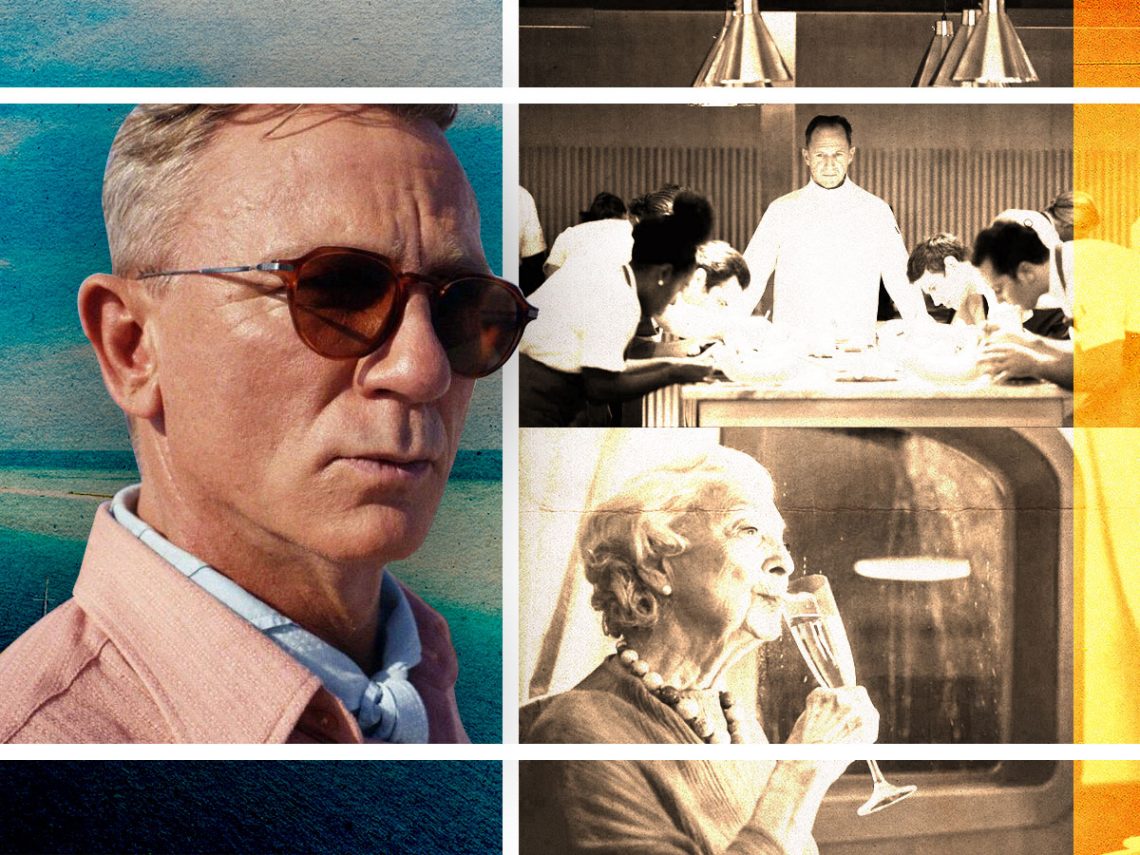
Three years later and this joyous thematic trend has once again reared its head with a trio of delightful criticisms against the ultra-rich, including another Palme d’Or winner in the form of Ruben Östlund’s Triangle of Sadness, Rian Johnson’s continued murder mystery movies, Glass Onion and Mark Mylod’s satirical stab at pretentious gastronomy, The Menu.
The most blatantly targeted of the trio is Östlund’s satire which has proved divisive with audiences and critics in spite of its spiky critique. Power corrupts all who dare embrace it in the Swedish film, which charts the journey of an eventful cruise carrying the world’s super-rich. Creating a clear hierarchy between the spoiled guests, headed up by Carl (Harris Dickinson) and Yaya (Charlbi Dean), and the hardworking deckhands, the film wedges the audience within this power gap, allowing us to observe the humour and social awkwardness resulting from the conceited and self-righteous guests.
As Östlund’s script explores the corruption of power and economic privilege, the boat begins to physically decay thanks to the arrival of a choppy storm and the incompetence of the drunken captain, played by Woody Harrelson, who spouts Marxist quotes through the intercom as the ship succumbs to sea sickness and human waste a-plenty. Rich guests sporting sequins and bow ties throw up all over their delicately presented main courses in the dining room, and Östlund spins the camera, plus the ship itself, like a gyroscope, sending guests skidding across the floor on a slip-and-slide of their own excrement.

It’s an absurd moment to be present in a Cannes award-winner, one which is horrific, hilarious and undoubtedly cathartic, with Östlund going to somewhat puerile lengths to ridicule the wealthy and condemn the superficiality of their livelihoods.
Whilst not so aggressive, a similar level of catharsis can be found in Johnson’s recently released Glass Onion, the follow-up to his 2019 criticism of the country house upper-class, Knives Out. Delicately striking the balance between authentic drama and enjoyable farce, a little like Östlund, Johnson takes a more pointed satirical note out of Adam McKay’s book, making a snappy star-studded spectacle with pace, vigour and pop-culture pertinence.
Once again, following the master detective Benoit Blanc (Daniel Craig) as he tries to solve yet another prickly mystery, this case takes him to the glamorous home of Miles Bron (Edward Norton), a billionaire playboy philanthropist who shares a boyish personality undeniably similar to the mega-rich and Twitter owner Elon Musk. With an ego that matches the size of his private island, Bron has built a lad-pad stuffed with popular art and modern technology, making the man-child seem like he has stylish taste and an enigmatic personality.
As the film goes on, layers begin to peel from Norton’s character as the truth of his personality is revealed, and his ego smashes with every piece of art destroyed by the supporting characters. Bron’s empire was built on lies, deceit and greed, so when we see the physical manifestation of his ego pathetically burn to the ground, Johnson hands us a chunk of catharsis so big that it makes us salivate.
Speaking of salivating, the final film from the pantheon of 2022 anti-rich movies comes from Succession director Mark Mylod, a series which also delights in ridiculing the wealthy, with the filmmaker and producer releasing the gastronomic satire, The Menu. Starring Nicholas Hoult and Anya Taylor-Joy as two guests of Ralph Fiennes’ Chef Slowik’s pretentious restaurant, Mylod’s film skewers not just the rich but everything they stand for too.
Representing the most reprehensible parts of contemporary society’s elite, from John Leguizamo’s George, an arrogant actor in the twilight of his career, to Janet McTeer’s Lillian, a snobby food critic, Mylod makes no mistake in highlighting exactly whom he wants to burn throughout his film. A commentary, not only on the utterly unnecessary gluttony of modern high-concept cuisine but on culture in sum too, which is largely dictated by those with vast financial fortunes, Mylod’s film is a rich and highly satisfying takedown.
In a world that seems to be on a downward spiral towards despair, with the super-rich observing from solid gold viewing platforms, such films act as a cathartic reminder of the fallibility of the wealthy – despite their grand appearance as financial gods, they’re human after all. Just like us, they can be casualties of their own greed, sufferers of their own ego and the victim to the slipperiness of their own excrement. To laugh at their perceived power, authority, and importance is to mock the absurdity of humanity itself; it’s an imperative cathartic exercise.
