


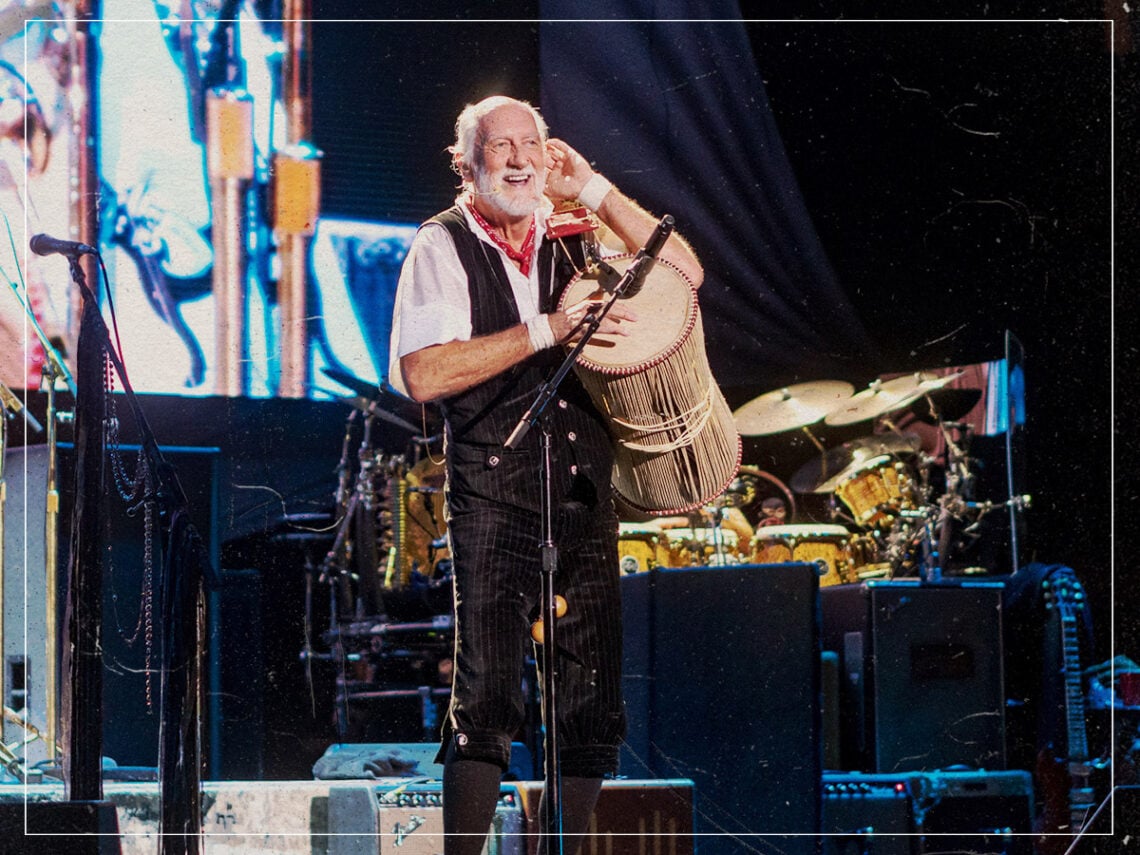
The frontman Mick Fleetwood said was born to be a star: “Then and now”

“The situation is so fundamentally unnatural,” Alex Turner once said, discussing the unease that comes with being a frontman. “It’s not a full-on, ‘Right, get into character’ thing; sometimes, part of how you feel comes out. But I think I always feel weird about that afterward.”
Indeed, from the outside, being a frontman does seem like one of the most unnatural things in the world, but only because, to most of us, it is. Few people actually enjoy getting up and occupying the spotlight, even fewer enjoy the idea of doing it for hours and weeks on end, but that also shows how much it takes to actually get up and perform that role, even if the characteristics come across as awkward as Turner’s.
But all of this is also because, psychologically, the whole idea is strange. Not only does it require a different kind of navel-gazing, it usually only works if it, well, works: whatever kind of dramaturgical theory Turner seems to be having a crisis about depends on the success of his own performance to make sense in the first place. In other words, it takes genuine charisma to be able to pull it off and, even then, there’s something beneath the hidden layers that’s nearly impossible to put into words.
For instance, charismatic frontmen aside (Mick Jagger, Freddie Mercury… Turner), there’s a lot to be said about the ones that hold themselves a little differently in ways that don’t always make sense, especially when it comes to understanding their allure. David Byrne, for one, always seemed a product of his own trepidation, but does that only work because the music itself pulls from several threads of societal paranoia? Probably.
Then there are the Ian Curtis types, the Jarvis Cocker figures who thrive on being a little more intense, a little weirder in ways that are hard to put your finger on, but which work because it’s authentic in a different way. Granted, Curtis occupies his own distinctive lane, but Cocker thrives because watching him is a little bit like sitting in the pub with that one mate who has a couple of drinks and starts saying things like, “I was wrestling with a coat hanger, can you guess who won?”
Anyway, the point is: frontmen come in all shapes and sizes. And yet, according to Mick Fleetwood, it’s Rod Stewart who deserves the most attention. Surprised? In all fairness, it makes complete sense. According to Fleetwood, he holds something innate that few seem to master, and that’s the hidden ingredient called charm.
“Rod was a star then, and he’s a star now,” he told Louder. “He turned himself out like nobody else. And although I was by no means the dandy that Rod will always be, I’m sure that’s where I inherited my love of a well-cut suit. We were in Shotgun Express together [in 1966], and we soon learnt that Rod was not about to get his clothes messed up unloading the van. He would invariably pick up one microphone: ‘Is that alright?'”
Continuing, he recalled how everything he did seemed to make sense, even when it didn’t. “Our feathers had been ruffled a few times, but we were okay with that, because we realised Rod had to be deluxe when he hit that stage,” he said. “He would put lemon juice in his hair to make it stick up. And if he’d been stood in the rain in the middle of winter we wouldn’t have had ‘the star’ looking good on stage. He wasn’t just some old gigster, he was always suited to being a star.”
In this case, therefore, being centre-stage didn’t have to be anything particularly well-thought-out for someone like Stewart. He already had it, which meant he had the confidence to go out there by any means necessary if it made sense for his “act”. He might have held high standards when it came to the scene setting, but once he was out there, it all clicked into place like no other.
