


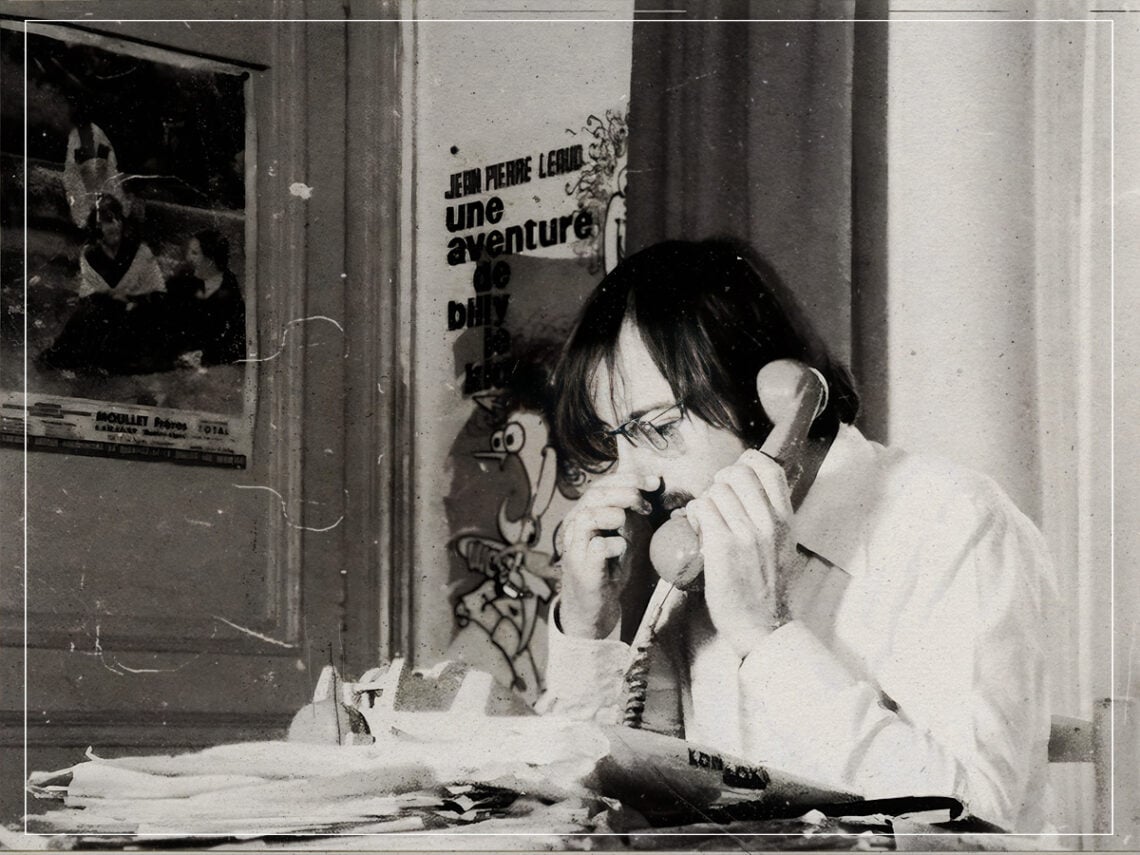
The lesser-known French New Wave experiments of Luc Moullet

The French New Wave movement that emerged in the late 1950s is often dominated by names like Jean-Luc Godard, Eric Rohmer, François Truffaut, Alain Resnais and Agnes Varda. However, the experimental and iconoclastic stylings of the French New Wave have several lesser-known but equally impressive figures among its ranks, including Luc Moullet.
The filmmaker, critic and screenwriter Moullet is a truly unique figure in the Nouvelle Vague scene and is celebrated, both within its circles and on a wider cultural scale. His idiosyncratic approach to the cinematic medium subverts the conventions of storytelling with an anti-authoritarian outlook and acerbic wit.
Having made a series of works over the course of six decades, Moullet’s body of work is challenging to pin down, proving his eccentricity and uniqueness as an artist. Moullet had begun his career as a writer, writing for Cahiers du cinema, where he was initially said to be disliked by François Truffaut but championed by Jean-Luc Godard. Eventually, Moullet turned his attention to filmmaking, and his first short was set to be shown before Godard’s second feature, Le Petit Soldat, which was banned for its overly political themes.
Moullet made his first feature in 1966, Brigitte et Brigitte, and along with his second, 1967’s Le Contrebandieres, the new director found his trademark penchant for exploring the stranger facets of the human condition with a unique sense of wit and tongue-in-cheek irony. Moullet slowly became a master of offering up social commentary through comic narratives, revealing the peculiarities of modern existence with a style that flirts between the mundane and the surreal.
This interest in the absurd continued throughout Moullet’s later works, like in 1976’s Anatomie d’un rapport, in which he explores the intricate complexities of sexuality amid a turbulent romantic affair. 1984’s Barres is also fascinating, serving as an examination of the banal nature of bureaucracy and social convention with a satirical outlook on loneliness and mortality.
Moullet has also delivered in the documentary field, and his project with the widest scope has to be Genese d’un repas of 1978, in which he charts the journey that a solitary plate of food makes from its origins in nature to its digestion by a human being. In the film, Moullet reflects on the inherent and historical meaning of food and its relation to a society of culture.
Aside from his directorial work, Moullet is championed as an excellent critic, where he transposes his artistic wit and biting satire and provides insightful commentaries on the process of filmmaking and the narrative and thematic facets of his peers. He’s admired in this regard by fellow auteurs and critics alike and has proven his deep passion for cinema with pen as well as camera in hand.
When thinking of the French New Wave, one immediately thinks of the likes of Godard, Truffaut and Rohmer, but the movement has its lesser-known heroes too. With his unique take on the cinematic medium, a desire to experiment and humour that always appears irreverent, Moullet has emerged as a true enigma of French cinema and is well worth consideration.
