


Franklin Avenue: How one road in Los Angeles captured the dark end of the 1960s

In any and all reflections on the 1960s, there is a fair share of rose tint varnishing the decade.
Woodstock is remembered as a place of peace and love, erased of the dangerous organisational chaos; the singers are remembered without the violent abuse they inflicted, and the drugs are romanticised as wholly fun; however, there was one voice who took up a unique spot both in the middle of and outside the crowd: Joan Didion.
Though born and raised in California, Didion was from a suburb that felt more like run-of-the-mill middle America, and so she was raised with more of a level head than the state’s artistic types. Thus, when she got into writing, that mindset fed in, leading her to write as a journalist and even apply that straight stare, fact-speaking voice to her fiction. When it comes to accurate and honest recounts of the era, free from the hero worship, Didion becomes the ultimate person to rely on, bravely writing of the reality of the turn on, tune in, drop out generation when she reported on the masses of missing kids in Slouching Towards Bethlehem.
She was also brave enough to take down Jim Morrison, visiting The Doors at their studio and writing disillusioned, “There was a sense that no one was going to leave the room, ever. It would be some weeks before The Doors finished recording this album. I did not see it through”. But mostly, she captured the violent end of the 1960s, because it happened in her neighbourhood.
In the glory days, despite her own mental separation from the glitzy crowd, the scene hung out at Didion’s house. At the Franklin Avenue home in Los Angeles, which she owned with her husband John Dunne, the biggest names in art, film, music and beyond would descend weekend after weekend. It wasn’t just new countercultural names, either, although they were there, but the biggest stars were at her place, like Judy Garland, Warren Beatty, and Sean Connery. Lines of status seemed to drop away as underdogs mingled with icons, and according to Eve Babitz, who was a regular fixture, the parties were “nonstop” but then abruptly, in 1971, they ended.
Didion and Dunne moved out of town to Malibu, and everything went quiet, for the very reason Didion herself wrote, “Many people I know in Los Angeles believe that the sixties ended abruptly on August 9th, 1969, at the exact moment when word of the murders on Cielo Drive traveled like brushfire through the community, and in a sense this is true.”
In her eyes, and the eyes of the scene at the time, the Manson Family murders ended the era of joy and hedonism. For Didion, it felt personal: Sharon Tate and Roman Polanski had been at her parties, the crowd all knew them, and then, at the end of the day, her death had happened only a 20-minute drive away.
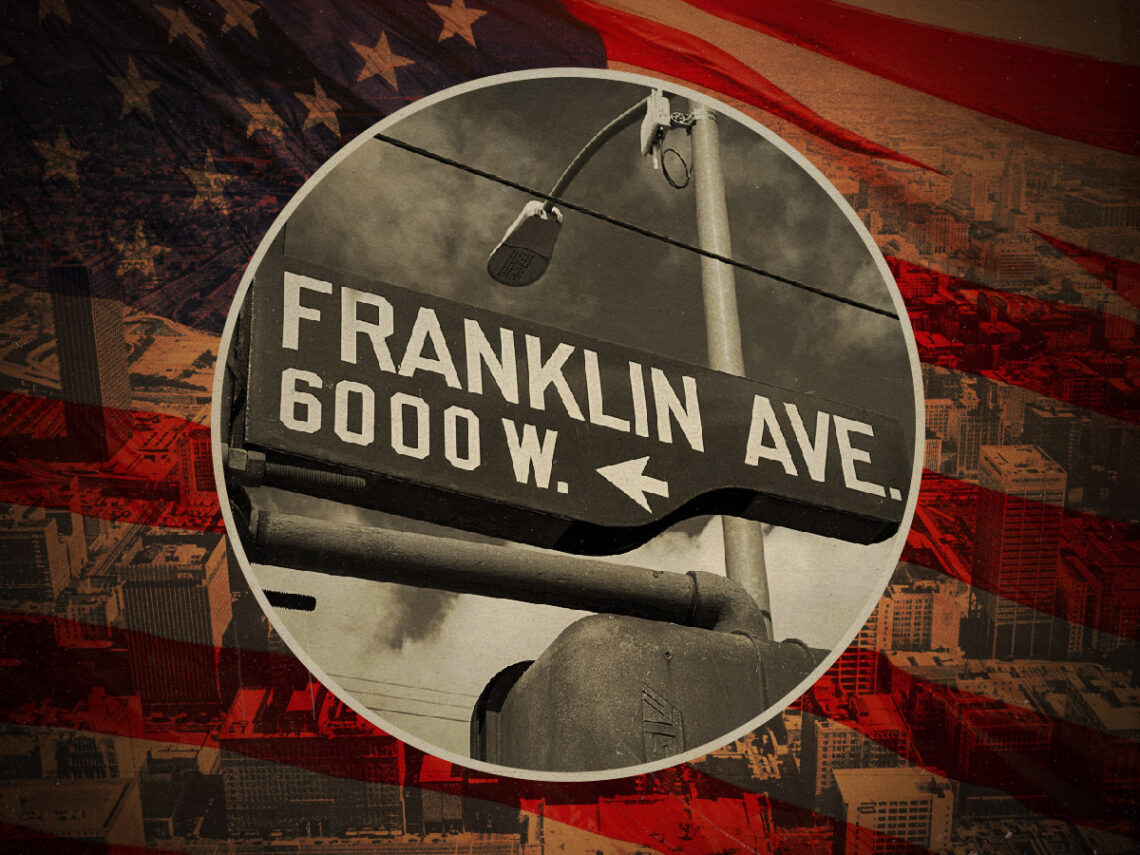
But really, it was even closer than that, as Didion’s home was at 7406 Franklin Avenue, and for years, Charles Manson lived in an apartment building at 6871 Franklin Avenue. Throughout the mid to late 1960s, they were a ten-minute walk away from each other, and while Manson was building his violent cult, Didion was hanging out with the crowd he would target.
So in the end, when she and her friends could likely hear the sirens racing to Cielo Drive in 1969, it felt like the end of the era had come to their doorstep, and it had come with blood on its shoes.
