


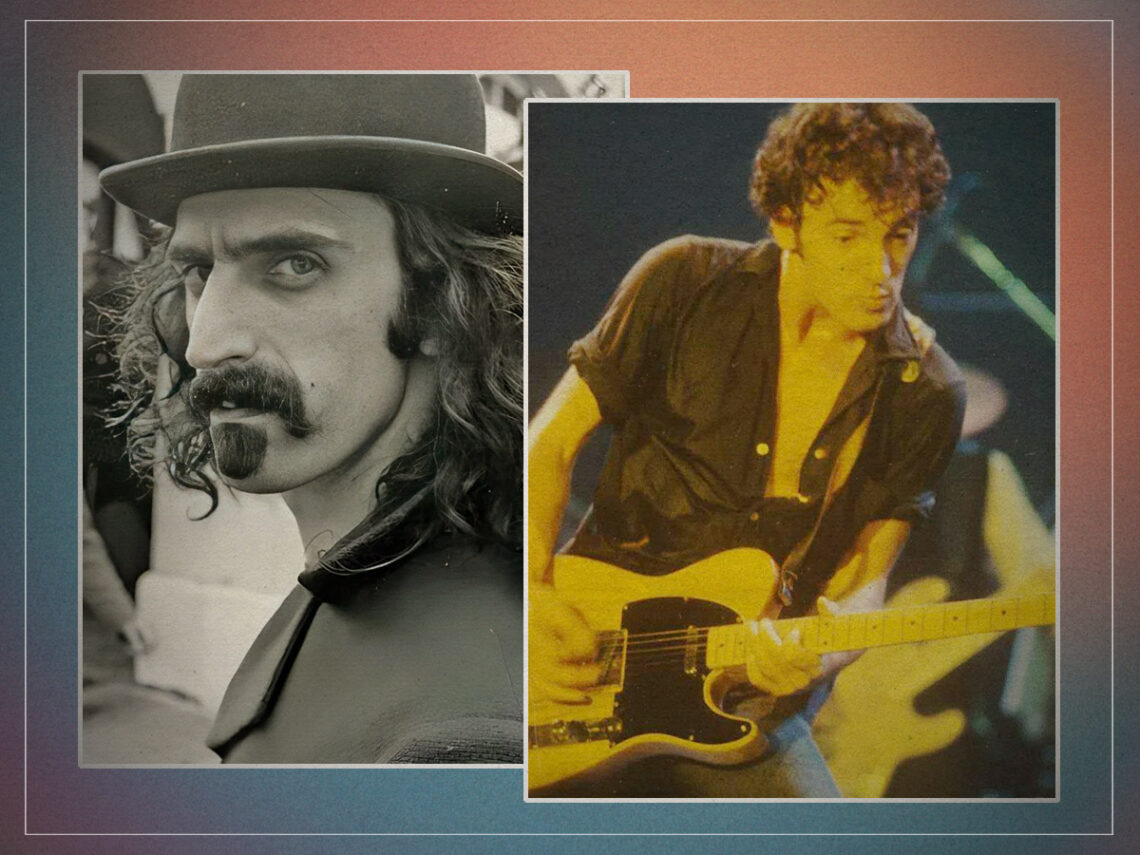
“Hook, line and sinker”: Frank Zappa believed Bruce Springsteen was a conspiracy theory

If you were to ask Bruce Springsteen, he decided to start writing about real-world events the moment he started listening to Bob Dylan. Dylan had this effect on a lot of people, as the way he wrote about emotion, politics, and societal imbalances resonated with people on a broad level and showed them just how powerful music could be. Dylan’s sound wasn’t just a vehicle for melody, but the cornerstone of genuine change conveyed through tunes.
Leonard Cohen put things best when he was asked what he thought about Bob Dylan winning the Nobel Prize for Literature. Despite the fact that the two had quite similar styles, Leonard Cohen was never worried about highlighting how much respect he had for Dylan, and this is evident when he described the award as “Like pinning a medal on Mount Everest for being the highest mountain.”
Springsteen was also equally moved by Dylan’s music. When he realised how much emotion could be used in music and how deeply it could move him, he made it his mission to move people with his own music. Springsteen went on to write songs with themes of nostalgia, emotion, and politics, becoming known as a rock star who wasn’t afraid to speak his mind.
One of his most famous examples of having politics within his music is with his classic track ‘Born In The USA’. The song was often misinterpreted as an example of patriotism, but it actually follows a soldier who has post-traumatic stress disorder after serving in Vietnam. He was inspired to write it following an encounter with Ron Kovic, who had to use a wheelchair after being shot in Vietnam. Springsteen joined Kovac on a visit to a veterans centre, which the musician said he found particularly difficult.
“I’m usually pretty easy with people, but once we were at the centre, I didn’t know how to respond to what I was seeing,” said Springsteen, “Talking about my own life to these guys seemed frivolous. There was homelessness and drug problems and post-traumatic stress – guys my age dealing with life-changing physical injuries.”
Most listeners were moved by Springsteen’s story and believed his stance on various branches of politics; however, Frank Zappa wasn’t one of them. By connecting a few different dots in musical circles, Zappa realised things may not be as they seem, and Springsteen might have intentionally misled the public.
“I don’t know anything about his music, but the thing that bothers me about Springsteen is the packaging and the merchandising, which started with the time he was on the cover of Time and Newsweek on the same week, and pronouncements by a rock critic named Jon Landau that this is the answer to everything that rock and roll always needed,” he said, “Remember the line, ‘I have seen the future of rock and roll and it’s blah blah blah?’ Remember that one? […] And then the guy turns out to be his manager! I mean come on, do you smell something here?”
Springsteen’s close ties with the person who wrote about him so fondly rubbed Zappa the wrong way, and he struggled to connect with him afterwards as a result. “It’s not coming up with a quote like that,” he said, “It’s placing it in the publications then manipulating the press to the point that they put out a massive advertising campaign and people are expected to swallow this hook, line and sinker.”
