


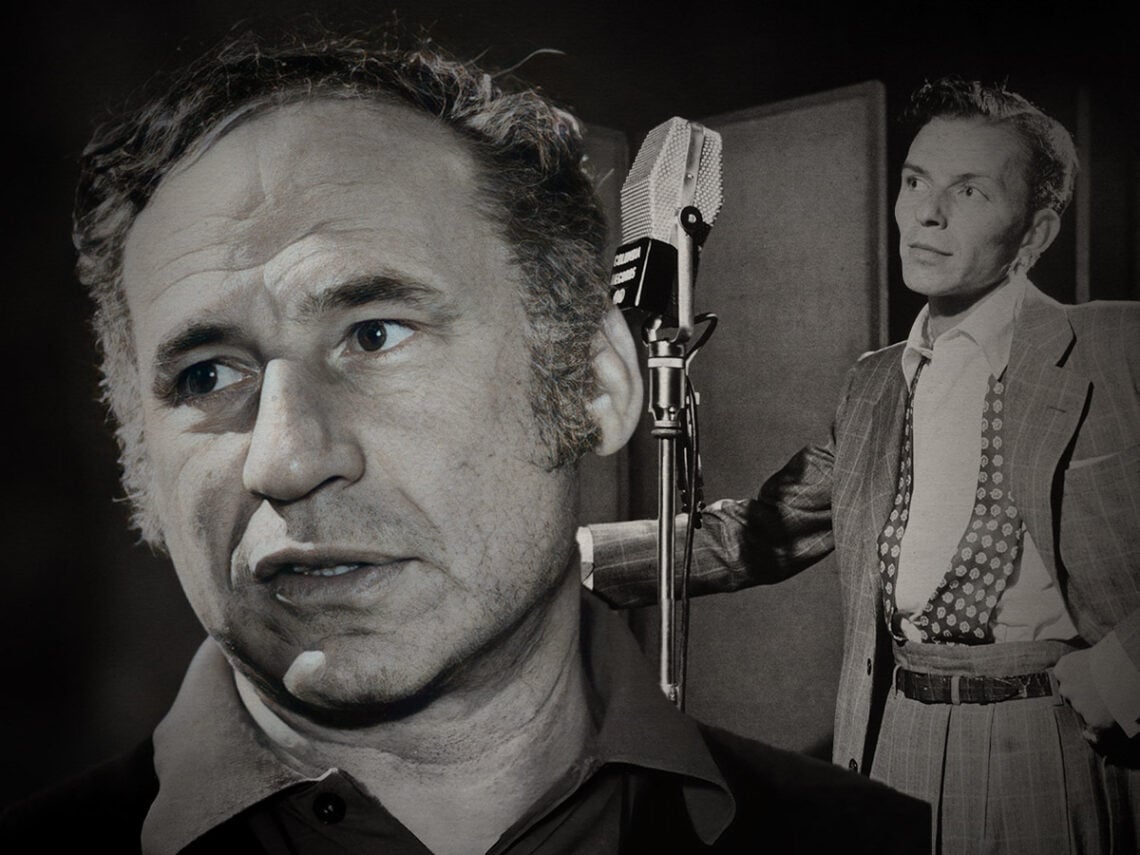
Frank Sinatra’s finest song, according to Mel Brooks

“If somebody had to live forever,” Mel Brooks quips in Unwrapped, “I’d vote for Sinatra”.
The comedian’s love for Frank Sinatra was profound. The feeling was mutual. “I’ll tell you who liked a laugh,” Michael Caine once attested, “Frank Sinatra. He was very nice, he became my friend, and he loved to laugh.” If you’re of that disposition, then Brooks is a handy fellow to know.
The man behind such classics as The Producers and High Anxiety once said, “Tragedy is when I cut my finger. Comedy is when you fall into an open sewer and die.” Brooks had good reason to be of that enlightened outlook. His parents were jews who immigrated from Europe amid a climate of growing antisemitism and poverty. When they arrived in the US, they were greeted with something money can’t buy: further poverty.
Shortly after they arrived in Brooklyn, when Mel Brooks was only two, his father passed away at the age of 34. “There’s an outrage there,” he later reflected. “I may be angry at God, or at the world, for that. And I’m sure a lot of my comedy is based on anger and hostility.” But if there was any lingering pain or trauma, it wasn’t just comedy that helped to keep it at bay.
The refined tones of Sinatra were a constant in Brooks’ life. Viewed as the height of elegant sophistication, as soon as Sinatra burst onto the scene with his debut album back in 1946, Brooks was all ears. Thereafter, he would unwind from the hectic life of filmmaking and comedy with the classic record, In The Wee Small Hours.
The title track from that 1955 album is a song that Brooks couldn’t live without. “I love music, I’ve always loved music, and I would be seriously bereft and at a great loss if music were taken away from my life,” he told Roy Plomley when he appeared on Desert Island Discs.
Adding, “I love, from the bottom of my left ventricle, all sorts [of music]”. But he held none dearer than ‘In The Wee Small Hours’ by his crooning chum. “Ah, perhaps the best living singer and one of [the] great crooners,” he reflected, “a legend, in his own life”.
In a manner akin to the way in which Brooks elevated comedy into something truly contemporary and profound without losing any of the laughs, Sinatra’s record was a major leap forward for swing jazz. With his purring tales of streetlight serenades, the crooner provided the world with its first mainstream concept album.
This mix of refined, comforting craft and cutting-edge artistry led Brooks to call the titular single the “peak of [Sinatra’s] career”.
It’s a peak that Brooks always kept close to hand. So close, in fact, that he knew it word for word. So, if they say imitation is the height of flattery, then there’s no higher compliment than the note-perfect impression Brooks was able to muster after years of listening to his dearly beloved ‘Ol Blue Eyes.
