


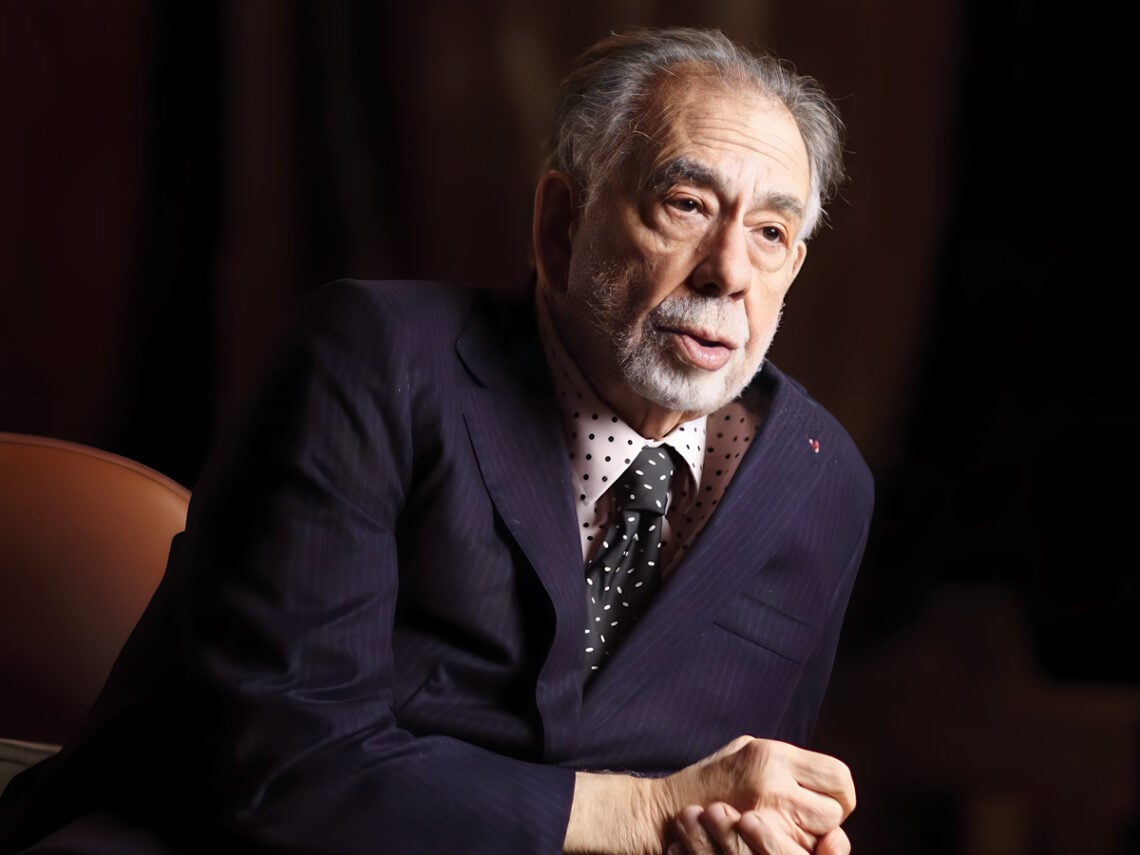
‘Rumble Fish’: Francis Ford Coppola’s favourite Francis Ford Coppola movie

Francis Ford Coppola has made some of the greatest films of the past six decades and some of the least successful. At every turn, he’s sought independence, often putting up his own money to fund a project when no one else would let him do it on his own terms. Even before the wild success of The Godfather in 1972, he and George Lucas founded a production company far away from Los Angeles to distance themselves from the confines of Hollywood, financially and creatively.
This has yielded some intoxicating highs and ruinous lows. With the success of The Godfather, Coppola was given wide reign on subsequent projects, which came back to vindicate and haunt him when he made Apocalypse, Now. The production was disastrous, with a spiralling budget, uncontrollable stars, and a schedule that kept getting longer. The film was expected to be just as disastrous, but in the end, it was one of Coppola’s best.
For every vindication, however, there was a swift reality check. The director poured all of his company’s money into his next film, One from the Heart, and when it performed spectacularly poorly at the box office, he had to file for bankruptcy.
Coppola’s passion for his work is the one constant in this rollercoaster of a career. So when it comes to picking favourites, it’s no surprise that he is reluctant to pick and choose. During a visit to Criterion’s closet film collection, he said that whenever people ask him to name his favourite of his own films, it’s like being asked to name his favourite child. “I love them all, I would think, differently but equally,” he explained. However, he did say that he had “a special affection” for one movie above the others, 1983’s Rumble Fish.
Coppola made Rumble Fish immediately after The Outsiders, using the same crew and even some of the same cast. Like The Outsiders, it centred on teenage gangs, though Rumble Fish was specifically about the relationship between two brothers. Starring Matt Dillon, Mickey Rourke, and Diane Lane, it was shot in black and white as a homage to the German expressionists. Both films had identical $10million budgets, but where The Outsiders earned about $25million at the box office, Rumble Fish earned a scant $2.5million.
“I thought of it as an antidote to the saccharine sweetness of The Outsiders,” Coppola said. “My goal was to make Rumble Fish as an art film for kids. The kids at that time didn’t totally get it right away. And I thought it was a very big failure and was very sad about it because I sort of loved the film.”
Coppola got experimental with the story, not just with his use of black and white, but with its darkly fanciful tone. There is a dream sequence in which the main character floats over the city like a spectral presence. It’s an eerie but beautiful moment that certainly wouldn’t have fit in Outsiders, but which makes perfect sense in Rumble Fish.
According to Coppola, the film had an unexpected afterlife. “A lot of young people from Latin America who were inspired by the great literary boom of Latin America in that period went to this one theatre to see this weird movie called Rumble Fish,” he said, explaining that it inspired many of them to become filmmakers.
“That is the greatest justification of being in the profession I’m in is when you can impart that to young people,” he said. So the next time Coppola loses his fortune on a film, remember that he might be measuring its success on different terms.
