


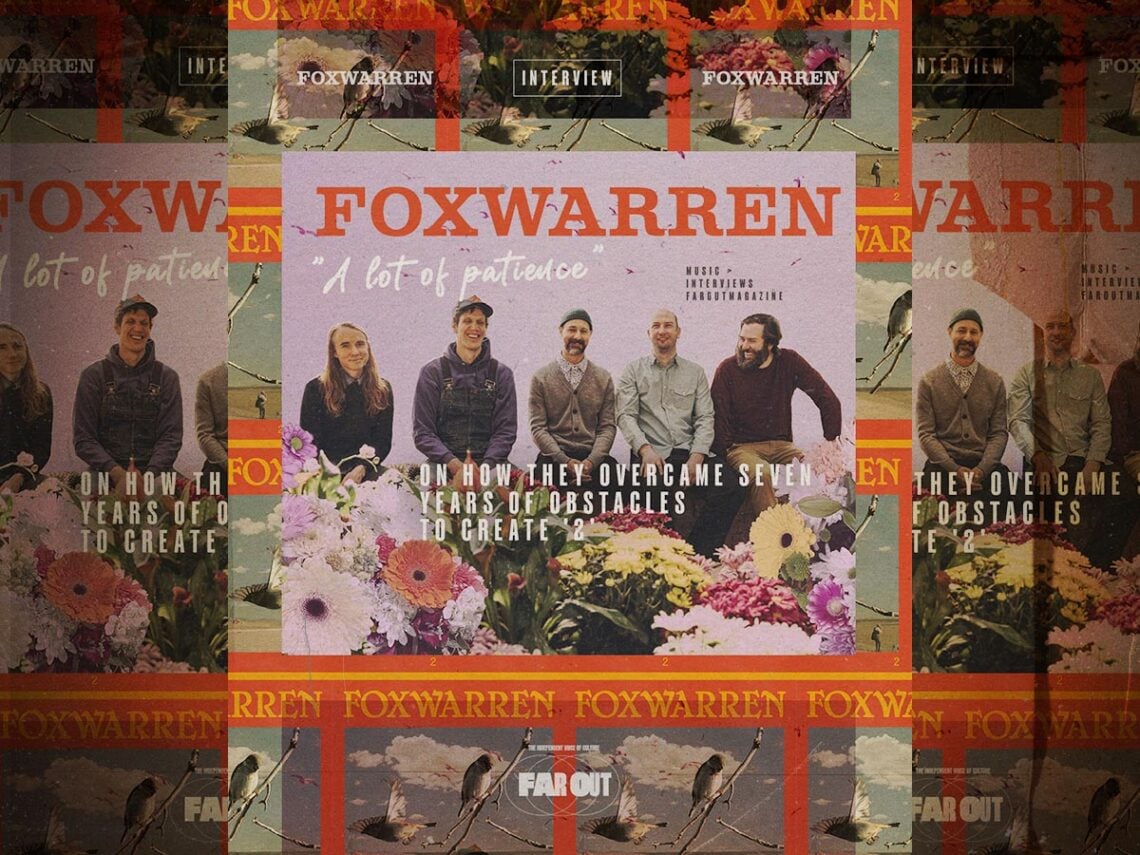
“A lot of patience”: Foxwarren on how they overcame seven years of obstacles to create ‘2’

The ‘difficult second album’ trope is often an excuse that listeners and critics attach to a band’s work that fails to live up to the same level of expectations as their debut. Granted, it is challenging to follow greatness with something of equal brilliance, and while some bands will end up settling for releasing whatever they can just to stay in the public consciousness, others will disband as a result of not being able to overcome those songwriting hurdles. For Foxwarren, the Canadian indie folk band led by singer-songwriter Andy Shauf, this was simply not an option.
After releasing their self-titled debut in 2018 to widespread acclaim and touring the world in support of the record, there wasn’t a huge weight of expectation placed on the band to follow up quickly due to the members all having other projects to attend to. That being said, they were eager to regroup after their tour, and having added touring multi-instrumentalist Colin Nealis into the fold, there was a palpable sense of excitement in Foxwarren HQ about making record number two.
However, it’s now seven years since their debut, and we’re presented with an album that very few would’ve expected them to come up with, let alone release so long after the first. Many bands would’ve called it quits if their second album took even half as long to create, but the five members knew that something would eventually come around.
“We’ve always taken forever with stuff,” Shauf admits, adding, “People think that it’s an anxiety thing where you’ve been working on something and you just want to get it out, but I feel like there’s this buffer where it’s kind of a relief that we take so long with things, because there isn’t the feeling of a looming deadline or that we want to get something out. There’s a lot of patience, and we just want to get it how we want it to be, and we’re all pretty content to do that.”
Their tour for the first album saw them come off the road in late summer of 2019, and by October, they’d all got together to start banding around ideas again. “We came off-road with such a momentum,” Shauf recalls of this swift return to writing. “We thought we knew exactly what we were gonna make, and it was gonna take a couple of studio sessions and we’d put it out.”
The band couldn’t have been further away from reality with this estimation, and while the enthusiasm was clearly there for writing a record, the chemistry required for collectively crafting the next batch of songs was unusually absent. “Our idea initially was that we were gonna record live off the floor, and so we rented our friend’s house where he had a studio in the basement,” Shauf recalls of the ill-fated first sessions. “We locked ourselves away for two weeks and just tried to force writing and recording, and we hit a wall pretty quickly that we just never broke through.”
Something was lacking. “Listening back, it was just really flat,” Shauf admits. “It’s hard for five people to record themselves; it’s just a mess. Also, there was a lot of alcohol being consumed, which you can really hear when you’re sober. Sounds great when you’re drunk, but oh man…” Nealis sagely agrees with his bandmate, confirming that his memories of the first session were “pretty dark”, and that they’d clearly rushed into something without ample preparation.
“We would have these ideas for a song, but it was so hard to flesh them out with everybody in the room,” he adds. “That was the benefit of being separate in the end, we would all have the week to work on different things.”

The separation of a band is usually a catastrophic sign for a need to increase a sense of unity among the members, but it clearly allowed each party to reestablish a focus, something that was absent from these first sessions. “My main memory of it is that we just really wanted it to be a rock record with an organ,” Shauf says of the abandoned 2019 meetup, “that was the general idea.”
In actuality, this description is far removed from how 2 sounds, although Nealis says that some ideas managed to get carried over, even if it was at the expense of another member’s idea. “There’s a couple songs that made it on the record in a different version, but there’s one song in particular that right until the end, Darryl [Kissick, bassist] still wanted to bring back, which is classic Darryl.” Shauf laughs at Nealis’ accurate portrayal of his bandmate, tacking on that he’s always been one for latching onto an idea. “It’s always been that way. When we started, our initial idea was to make a post-hardcore band, so we made three weird, loud songs initially. I feel like Darryl still thinks we should release them, but we’ve moved on.”
2 is a light and breezy psychedelic folk record and far from the post-hardcore affair that the band could’ve once become. However, the fact that the album’s initial sessions failed to produce anything of significant quality meant that they had to change tack, and this is when the band began toying with the idea of recording ideas remotely and exchanging them on a weekly basis.
“At the start, there was a very loose call for ideas,” Shauf said of their change of approach. “Dallas [Bryson, guitars] uploaded a ton of ideas using our drummer Avery [Kissick’s] initial drum loops that he put up. There were probably three or four ideas a week in there.”
However, what the band were going to do with all of these ideas was another matter, and it wasn’t until Shauf brought in a device that altered the entire process significantly that the wheels really began to turn. “At some point, Andy introduced the sampler that changed the whole process,” Nealis notes. “I remember being a little overwhelmed, but at that point, it became less important to have something bigger. You could post a five-second clip of something, and then we could put it into the sampler and loop it, so it felt like we really gained traction.”
No longer attempting to flesh out ideas to the hilt, the band realised that the smaller their ideas were, the more useful they would be to the process, due to how malleable they were. Melodies were beginning to take shape, and songs were slowly forming through chopped-up samples of their own individual recordings. While Shauf didn’t immediately know what elements were going to be the things that caught on for him, he managed to apply the sampler to what he already knew about the collaborative process and tried to find parallels between the two.
“Generally, that’s what happens when you’re writing in the room with someone anyway,” he explains. “You’re taking their idea and furthering it, or latching on to one tiny part and furthering that part. You watch something evolve that way, and I didn’t know how we were going to be able to do anything like that from a distance, so that really helped.”
In addition to chopping up short ideas and placing them into samplers, the band have also sprinkled a healthy portion of orchestral samples from 1940s film scores, as well as dialogues from them. Although, as Shauf insists, the band aren’t at liberty to reveal their exact sources. This addition helped steer the record even further in a direction that they hadn’t even planned for, but Shauf acknowledges that having these added voices, other than his own, created a certain atmosphere. “I found it helpful in formulating the structure of the record, because I thought about it too hard and came up with this storyline that you could interpret if you went all the way.”
In terms of narrative, Shauf’s approach on this record is somewhat different to how he tends to present his imaginative storytelling on his solo material. “I think a distinction I’ve drawn for a long time was that I’ll save the story stuff for myself, and I’ll do the non-story stuff with Foxwarren,” he highlights, underlining the fact that this is a completely different project for him. However, one of the first things they noticed was that the older methods used on Foxwarren were proving to be disconnected, and the need for some sense of character began to show itself.
“One of the first songs that we finished to a point where we were all happy with it was ‘Yvonne’,” Shauf explains, “And that had a very clear character. I guess I was picturing this older woman who has a metal detector, but we wrote it mostly together, and it had this sort of vagueness to it, where it’s a poetic impression of the character and the situation. That felt like a good cheat code for me to keep using on the record.”
Despite the dialogue samples being helpful, the orchestral samples proved a bit more of a challenge when assembling the record in a cohesive manner, with Shauf almost making the job more difficult for himself due to their inclusion. “A lot of the string samples that went over the top were put there after the fact,” he confesses. “We had a lot of creative walls that we hit with making this, the first one in 2019, and then we all got together in 2021 at the Kissick’s family farm, where we had to reconsider our approach again.”

As if two major setbacks weren’t enough, retrofitting the orchestral samples could have completely rendered the process even longer. “There were moments when it felt like finding a puzzle piece,” Shauf notes, “as though it was meant to be. A lot of the time, you’d then have to reharmonise the melody because you’ve changed the key slightly, and that was a lot of work. It was the wrong order to do things in.”
The strangeness of being separate from one another, especially during the pandemic when the record really began to come to life, meant that every member was busy digesting different things and immersing themselves in different kinds of music. “Avery said in one of our Zoom meetings that he wanted it to be a record that sounds cool coming out of your car speakers,” Shauf recalled of an early idea sharing session. “From that point, the question of ‘how can we make something different’ was my focus. I had a big vaporwave phase, and then, think, I had a bit of a rap phase, so I was referencing Liquid Swords, that GZA record, where there’s lots of chopping.”
The record and all of its challenges may now be out of the way, but the next hurdle the group have to collectively try and jump over is translating it to a live setting. While the best case scenario would be to bring in some orchestration to recreate some of the samples, the band know that this isn’t the easiest thing to do, and the fact that they’ll be performing songs from two records will mean that they have to make compromises in this regard.
“I guess the biggest concern that we have is you could nail it with having the samples all in the right place, but if you’re doing this night in, night out, is that satisfying?” Nealis queries, and rightly so. “Part of a good live show is feeling like you want to play. We’ve got to be creative with how we decide to play the samples so we’re not too rigid. You still need to be in line with the sample, so it loses a lot of the human feel of speeding up or slowing down.”
Yes, making 2 was a clearly an arduous process for Foxwarren, but that doesn’t mean that the utmost love and care wasn’t put into it every step of the way to ensure that they collectively produced an album they could be proud of. Whether they’d do it all again is another matter entirely, and Shauf isn’t certain at the moment about what the future holds. “In making this record, I think the conversation was that these things take so long, and none of us know if this will be our last one or not. I imagine we’ll start tinkering away at something, and I imagine it’ll be from a distance with this same technique, or slightly altered. I think every time we start something, we come into it with a different idea of what limitations could help us find a path.”
