


How ‘Four Daughters’ approaches the ethics of documentary cinema

Amidst the upsetting content of Four Daughters, there is a moment where one of the actors has to step away. The documentary attempts to retell the story of Olfa Hamrouni and her four daughters, two of whom ended up being indoctrinated into joining the Islamic State and running away to join their army. But before extremism ever enters the conversation, the tale being told is a tough one, rife with generational trauma, child abuse, sexual assault and oppression. As the real people reenact some of their worst memories, the response of the actors involved serves to highlight a whole other message to the piece.
I went into it totally blind, with no prior knowledge of what Four Daughters was about. “In this film, I will try to tell the story of Olfa’s daughters,” director Kaouther Ben Hania’s voice speaks in the opening as she appears to introduce her cast. Without context, and with the included scenes of Ofra and her daughters in hair and makeup or chatting lightly, laughing with cast members, there’s a level of parody at play. It feels like a mockumentary setting up, playing with the very form itself as Ofra meets Hend Sabri, the woman cast to play her when things get too upsetting.
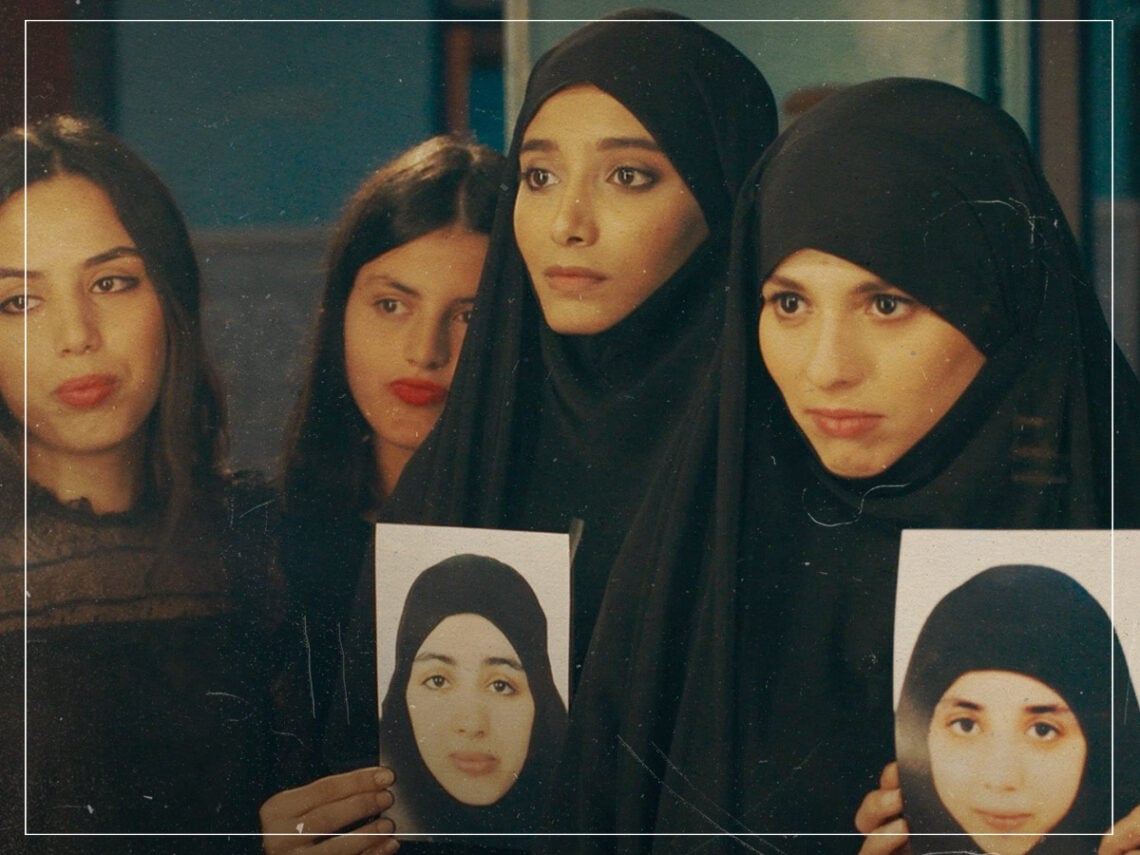
When the family meets Nour Karoui and Ichraq Matar, the actors playing their lost sisters Rahma and Ghofrane Chikhaoui, I still couldn’t quite figure out what was real and what wasn’t. They talk openly about the likeness of the actors as comments like “sit next to your mother” are thrown around with a laugh and a smile. Without knowledge of the Chikhaoui sister’s stories, their fate is still unknown here. And without any knowledge of Four Daughters even being a documentary, I thought, “Surely not”. Surely, this isn’t a real family being brought in to play themselves or taking on acting roles in the traumatic story of their own life. Surely, these sisters aren’t characterising themselves, side by side with actors cast as look-alikes for their missing siblings. And surely Olfa Hamrouni isn’t dipping in and out of this production, all based on how distressing a certain moment might prove.
But that’s precisely what was happening. As Four Daughters goes on and the family’s story reveals itself, their engagement with the documentary and Hania’s decisions on how to retell it is fascinating. However, the fascination is of the uncomfortable kind. As Olfa interrupts, offering pointers to help map out a retelling of her assault with more accuracy, the audience is left shifting in their seat, wondering whether that’s empowering or unethical.
The same conflict is raised again at a moment when Eya Chikhaoui delivers a speech to the actor playing the stepfather who abused her. With a fake knife in her hand and her sister sobbing beside her, the sister plays out an imagined confrontation, finally saying all the things she wished she could’ve done as a child. It’s a moment so emotionally heavy that the actor, Majd Mastoura, has to stop.
As he walks off to collect himself, Chikhaoui laughs. She says he just needs to see it as a scene and her as an actor. She claims to have worked over this exact speech for years with a therapist and that she’s fine to continue. The victim herself approaches her own life with a kind of calm professionalism while the actor hired to help retell her tale cracks. At that moment, whether she meant to or not, Hania’s work seems to engage with a broader topic on the ethics of documentary filmmaking and whether exploiting trauma in any media or through any method is ever okay.

In Four Daughters, the director’s method seems to reach the darkest lengths for the form. While there has always been talk about how moral it is to retell true stories, either with actors or with soundbites from real people, Hania goes in hard by merging the two. “At some point, I thought to myself, reenactment is such a cliché, so I’ll use [the cliché], I’ll hijack it as a way to summon the past and [let] the family think about this past, [let] the actor ask questions about motivation,” Hania said about crafting the film and turning the genre on its head. As the real people in this story are right in it, working alongside actors on a dramatised set, their truth is handled like a script as the sisters become actors for their own reenactments.
Throughout, the documentary plays between fascinating layers of self-awareness that leave its audience wondering what was right, what was cruel and what was ethical. In some moments, caught in between ‘takes’ of the sisters acting out their story, the cameras catch off-the-cuff conversations that seem utterly healing and moving as the young girls chat to the actors hired to play their older siblings. It could be argued that the bond between the four girls allowed the real sisters to find some catharsis or some closure in their story. But even still, the idea of forcing them to relive their life beside the stand-ins feels uncomfortable.
That feeling is even worse in moments where Olfa Hamrouni’s behaviour is picked apart and questioned by the actor playing her as she searches for the motivation behind the scenes. Similar to the ideas brought up in May December, Olfa seems to become a subject to analyse for inspiration, rather than actually being the subject of the story. While it’s a worthy topic to analyse how Hamrouni’s own strict upbringing and her own enforcement of stringent rules on her daughters may have led them to fall victim to religious extremism, considering that in front of her or with her feels somewhat callous.
However, and as questionable as this sounds, it’s the callousness and conflict of Four Daughters that makes it gripping. While the story of the Chikhaoui sisters is worthy enough for exploration, Hania’s decision to explore them in this way, with the family themselves, opens it up into a wider, fascinating treatment of documentary making as a whole. As I shift in my seat at the uncomfortable moments or find myself, jaw dropped open, during the repeated confrontations between the team, the film engages you on a level beyond just hooking in your empathy. Four Daughters doesn’t rest on its laurels by simply wanting audiences to feel bad for the family. Instead, it gets into the guts of why this happened and where they are with it all now, building a meatier piece of work, whether that method feels ethical or not.
In some instances, it seems like Hania is aware of the blurred line she’s walking on. The decision to leave in the moments where her actors can’t handle what her real-life subject can, or to keep the cameras rolling during arguments or emotional moments, seems to suggest a self-awareness that this documentary is also in part interested in documentary making.
Engaging with huge topics through the story itself and then mixing in more massive considerations about ethics and genre, Hania’s film about four sisters becomes a mammoth. The emotional weight it carries both as a retelling of a hard story and as a feature is heavy. The project feels more like therapy than archiving, engaging the family in active work both emotionally and literally as they take on acting roles. Through this, Four Daughters tests the limit of how much the subject should ever be involved in a documentary and how ethical, on the whole, the form is.
