


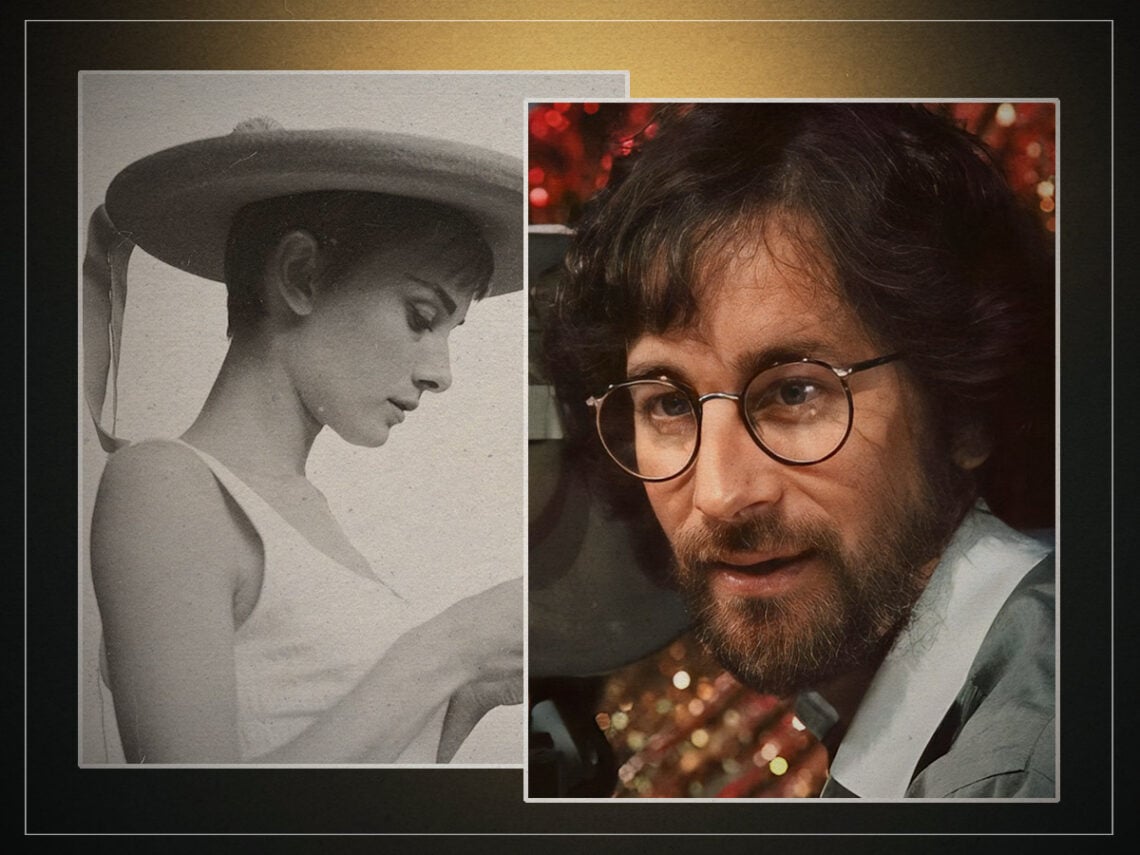
The forgotten collaboration between Audrey Hepburn and Steven Spielberg: “One of the best times of my life”

These days, Steven Spielberg is a nostalgic kind of filmmaker. Movies like Indiana Jones, ET, and Jurassic Park harken back to bygone eras, even if those eras are just a handful of decades in the past. Although many of his films have a retro sensibility about them from a 21st-century perspective, at the time he was making them, they were very much of their time. Whether it was the 1970s version of small-town America in Jaws or the 1980s suburban world in Poltergeist, his movies reflected the present.
It is difficult, therefore, to imagine one of the quintessential actors of Hollywood’s Golden Age cropping up in a Spielberg movie, especially one who had semi-retired many years before. Audrey Hepburn was a one-of-a-kind star who embodied the glamour of the 1950s and ’60s even though there was no one else like her on-screen. Movies like Roman Holiday, Sabrina, and Breakfast at Tiffany’s made her a star and continue to be cherished classics.
She, too, was very much of her time, partly because she all but retired from acting in the late 1960s to devote more time to her humanitarian work, specifically with UNICEF. In the late ’80s and early ’90s, she spent large periods of time abroad with the organisation. However, in 1988, Spielberg, of all people, managed to lure her back in front of the camera for his latest project, a remake of a classic Hollywood film.
1989’s Always is a loose adaptation of Victor Fleming’s 1943 romance A Guy Named Joe, which follows a pilot who returns from death as a guardian angel for his former girlfriend. In Always, Richard Dreyfuss plays an updated version of the character, a hot-headed pilot who puts out wildfires in the Northern United States. Holly Hunter plays Dorinda, his girlfriend and a pilot who is left grief-stricken after he takes one too many risks. When he returns, it’s to mentor a new pilot (Brad Johnson) who falls in love with Dorinda.
Hepburn doesn’t appear in the film very often, but she is perfectly cast as an angel named Hap, who helps Dreyfuss understand his new role in the world. She appears all in white, but rather than donning laughably Biblical robes, she wears a simple pair of white trousers and a knit jumper. She is impossibly elegant, and Spielberg uses lighting to make her look as luminous as she ever looked. She always appears in a natural setting, whether leaning up against a tree or casually sitting in the grass, adding to her otherworldly beauty.
Spielberg could hardly believe his luck when she said yes to the project. Hepburn had been mostly retired for the past two decades and had just started ramping up her work with UNICEF. However, part of her reason for taking the role was to donate the million-plus paycheck to the organisation, so it turned out to be a win-win for everyone. It turned out that she got a lot more out of making the film, too.
“I loved it, and I wouldn’t mind if [Spielberg] asked me again, like next summer,” she said. “I had really one of the best times of my life.”
It turned out to be her last movie role. She died several years later, in her mid-sixties, after a battle with cancer. It is unmistakably a Spielberg film, full of regular folks and heartstring-pulling sentimentality. But it’s very hard to imagine anyone managing to pull off the role of Hap with the same warmth and ethereality as Hepburn, making it just as much her film as his.
