


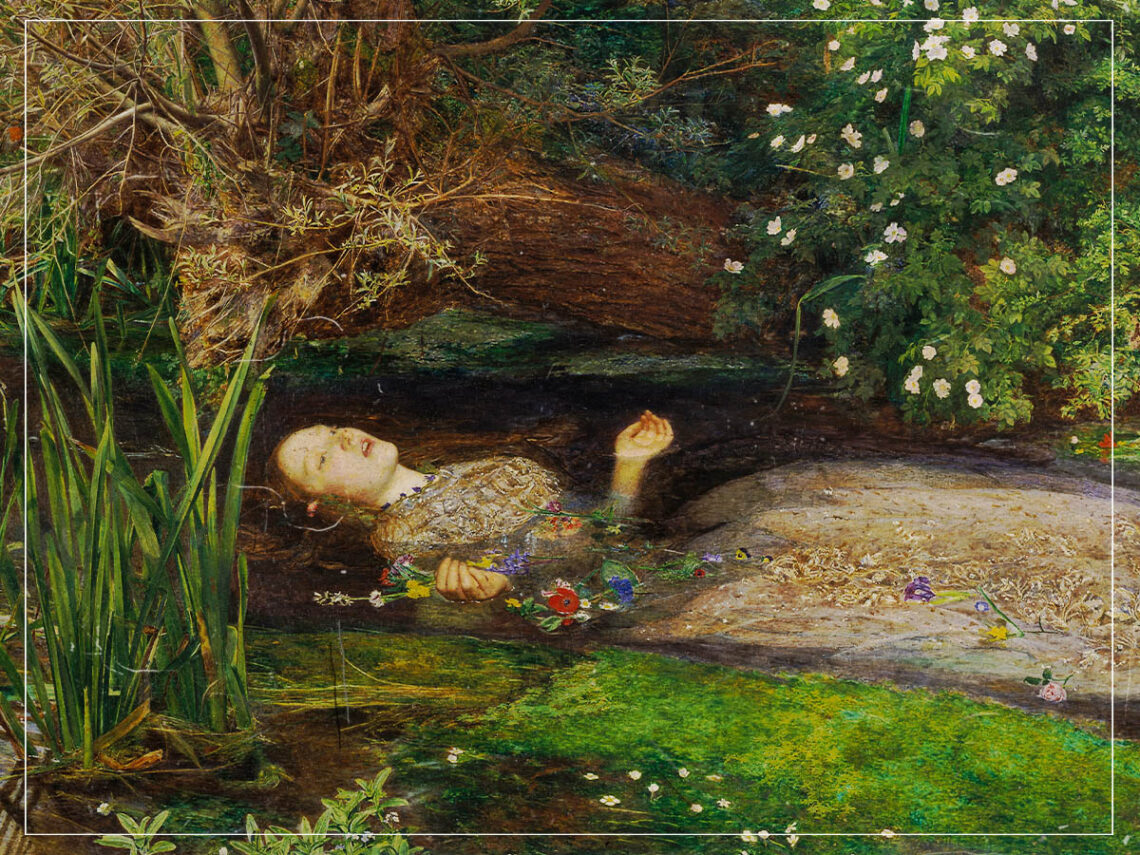
How flies, illness and trespassing shaped ‘Ophelia’

When painting a tragic Shakespearian character’s death scene, it helps to have a flair for the dramatic. Much to the advantage of his oil painting of Ophelia, John Everett Millais had in spades. Drawing from Ophelia’s death in Hamlet, which hints at her demise with poetic allusions to “cold maids” wilting in the weeping brook, his art became closely associated with tragic female characters. In her lifetime, Ophelia is consumed by madness and in death, forever suspended in a “muddy death”. Forget her eternal suffering, Millais was the real victim – at least, according to him.
The background alone, which most painters would consider the creative warm-up to the real meat of a painting, took him five months. Moved by the sheer physicality of the scene Shakespeare set out, down to the way the coronet weeds hung, he decided to paint in the open air. Millais, a prominent Pre-Raphelite painter, began momentously capturing the plantlife of a Surrey river bank. This method was encouraged by the Raphelite Brotherhood, whose aim was to observe nature as closely and accurately as they could.
But his five-month jaunt studying weeds on the Hogsmill River left him spiritually bereft. “My martyrdom is more trying than any I have hitherto experienced,” he wrote in a letter to Thomas Combe. While getting a sense of the scenery, he found himself making enemies with flies. The ones from Surrey, he wrote, were more “muscular”, which gave them a “greater propensity for probing human flesh”.
To add insult to injury, while being hounded by flies, he was also threatened with legal action. “I am threatened with a notice to appear before a magistrate for trespassing in a field and destroying the hay,” he lamented, also adding he was in equal danger of “being blown by the wind into the water”. Like a performer losing their sense of self through method acting, Millais started to unravel.
Of all the issues associated with his immersive painting methods, he wrote that his chief concern was: “Becoming intimate with the feelings of Ophelia when that Lady sank to muddy death, together with the (less likely) total disappearance, through the voracity of the flies.” That said, of all the artistic takes on Ophelia, his painting has retained cultural significance more than versions by Arthur Hughes and Thomas Francis Dicksee.
Much of that is owed to Elizabeth Siddal, the 19-year-old model and Pre-Rahpelite muse who sat for the painting in a full bath of water. Millais’s insistence that he painted from life meant she sat there for incredibly long periods. She inevitably became gravely ill when the lamps that kept the water at something close to a bearable temperature broke. As a thank you, and at the behest of her father, he paid the medical bills.
But yet again, Millais’ writings show he was convinced he was the one suffering. “Certainly,” he said, “The painting of a picture under such circumstances would be a greater punishment to a murderer than hanging.”
