


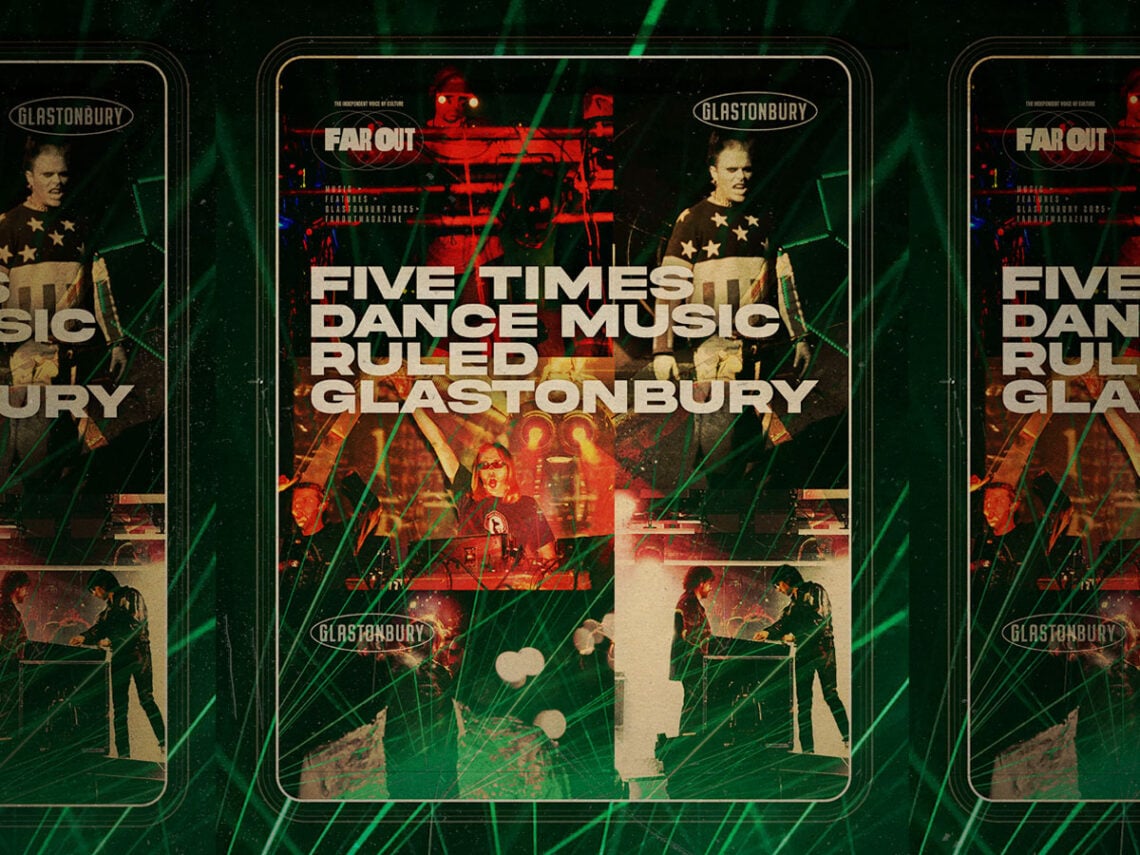
Five times dance music ruled Glastonbury Festival

People have this idea that Glastonbury is a rock show. A cursory glance at the lineups seems to support this theory, especially if you take the festival’s history into account. The early days were built on performances by the likes of T Rex, David Bowie and Hawkwind. As time has gone on, however, the festival has become a lot bigger than one genre. Arguably, it’s become a lot bigger than one kind of medium.
Glastonbury is, after all, a place where you can see everything from theatre and film to stand-up comedy, and, on some years, at the Pyramid Stage, the English National Ballet. However, it does all come back to music and that music has also branched out from plain old rock music, no matter how much of a conniption certain members of Mancunian Britpop relics have about it in the press. Arguably, the best example of this today is the fact that dance music is now considered part of the festival’s lifeblood.
However, had you told Michael Eavis this in the late 1980s, the man would have probably had kittens. He was famously anti-repetitive beats when headlines about rave music were first hitting news outlets. Perhaps because they were stealing his idea of taking a field in rural England, throwing a massive party there with all the hippy-esque ideals that entail, except this time with synths and E rather than guitars and LSD.
He soon came around to the idea, though, and today, it’s unlikely that there’s a single moment of a modern Glastonbury Festival where a DJ isn’t hyping up a field of bleary-eyed ravers. So let’s have a look at five of the moments when dance music truly ruled Glastonbury!
Five times dance music owned the stage at Glastonbury:
Orbital (1994)

By 1994, a true blue, dyed-in-the-wool dance act headlining one of the major stages of Glastonbury had been a long time coming. New Order had played a handful of times in the 1980s. They’d already platformed some of the major names of baggy and Madchester with the Happy Mondays’ headline set on the Pyramid Stage in 1990. Primal Scream had debuted Screamadelica for their 1992 set, but in 1994, it became time for a capital D Dance act to not only perform but capture the entire festival’s attention. On the Saturday night of 1994’s ‘Glasto’, Orbital did just that with a titanic headline set on the NME Stage (today known as the Other Stage).
By playing the same kind of flowing, formless yet utterly captivating set that they’d taken to countless semi-legal and outright illegal shows across the country, Orbital converted 40,000 Glastonbury-goers to the church of rave. The night before, Levellers had played to 300,000 people. The night afterwards, Blur, Oasis, Pulp and Radiohead would play on the same stage. However, if you were at that festival, the only thing anyone could say to each other on the site was a wide-eyed, awestruck, “Did you see Orbital?!” The levee had broken. ‘Glasto’ would never be the same again.
The Prodigy (1997)

Here we fucking go, lads. After Orbital crushed the second stage, all eyes looked to the big one. Who would be the first act to take dance music to the very pinnacle of the festival, closing out the Pyramid Stage? Orbital themselves came close the year after their triumph on the second stage, playing second on the bill on Saturday in 1995. However, they were somewhat overshadowed by Pulp, following them with arguably the single greatest headline slot in the Pyramid Stage’s long history. No. After a fallow year in 1996, the first dance headliner of Glastonbury Festival came in 1997.
Fittingly for rave music’s counter-culture roots, it came in the form of arguably the most notorious, feared and loathed band in the country at the time. Unfortunately, they did so at arguably the worst year for weather in the history of Glastonbury. Despite a few technical issues that stemmed from the ever-present mud, The Prodigy pulverised the Pyramid Stage with a hit-packed set that more than justified their place on the bill. A few days afterwards, their third album, The Fat of the Land, made them not only the most infamous band in the UK, but one of its biggest too.
The Chemical Brothers (2000)

Let’s be real here, we all love The Prodigy, but it can’t be ignored that their notoriety was at least part of the reason they were so high up the bill. To be clear, I’m not taking anything away from ‘The Prodge’. God forbid a band has personality, especially in the typically anonymous world of dance music. However, their infamy can’t be sidestepped, and it was part of the reason they enjoyed pride of place at the peak of Glastonbury. Now, when The Chemical Brothers topped the Pyramid Stage a few years later, it was a different story.
If The Prodigy were the Sex Pistols of rave, then The Chemical Brothers were the Elvis Costello. They took the fundamentals of rave and presented them in a more thoughtful, more palatable way and ended up being just as successful. While people don’t remember this set with quite the fondness of the previous two, and have been back since for much more celebrated sets, The Chemicals’ turn at the pinnacle of the Pyramid did draw one of the biggest crowds in the festival’s history. That doesn’t just happen for some flash in the pan.
Faithless (2002)

For all the bitching and moaning about 2025’s set of headliners, they’re caviar compared to 2002’s unbuttered, week-old toast. The Strokes would have been at least interesting, but they pulled out with two days’ notice, leaving a fresh-faced Coldplay to step in at the very last minute. An admirable effort, but Chris Martin’s lot, along with Rod Stewart and (seriously) Stereophonics, is a truly sorry state of affairs. However, the second headline slot on the Pyramid, with the sun going down behind them, is often one of the most treasured in the whole festival, and nowhere is this more apparent than Faithless’ turn on Friday.
In front of an absolutely ludicrous crowd of over 100,000, Faithless certified themselves as dance royalty with one of the deepest, most beloved back catalogues of the whole genre. That footage of ‘Insomnia’ kicking in as the sky glows wine-red and the entire crowd starts bouncing like the ground is a muddy trampoline is life-affirming stuff. One can only imagine how Coldplay thought that ‘Yellow’ could possibly follow it.
Justice (2024)

I know, I know, I know. A gap of 22 years?! Surely there have been important sets in the meantime, and yes, there have been… far away from the main stages. The truth is that as the 21st century went on, dance music found a new niche of its own. It’s relatively rare to see slots on the main stages given to dance acts when there are countless stages, tents and random little corners of the festival site devoted to 24-hour party people. Yet sometimes, you get the right band at the right time, playing their bangers in just the right way.
There were more than a few candidates for this slot, especially if you fudged the definition of dance music to include LCD Soundsystem and Chic. Even without that, Massive Attack, Deadmau5, Flying Lotus and Four Tet have all done themselves proud. However, Justice were a cut above all of them. Perhaps it’s the sheer rock ‘n’ roll force with which they’ve played their deathless bangers. Perhaps they’re here because that fabled Daft Punk set never showed, but their headlining set on the West Holts Stage was one of the defining moments of that year’s festival. Here’s to years of block-rockin’ beats to come!
