


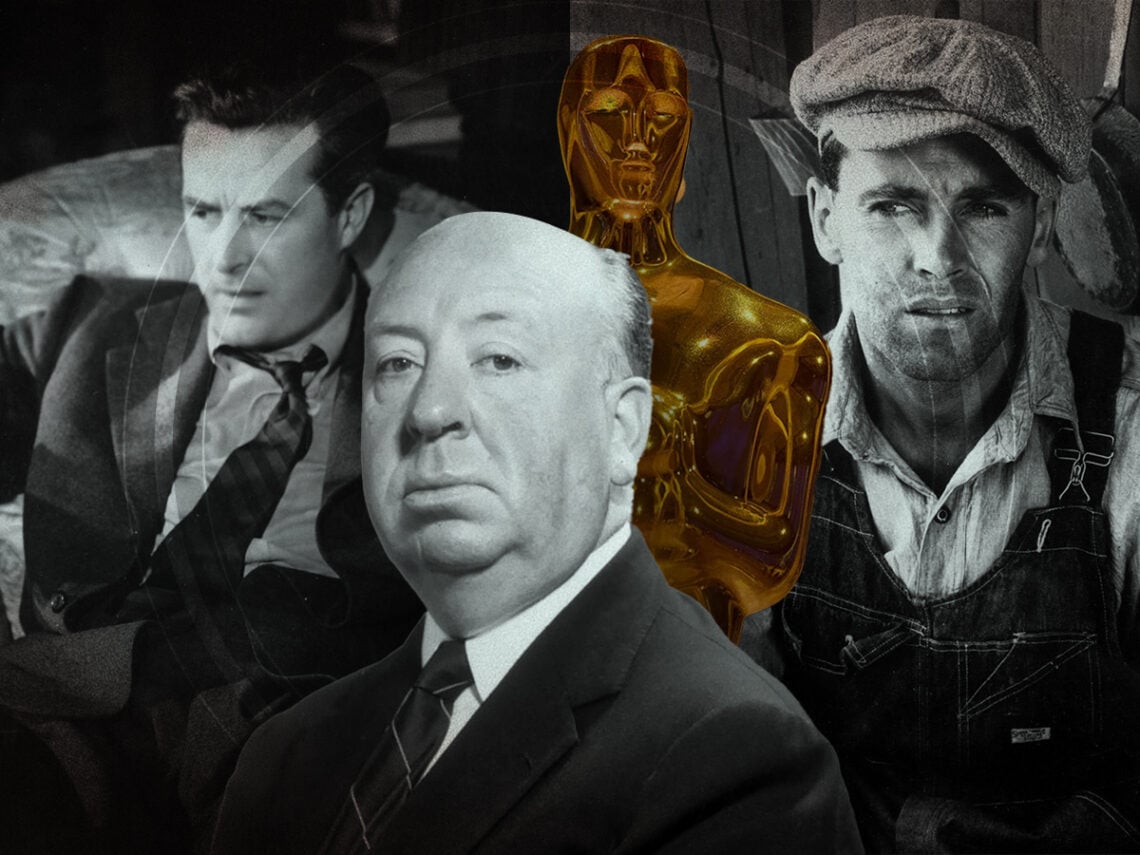
The five movies that beat Alfred Hitchcock to ‘Best Director’ ranked from worst to best

Few directors have had the enduring legacy of Alfred Hitchcock. Even now, nearly five decades after his final film, he is a household name. He helped pioneer the suspense genre and introduced techniques like the dolly zoom and the plot device known as the MacGuffin. He was able to blend glamour, heart-pounding tension, mystery, and comedy and influenced countless filmmakers in the process.
Hitchcock made a remarkable number of movies that continue to be beloved by generations of cineastes, including Vertigo, North by Northwest, Rear Window, and Psycho. He began his career making silent movies in the UK before exploring mystery films set during the war, like Foreign Correspondent and The 39 Steps.
When he moved to the US, Hitchcock continued to make black-and-white mysteries such as Rebecca, Suspicion, and Notorious but didn’t become a box office sure-thing until he transitioned into big-budget, colour movies in the 1950s like Dial M for Murder and Rear Window. For much of his career, he was seen as a commercial director but not an auteur. Given how distinctive and influential his style is, this is pretty hard to believe, but it wasn’t until the 1960s that critics began dissecting his movies and showering his work with praise.
Given how slow Hollywood was to recognise his contributions to cinema, it is slightly less galling to realise that Hitchcock never won a competitive Oscar. Although he is now considered one of the greatest filmmakers of all time and has no fewer than six movies in the BFI’s ranking of the 100 greatest films of all time, he had to settle for only five Oscar nominations. So, which films were deemed to be better directed than his?
Ranking the five movies that beat Alfred Hitchcock at the Oscars:
‘Going My Way’ – Leo McCarey (1944)

In 1945, Hitchcock was nominated for ‘Best Director’ for Lifeboat, a film which even his most ardent fans would admit is not his greatest achievement. It follows the survivors of a German U-boat attack who are stranded on a lifeboat, and it takes place entirely within the small vessel. Given such a considerable limitation, it’s hardly surprising that Hitchcock earned a ‘Best Director’ nomination, but it would have been insulting to most of his other films and to his own skills as a director if it had been the only one of his works to earn him an Oscar.
The Academy must have been extremely confused that year in general because it nominated two directors for some of the greatest films ever made (Otto Preminger for Laura and Billy Wilder for Double Indemnity) and still managed to hand the statuette over to Leo McCarey for a musical called Going My Way. It stars Bing Crosby as a priest who joins a new parish and has to win over his predecessor. It’s pretty saccharine stuff and is not, needless to say, anywhere close to the calibre of Laura or Double Indemnity. Even Lifeboat would have been more deserving.
‘The Grapes of Wrath’ – John Ford (1940)

Hitchcock’s first Oscar nomination came in 1941 for his first Hollywood film, Rebecca. He actually had a pretty good shot at winning this one. He had yet to be considered a flashy popcorn director and was viewed as a rather impressive import from England. The film was based on the classic Daphne Du Maurier novel about a naive young woman who marries a wealthy aristocrat, only to be haunted by his late wife. It was nominated for a staggering 11 Oscars that year and won ‘Best Picture’ and ‘Best Cinematography’. However, Hitch walked away empty-handed.
The director who did win that evening was John Ford for his adaptation of John Steinbeck’s seminal American novel The Grapes of Wrath. It is, without question, an excellent film, with a moving central performance from Henry Fonda. However, it is far from Ford’s best work, which, admittedly, is a very high bar.
The person who should have won that night was neither Hitchcock nor Ford but George Cukor for The Philadelphia Story. Cukor, like Hitchcock, was regularly passed over by the Academy, probably because his greatest strength was directing female-driven comedies, which was and still is a deadly combination as far as awards are concerned.
‘The Lost Weekend’ – Billy Wilder (1945)

1945 saw another strange choice from the Academy. Hitchcock was nominated for Spellbound, a film that focused on the very trendy topic of psychoanalysis and dream interpretation. It stars Ingrid Bergman as a psychiatrist who falls in love with the new head of the prestigious institution where she works, played by Gregory Peck. Quickly, however, three things become evident: he is an imposter, he might be a murderer, and he’s suffering from amnesia. By modern standards, it is one of Hitchcock’s more quaint and dated movies.
These days, Spellbound is remembered mainly for a dream sequence designed by the Spanish Surrealist Salvador Dalí, which, naturally, holds the key to Peck’s identity and the solution to the murder mystery. The sequence is about as psychedelic as Hollywood got in the 1940s, and the studio cut it down significantly. The film went on to win the Oscar for ‘Best Original Score’, but lost the awards for directing, special effects, cinematography, supporting actor, and film.
The filmmaker who did win ‘Best Director’ was Billy Wilder for The Lost Weekend, which also won ‘Best Picture’ and ‘Best Actor’ for Ray Milland, as well as ‘Best Screenplay’. It follows four days in the life of a writer suffering from alcoholism and highlights his painful descent into self-loathing, self-destruction, and suicidal ideation. It isn’t the most enjoyable of watches, but it is one of the more unflinching, realistic films that Hollywood produced at the time. Of the nominees that year, Wilder was the most deserving of the ‘Best Director’ award.
‘On the Waterfront’ – Elia Kazan (1954)

In 1955, Hitchcock was finally nominated for one of his best films, Rear Window. Like Lifeboat, it had a central geographical constraint: the main character, a photographer played by Jimmy Stewart, is confined to his high-rise apartment after breaking his leg. Unlike Lifeboat, that constraint feels more like a stroke of genius than an unnecessary limitation. The film is Hitchcock at his best. The chemistry between Stewart and Grace Kelly crackles, the murder mystery is full of suspense and terror, and its visual inventiveness never detracts from the story.
Sadly for Hitchcock, however, Hollywood was under a very powerful spell that year, and the magician was Marlon Brando. His performance as Terry Malloy, an ex-prize fighter turned longshoreman battling with existential disappointment and corrupt bosses, remains one of the most influential pieces of acting ever committed to film. Countless performers have used his performance as a benchmark for their own work, and every one of them would tell you that no one has ever come close to it.
As a film, On the Waterfront still packs a punch, but it is all down to Brando’s performance. Elia Kazan was instrumental in developing the actor’s talents, but the movie isn’t the greatest to ever beat Hitchcock at the Oscars.
‘The Apartment’ – Billy Wilder (1960)

Despite the countless concessions he had to offer in order to make the film, Hitchcock was vindicated many times over when Psycho was finally released. It is widely considered to be the first slasher movie and was an unexpected hit, becoming the director’s highest-grossing film. It was also one of his cheapest. Paramount refused to produce it at any price, so the director put up his own money (about $800,000) to get it done. It went on to become one of the highest-grossing films of the year and a movie that pretty much every film fan has seen. The shower scene alone is one of the most famous moments in cinema history.
Given the constraints he was under and the genre-defining innovations he made in the film, Hitchcock almost certainly should have won the ‘Best Director’ Oscar that year, but he was also up against his stiffest competition with Billy Wilder’s The Apartment. The comedy-drama stars Jack Lemmon as a timid insurance clerk who allows his boss, played by Fred MacMurray, to use his apartment to carry on his extramarital affairs. Lemmon’s character finds a kindred spirit in a new elevator operator at the office, played by Shirley MacLaine, not realising that she is his boss’s new mistress.
Wilder could do comedy unlike any other Golden Age director, but as evidenced by The Lost Weekend and Sunset Blvd., he could also plumb the depths of real-world darkness in a way that few other directors of the time could get away with. The Apartment is one of the greatest examples – a movie disguised as a rom-com that delves into the darkness and meaninglessness of capitalism and the loneliness of modern life.
