


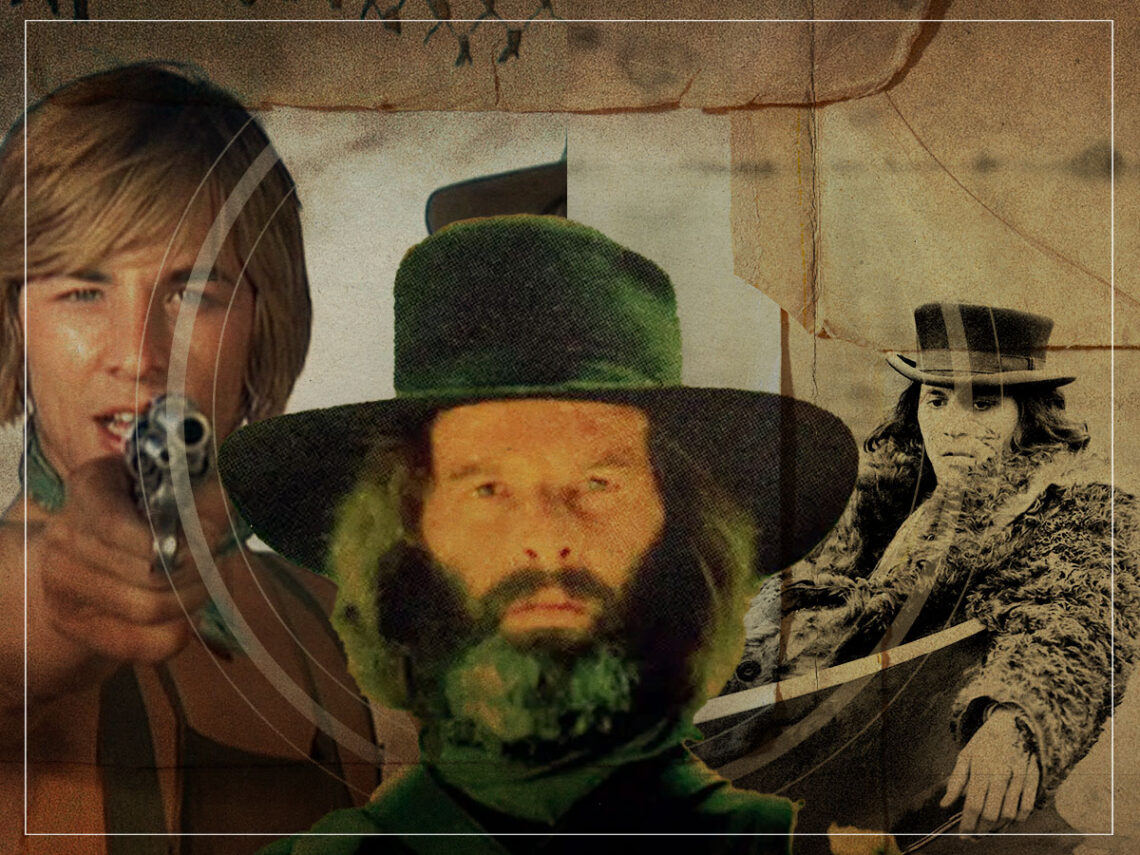
Five essential acid westerns to see before you die

Have you ever watched a John Wayne movie and either wished that it did more to critique the problematic ideals of Manifest Destiny and/or was made by people who were high out of their minds? If your answer to both questions is no, you might still enjoy delving into the subgenre known as the acid western.
In the 1960s and ‘70s, Hollywood was undergoing an existential transformation. The studio system was collapsing, and with it, the industry’s will to ignore the broader shifts in society. The civil rights movement was erupting around the country, presidents were being assassinated, and the kids were smoking a lot of weed. The upshot of all of this, at least in cinematic terms, was that the movies got leaner, meaner, and much weirder. Young upstarts like Dennis Hopper were bombing around the desert, making renegade flicks like Easy Rider and winning awards for it. America’s identity was crumbling. Its perceived superiority in the world was being questioned by a new generation, and they weren’t afraid to make art about it.
In this environment, no cinematic institution was as threatened as the western. Once a bastion of propaganda in which Native Americans were villainised, and westward expansion was a symbol of progress, the genre was ripe for subversion. There had always been progressive westerns that deconstructed the racism and tyranny that defined the genre, but the acid western was the most stylistically and narratively disruptive.
Most acid westerns were made between the late ‘60s and the mid-70s, subverted the positive stereotypes of the Old West, and featured elements of surrealism. New Yorker critic Pauline Kael coined the term in her review of Alejandro Jodorowsky’s El Topo, and it quickly caught on. So whether you’re mildly curious about what this genre actually looks like in practice or are ready to dive in headfirst, here’s where to start.
Greaser’s Palace (Robert Downey, 1972)

It is worth noting from the outset that not all must-see acid westerns are ‘good’ in the classic sense. But some of them, like Greaser’s Palace, are just so stridently bizarre that they need to be watched to be believed. Long before his son was jetting around Marvel’s infinite universes as Iron Man, Robert Downey Sr concocted a parable in which a man named Jesse paraglides into the Old West with no memory of his purpose except that he must find his talent agent and get to Jerusalem to become a star. What he finds is an evil saloon owner named Seaweedhead Greaser, whose son, Lamy Homo, needs resurrecting.
This film is a close cousin of John Waters’ movies in terms of weirdness but doesn’t approach them in terms of abject degeneracy. As such, it is more of a curiosity than a masterpiece, but it is still an extremely surreal watch worth having. It’s not exactly clear what this film is trying to say, but it sure does make a lot of noise.
High Plains Drifter (Clint Eastwood, 1973)

Clint Eastwood was one of the few actors who managed to transcend all versions of the western. Starting his career in the traditional western television series Rawhide, he transitioned into spaghetti westerns with Sergio Leone’s Dollars trilogy and then transformed yet again with High Plains Drifter, a sci-fi inflected western horror that spits on the grave of the 1940s and ’50s versions of the West.
Eastwood stars as a mysterious man known only as The Stranger who rides into a corrupt frontier town and accepts a job offer to defend the citizens against bandits. However, it soon becomes clear that he’s there to dole out his own brand of justice, usually in the form of a body count. Although the plot follows similar lines as Leone’s movies, High Plains Drifter is significantly darker, and it’s implied that The Stranger might be a ghost seeking revenge rather than a gunslinger overstepping his job description.
While the film never reaches El Topo levels of surreality, it does walk a bold line between western, horror, and ghost story. It was so bold, in fact, that John Wayne himself decided to kick up a fuss about it. In a letter to Eastwood, he wrote, “That isn’t what the West was all about. That isn’t the American people who settled this country.” Many historians would disagree.
Zachariah (George Englund, 1971)

If you want to see the collision of ‘70s counterculture and westerns at its most explosive, look no further than Zachariah, a film which was inspired by the screenwriter’s trip to India with The Beatles. It is, appropriately enough, a musical of some variety, featuring acid rock bands in the desert, a howling duo of wannabe gunslingers, and a cursory nod to the peace-and-love version of Buddhist philosophy, murder notwithstanding.
John Rubinstein and Don Johnson star as the young gunslingers who start out with high-minded ideals about becoming outlaws, only to part ways and find their fortunes separately. According to screenwriter Joe Massot, the script was inspired by the time he stumbled upon John Lennon and George Harrison in the midst of a transcendental meditation duel to see which was the most spiritual. The resulting film is about as pure an expression of the ‘70s as you can get in a western and a much more raucous deconstruction of the genre than the other ponderously absurdist versions.
Dead Man (Jim Jarmusch, 1995)

Though Dead Man was made long after the counterculture movement had flamed out, it is, in many ways, the best example of the subgenre. With the benefit of hindsight, Jarmusch was able to pick and choose the elements he wanted to keep and let go of the attention-seeking antics that many of the films in the 1970s were throwing in the faces of their audiences. Rather than wasting his time with showiness, Jarmusch puts more emphasis on making the surreality thought-provoking rather than merely provocative.
Johnny Depp stars as a mild-mannered accountant in the Old West who is on the run after killing a man. He stumbles into trouble, only to be met by a Native American named Nobody, who believes he is the reincarnation of the English poet William Blake. Where Zachariah was supposedly inspired by meditation, Dead Man feels like meditation. With its monochromatic black-and-white cinematography and Tom Petty’s improvised soundtrack, it feels less like travelling a story arc than being swept along by a slow-moving river.
El Topo (Alejandro Jodorowsky, 1970)

The granddaddy of them all, El Topo is the first movie ever to be called an acid western and the last to fit that category so precisely. Inspired by spaghetti western maestro Sergio Leone, surrealist pioneer Luis Buñuel, and Eastern philosophy, Chilean director Alejandro Jodorowsky created something all his own. He stars as a mysterious drifter dressed in black who rides on horseback with his naked son through the desert. After a sexual encounter with a woman, he resolves to challenge the four masters of the desert in combat, embarking on a journey laden with spiritual symbolism.
The hallucinatory nature of this film – its utter uniqueness as a cinematic experience – entranced the small handful of audiences who saw it when it was released. It became a touchstone for everyone from John Lennon and Yoko Ono to David Lynch and Roger Waters, and is credibly described as the first midnight movie. It careens from grotesque horror to dreamlike spiritualism with a visual intensity that even Lynch never quite reached, though perhaps with less depth behind it. It is cosmic counterculture at its finest, full of brutality and starry-eyed philosophy, ruby-red blood and glaring blue skies. You might not understand it on even the most basic level, but it will move you, like it or not.

Never Miss A Tale
The Far Out Clint Eastwood Newsletter
All the latest stories about Clint Eastwood from the independent voice of culture.
Straight to your inbox.