


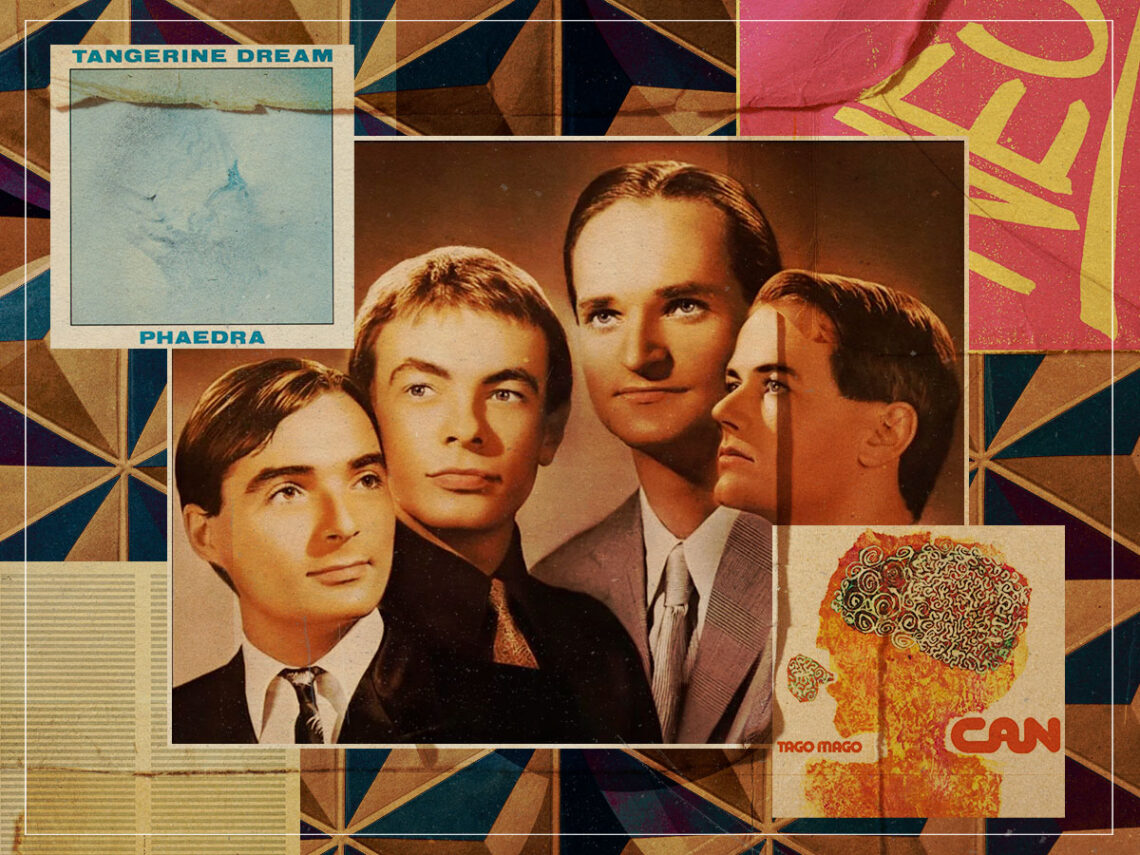
Five Easy Masterpieces: An introduction to krautrock

Throughout the 1960s, the rock vanguard pushed east from the US to the shores of Britain, where The Beatles energised a countercultural revolution. By the end of the decade, rock had been completely bent out of shape by the influence of LSD, the Beat Generation and a contingent of intrepid musicians. As The Beatles bowed out in 1970, prog-rockers continued in the vein of psychedelic abstraction, but something much more intriguing had already manifested in the heart of Europe: krautrock.
Krautrock is often regarded as a genre but was more accurately a movement, given its specific geographical origin and not-so-specific stylistic signature. The movement is so-named as a playful nod to the ethnic slur by which British forces addressed the German forces in both world wars. The word kraut translates to “herb” in English, but the ethnic slur pertained to the Germans’ favourite cabbage preparation: sauerkraut.
It seems fitting that the movement was named after the British slur, given that krautrock bands, most hailing from West Germany, derived their initial sonic identities from the psychedelic rock movement, which was centred in London in the late 1960s. With jazz-inspired drummers like Ginger Baker and innovative guitar virtuosos like Jimi Hendrix leaving their mark during this period, the preconceived bounds of rock were scattered to the wind.
Since krautrock isn’t strictly a genre, describing it with a set of uniform parameters is difficult. However, each band set out with an experimental rock sound often accompanied by rudimentary synthesiser treatments and effects-ridden instrumentals. From this general foundation, each band worked within a unique niche. For example, CAN became associated with percussive, funk-influenced music with sparse lyrical motifs. Meanwhile, Kraftwerk quickly abandoned traditional instruments, favouring synthesisers, drum machines, and vocoders.
The krautrock wave brought us an eclectic range of progressive music without which many of our cherished alternative rock and electronic artists wouldn’t exist. The most prominent names in krautrock included Neu!, Can, Faust, Tangerine Dream, Kraftwerk, Cluster, Ash Ra Tempel, Popol Vuh, Amon Düül II and Harmonia, but there are plenty more to explore. Today, I introduce this extraordinary musical movement with five essential masterpiece albums.
Five essential krautrock albums:
Tangerine Dream – Phaedra (1974)
The Tangerine Dream discography is a dream for seasoned fans and a nightmare for newcomers. The simple reason for this is that the band has such a vast catalogue spanning five decades, including 23 EPs, 36 soundtrack albums and 108 live and studio albums. It turns out that when an artist creates mostly experimental instrumental music, they can become rather prolific.
An introduction to krautrock should always reserve space to mention this Berlin-born behemoth. I urge you not to be intimidated by the band’s sprawling catalogue and focus on the classics to begin with. The band’s most revered albums in their associative medium of experimental electronic music are Phaedra, Rubycon and Stratosfear. My personal favourite is Phaedra because of its fine balance of moods, spanning from intense rhythms to mellow ambience.
CAN – Tago Mago (1971)
In my humble opinion, CAN was the best of the Krautrock bands. Their classic early iteration with Damo Suzuki front and centre defined not only CAN’s unique sound but also set the tempo for the wider krautrock scene. The band’s approach morphed over time, but at their best, they brought synthesisers, bold drum beats and psychedelic guitar solos to some unforgettable jams.
The CAN discography offers so much to enjoy, from the Malcolm Mooney years to the danceable hit single ‘I Want More’. However, the most essential is a trilogy of albums from the Damo Suzuki years: Tago Mago, Ege Bamyasi and Future Days. Ege Bamyasi is likely the most accessible thanks to its accessibly brief classics like ‘Vitamin C’ and ‘One More Night’. Still, few seasoned fans will argue against Tago Mago as the jewel on the crown. It is a masterpiece that marries psychedelic rock and funky grooves in a perfect balance. The epic centrepiece, ‘Halleluhwah’, is an unmissable highlight.
Kraftwerk – Trans-Europe Express (1977)
Kraftwerk is perhaps the most enduring krautrock band, thanks to their career longevity and a run of extremely influential albums in the 1970s. While CAN influenced plenty of neo-psychedelic rock outfits on the fringes through the 1980s and ’90s, Kraftwerk had their hands well and truly on the helm of popular music. Famously, the band’s early experimental work influenced David Bowie’s lauded Berlin Trilogy.
Approaching the end of the 1970s, Kraftwerk migrated to more radio-friendly territory with The Man-Machine and Computer World, thus setting the perfect conditions for a synth-pop takeover in the 1980s. Just before these two essential albums, the robotic Düsseldorf collective released their most consummate release, Trans-Europe Express. The album is a perfect balance between Kraftwerk’s early experimental phase and later pop-inclinations.
Faust – Faust IV (1973)
Faust translates to “fist” in English, but it is a much more interesting name in connection to the tragic play by German polymath Johann Wolfgang von Goethe. As central figures of the early 1970s krautrock scene, Faust are best remembered for a sound not dissimilar to that of CAN. The band relied heavily on improvised jams and enjoyed blending rhythmic psych-rock grooves with exotic instrumentation and experimental electronic treatment.
The Faust catalogue is split into two chapters, the first running from 1971-75 and the second spanning from the early 1990s reunion to the present day. Over this timeframe, the band has experimented with a few different stylistic approaches, and the latter chapter is certainly worth listening to. However, newcomers should start with the classic era and give Faust IV a spin first. It doesn’t get much more krautrock than the opening track, ‘Krautrock’, a swirling mirage of sound prescient of 1990s shoegaze and neo-psychedelia.
Neu! – Neu! (1972)
Neu! was formed in Düsseldorf in 1972 by Klaus Dinger and Michael Rother, formerly members of Kraftwerk. Their instantaneous impact was a drop in the ocean compared with that of Kraftwerk, who surged through the 1970s with a run of acclaimed records. However, despite their failure to break through in their first run from 1971-75, Neu! became retrospectively world-renowned.
During their classic run, Neu! released three seminal albums: Neu!, Neu! 2 and Neu! 75. Fortunately, the music within each is much more inventive than the titles let on. For anyone looking to get into krautrock, these three albums are all essentials, but the 1972 debut is the best place to begin, both in terms of chronology and because it is home to some of the band’s most accessible tracks, such as ‘Hallogallo’ and ‘Weissensee’.
