


The five biggest hoaxes in art history

What would the world look like without art? It would be a bleak place, albeit one that’s hard to imagine due to the omnipresence of a cultural society in which art runs so freely – and has done for centuries. Since the beginning of time, humans have expressed themselves through the creation of art, from etching shapes on cave walls to intricately painting realistic scenarios and portraits on canvas.
As Oscar Wilde famously quipped in The Decay of Lying, “Life imitates Art far more than Art imitates Life.” Humans rely on art to survive and to shape our lives. Without art, we would be lifeless, and our existences would be rendered meaningless. The universality of art, which comes in countless different forms, from painting to filmmaking, makes it an accessible medium of expression that most people regularly engage with, either as creatives, consumers, or both.
However, despite the inherent universality of art, it has become somewhat of an elite club over the centuries. From the insanely high prices of original art to the pretentious and snobbish attitudes of selected figures, it feels impossible to enter the high art world without wealth, privilege and connections. Thus, there have been many instances of people faking their way into the art world through hoaxes, attempting to prove the ridiculousness of elitism. Elsewhere, scandals have made a significant dent in the art world, such as money-grabbing fraudsters faking work by famous artists.
So, from David Bowie’s involvement in a dramatic art scam to paintings secretly created by a donkey, here are five massive hoaxes that shocked the art world.
The five biggest hoaxes in art history:
Lolo the Donkey
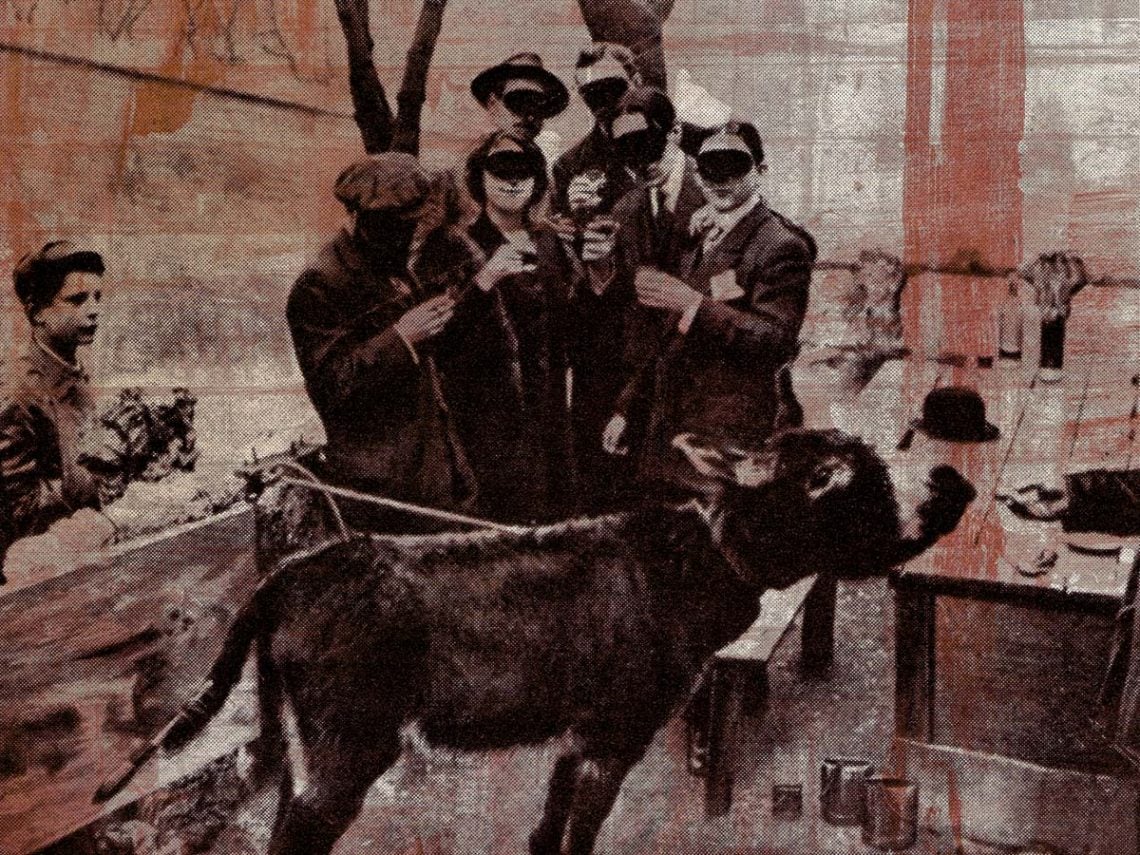
In 1910, a painting sold for 400 francs – around $1,200 in today’s money – at the Salon des Indépendants. Et le soleil s’endormit sur l’Adriatique (Sunset Over the Adriatic) by Joachim-Raphaël Boronali amazed critics, who were impressed by the vivid oranges, yellows and blues that comprised the painting. The exhibition labelled the work as part of a mysterious ‘Excessivist’ movement, and people were eager to discover who the elusive Italian painter was.
As it turned out, the painter was not a human but a French donkey named Lolo. The writer and Académie Goncourt member Roland Dorgelès staged the whole thing by attaching a paintbrush to Lolo’s tail and letting him brush incoherent streaks over the canvas that he had painted random blocks of colour onto. Although the satirical hoax shocked the art world, most people eventually saw the funny side of it.
Knoedler Scandal
Chinese artist Pei-Shen Qian tricked art collectors for over 20 years by creating artwork that was then attributed to iconic artists, such as Mark Rothko, Jackson Pollock and Willem de Kooning. The esteemed Knoedler Gallery, under the direction of Ann Freedman, frequently sold these fake paintings, with Qian asserting that he was unaware his work was being sold using the names of famous artists.
It all began when a new Rothko painting appeared, courtesy of Glafira Rosales. The previously unseen work was said to belong to a mysterious ‘Mr. X’. With little solid evidence that the paintings were genuine, Freedman accepted them regardless, eventually earning $80million from her sales. The scandal led to the Knoedler Gallery’s downfall, and Rosales was sentenced to jail time. Talking to ABC, Quian, who has not been prosecuted, insisted, “My intent wasn’t for my fake paintings to be sold as the real thing. They were just copies to put up in your home if you like it.”
David Bowie, William Boyd and the mysterious Nat Tate
In 1998, David Bowie hosted a party for the “lost American artist” Nat Tate, who, after studying in America and France, and meeting Picasso along the way, indulged in destructive behaviours and killed himself in 1960. Yet, Nat Tate never existed. He was the fabrication of Bowie and his novelist friend William Boyd, who went as far as to publish a monograph on the artist. The pair were seriously dedicated to the hoax, with Boyd painting some of Tate’s work. Picasso’s biographer John Richardson even contributed to the blurb of the monograph to heighten its believability, and journalist David Lister engaged in conversations with party-goers.
Lister found that many people feigned knowledge of the fake painter, with some even claiming that they had attended Tate’s shows decades prior. When Lister revealed the hoax, people were incredibly shocked that such an intricately organised event was a complete fabrication. Bowie and Boyd highlighted the elitism of the art world, with people going along with the story of Tate despite his inexistence. Following the hoax, Boyd wrote, “It’s a little fable, particularly relevant now, when almost overnight, people are becoming art celebrities.”
Pierre Brassau, the chimp
A similar tale of animal-based forgery to Lolo’s occurred in 1964 when Swedish journalist Åke ‘Dacke’ Axelsson attempted to fool art critics by presenting a series of paintings by an obscure French artist, Pierre Brassau. Of course, Brassau was not an unknown master of the avant-garde – he was a chimp. Axelsson was keen to see how high-brow art critics would react to his animal paintings, and, much to his delight, they responded terrifically. In the Göteborgs-Posten newspaper, Rolf Anderberg described how Brassau painted with “painted with powerful, determined strokes,” calling him “an artist who had the delicacy of a ballet dancer.”
Although the four paintings, exhibited in the Christinae Gallery in Göteborg, were mainly received well, one critic declared that “even a monkey could do it.” Of course, they were right, but that didn’t fool most people. When Anderberg discovered that a four-year-old chimpanzee was the mastermind behind the work, he maintained his statements on the quality of Brassau’s work.
A new movement: Disumbrationism
When critics received Sarah Bixby Smith’s artwork poorly, her husband, novelist Paul Jordan-Smith, decided to enact his revenge. He decided to fake a whole new art movement entitled ‘Disumbrationism’. His first piece was titled Yes, we have no bananas, although he soon changed its name to the more refined, Exaltation. Using the name Pavel Jerdanowitch, Jordan-Smith debuted his piece at the Exhibition of the Independents in New York’s Waldorf-Astoria in 1924, claiming that the piece was about “breaking the shackles of womanhood.”
Critics quickly revered his work, which he described as part of a new movement, Disumbrationism. Jordan-Smith continued to create work under his pseudonym, trying to trick art critics into believing that an authentic new wave of artists was crafting a pioneering style. The novelist had never painted before, and his work was not particularly good, often using heavy-handed techniques and garish imagery. Eventually, he confessed that he had fabricated the whole thing in 1927.
