


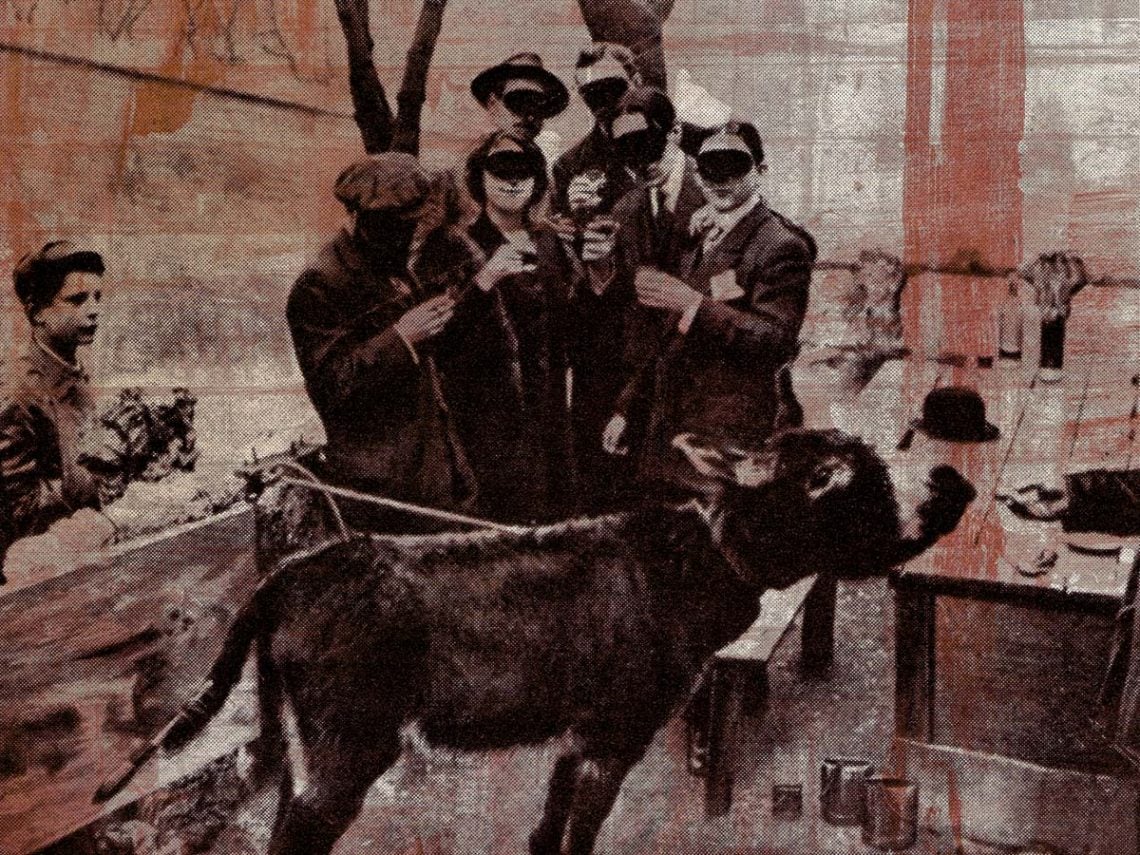
Joachim-Raphael Boronali: The donkey that made an ass out of modern art

Why is ‘The Mona Lisa’ considered a masterpiece? Well, the fact that Leonardo da Vinci – a man more revered than every chocolatier in a Lindt advert combined – worked on it for ten years, and was still putting the final touches to it when he died, certainly helped. But aside from its historical narrative, being hung in Napoleon’s private quarters and the French press getting soppy about their prised acquisition, it does perfectly exhibit pioneering technique and a progression in the world of art.
You see, prior to the renaissance, we simply couldn’t get our heads around how to represent 3D perspective on a 2D canvas. It might seem like the easiest thing in the world now, but that only occurs after the fact. For instance, in more recent times, the steering wheel was invented a mindboggling eight years after the car. This was because we were working from a blank slate. Before the steering wheel, the only way to manoeuvre a large moving vehicle was to yank the reins on a horse’s head. That becomes a whole lot trickier with a combustion engine, so we had to troubleshoot a solution and that takes time.
Accordingly, while it might make our ancestors seem stupid at first, with a bit of empathy, you can grasp how mindbending it would’ve been to sit in front of a canvas before the code was cracked and exclaim, ‘Well, it’s going to look mad if I make this horse somehow bigger than a mountain!’ In essence, figuring out how to alchemically establish a foreground on canvas was like the black magic wonder that your grandparents experience when you get their TV back on MDI1.
By no means was da Vinci the first to use perspective in his paintings, but his wonderful use of softening edges with light and creating depth with hazy distance was a masterstroke that made the ‘Mona Lisa’ stand out (excuse the pun). This subtle technique became a defining factor separating your Albrecht Dürer from your eggshell Dulux decorators for centuries to come. And then came the great curveball.
In 1839, when Louis Daguerre presented the world with the first high-quality camera, with images that didn’t fade, he opened the world up to a new age of liberation. Sadly, it had artists sweating. Suddenly a machine could do their job better in a fraction of the time. To reduce a thousand theses down to a single sentence: this was the birth of modern art. Suddenly rather than paint a field with fidelity, you had to capture the internal essence of it.
Cue the dawn of a thorny issue that the Coen brothers put their finger on in the film The Man Who Wasn’t There. In that masterful movie, there is a scene whereby a pretentious French piano instructor dismissively explains, in roundabout terms, ‘I don’t know what it is, but she hasn’t got it’. There is a grain of truth to this mystic je ne sais quoi of artistry that we are all familiar with.
However, there is a nettlesome potential to this enigma that modern art has often exploited. That same mystic je ne sais quoi of artistry that slaps us around the face most weekends in bars where the performer knows the chords, but the true sincerity is missing, also underpins the elitist tripe that has allowed trashcans to sell for millions at the Museum of Modern Art. Roland Dorgelès was a critic who knew this quandary all too well. But he himself wasn’t about to expose it without his own flourish of artistic je ne sais quoi.
Dorgelès wasn’t that keen on some of the expressionist art that was emerging at the dawn of the 1900s. He saw this new splurge of colour as a way of masking diminishing skill rather than redacting the very quintessence of man’s struggle onto a squiggly canvas. But he paused before publicly condemning it—he realised that given that the galleries needed expressionism to win, he was going to be outgunned and drowned out in pretentious waffle by scholars claiming that he was too dogged to see the metaphysical.
So, the first piece of modern art appraisal he did as a critic was to champion the painter Joachim-Raphael Boronali as the new master of modern art. He dubbed this mysterious, flamboyantly named, Italian a pioneering ‘excessivist’ with a superb knack for placing God on the canvas. His fellow critics agreed. The enigmatic Boronali was quickly becoming one of the most celebrated names of his age.
At the fever pitch of this critical adulation, Dorgelès was ready to answer the question that everyone had been imploring: Who was Joachim-Raphael Boronali? It turns out, he was Père Frédé the local farmer’s donkey named Lolo, Boronali was merely his pseudonym for when he was done munching hay.
Dorgelès would simply slap a few cheap blocks of colour onto a canvas, vaguely mimicking a horizon. Then he would take the canvas down to the farm where a paintbrush was attached to Lolo’s tail and it back its booty into the picture, using its derriere to daub a few ‘excessivist’ scribbles onto the so-called masterpiece.
Now, the critics who praised Boronali had to come to terms with the fact that they had just eulogised a donkey as being a pioneering force in modern art who successfully surpassed the old ways of da Vinci, forgoing the trifling matter of depicting a scene with fidelity and venturing beyond the physical into the ether of art that clings to the mire of existence but escapes the grasp of mere mortals. This zenith had been achieved by Lolo—a steed who smells a bit like faeces and would rather go to a carrot factory than the Louvre.
Naturally, this created quite a storm that was then quickly muted by the status quo. Now it stands as both a warning and an ingenious piece of artistry in itself. It doesn’t mean that every modern artist breaking the norm is a bleating donkey, but we have to be careful that we don’t make an ass of ourselves by mindlessly championing a bum job. Or in the less punny words of the great Kurt Vonnegut: “Modern art is a conspiracy between shysters and the rich to make poor people feel stupid!” If you can’t find the crucifixion of Christ in the swirling colours of the Jackson Pollack then you simply aren’t cut out for the elite club.
The final irony is that I’ll be damned if old Lolo’s tail doesn’t have the most flair in farmyard history. There are no two ways about it, that painting simply does have a certain something going for it. Perhaps it was the great hoax of engineered hubbub or the almost-inadvertent lure of the painting itself that caused someone to fork out the equivalent of $1300 for it back in 1910, but it certainly turned out to be a total bargain given that the picture is now one of the most interesting paintings in the history of art. It is satire at its finest with a story of the richest history around.
