


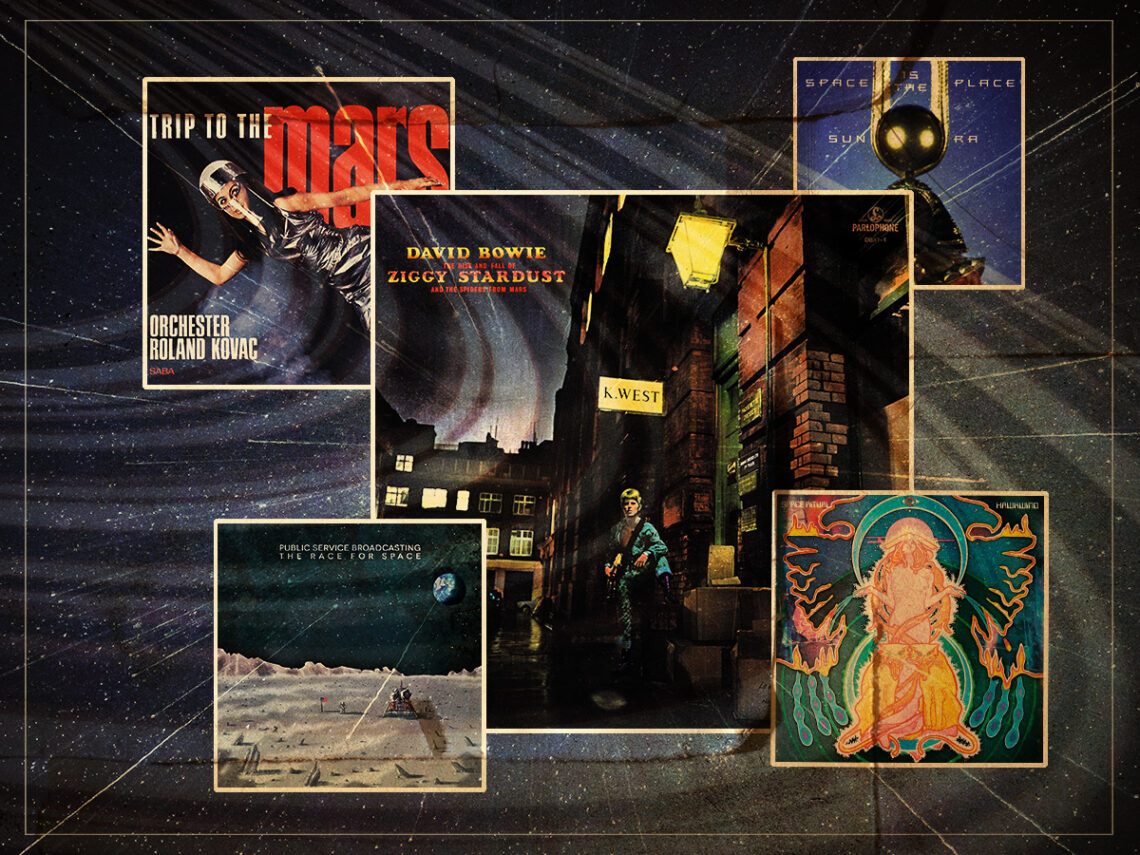
“Ground control to Major Tom”: Five albums inspired by cosmic exploration

For millennia, humanity has been fascinated by space exploration. From the very first moment that a homo sapien craned its neck upwards towards the endless blackness of the night sky, ideas about space and cosmic exploration have provided a wealth of inspiration to scientists, philosophers, and, of course, artists. Musicians, in particular, have regularly demonstrated a fascination with outer space, with everybody from Frank Sinatra to Alex Turner drawing from the cosmos at one point or another.
In the modern age, space exploration is invariably linked to the Cold War. The race to reach space dominated the conflict between the USA and Russia throughout the 1950s and 1960s, with each superpower engaging in a constant one-up battle to see who could be the first to conquer the cosmos. Unsurprisingly, this led to the general public’s development of an intense fascination with space and cosmic exploration, which quickly translated into popular music and art.
At the height of the space race, for instance, David Bowie released his triumphant single ‘Space Oddity’ in 1969, which typified intergalactic interest at the time, as well as laying the foundations for the rest of his early career. Bowie was not the only person who used the themes of outer space in his art, of course. The advent of psychedelic drugs, which largely coincided with the space race during the 1960s, only seemed to bolster musicians’ ability to find inspiration in cosmic exploration and the potential of life on faraway planets.
In the decades since the United States put a man on the moon, interest in outer space has never particularly waned. Perhaps as a result of current affairs here on Earth being far from palatable, more and more people are looking to space for an artistic escape. So, join us as we revisit five of the most far-out, genre-defying explorations of the cosmos to ever grace our Earthly airwaves.
Five albums inspired by cosmic exploration:
Sun Ra – Space Is The Place (1973)
No discussion of cosmic exploration in music could be complete without a healthy dosage of Sun Ra. Space was an unavoidable influence on the American composer and band leaders, with each of his experimental jazz compositions taking on new extraterrestrial tendencies. Even his stage outfits and persona were heavily inspired by the space age; if anybody on this list could theoretically be an otherworldly being sent to Earth to share their music, it is Sun Ra.
The avant-jazz pioneer’s most overt exploration of space came on the 1973 album Space Is The Place, which blended mind-bending melodies and improvisational, sprawling compositions with Ra’s clear and obvious dedication to the cosmos. The 21-minute title track, in particular, represents the apogee of what the composer spent so long pursuing: raw, organic, free jazz, the sound of which transcends Earthly perceptions of both jazz and modern music in general.
Orchester Roland Kovac – Trip To Mars (1968)
Sticking with the world of jazz but going for a much more overlooked figure, Austrian pianist and composer Roland Kovac flirted with the idea of space exploration back in the 1960s. Releasing Trip To Mars in 1968, only a year prior to Neil Armstrong taking that giant leap for mankind, Kovac provided a kitsch, lounge-jazz take on the idea of intergalactic travel. Including tracks like ‘Blue Dance’ and ‘Milky Way’, the album almost sounds like it was created for a retro-futurist travel agency offering package holidays to the Red Planet.
Although, upon its initial release in 1968, Trip to Mars did not have the same impact as some of the other albums included in this list, its cult following among devotees of obscure lounge jazz and exotica has led to a long-awaited resurgence in popularity of the album. If you are looking for a record that captures the excitement and modernism of the space race at the time when it was reaching its ultimate peak, you need to look no further than this gem by Roland Kovac and his orchestra.
Hawkwind – Space Ritual (1973)
The impact of psychedelic substances on artistic renditions of space exploration cannot be ignored, particularly in the case of space rock progenitors Hawkwind. From their formation in 1969, at the tail end of the hippie counterculture revolution, the Ladbroke Grove band dedicated themselves to exploring the outermost reaches of the galaxy through diverse, long, psychedelic rock and roll records. This cosmic manifesto is best exemplified by the 1973 live album Space Ritual, recorded in Liverpool a year prior.
Although the setlist largely comprised tracks from the Doremi Fasol Latido album, the live recording adds an entirely new layer to the all-encompassing space rock experience of Hawkwind. An 87-minute continuous performance, accompanied by a short sci-fi story and tales of intergalactic travellers in suspended animations, Space Ritual is a fantastic introduction to the weird and wonderful world of Hawkwind. Recent reissues and expanded editions have only added to the psychedelic, otherworldly experience of this record.
Public Service Broadcasting – The Race for Space (2015)
Going down a more factual, historic route, Public Service Broadcasting have been adept in providing a soundtrack to a range of interesting topics from throughout history. Perhaps their most accomplished effort was 2015’s The Race for Space, which runs through some notable moments in the battle to conquer the cosmos, including Yuri Gagarin becoming the first man in space and the Apollo 11 moon landing. Punctuated by audio clips from the period, including a rousing speech from former President John F. Kennedy on the opening track.
While this stunning concept album might not be as imaginative or psychedelic in its exploration of space as, for instance, Sun Ra, it provides an unparalleled musical and historical account of the Cold War-era space race, reflecting the real-life realities of space exploration, warts and all. All major space-based events from Sputnik to the end of the Apollo programme are covered expertly here by the London art rock outfit.
David Bowie – The Rise and Fall of Ziggy Stardust and the Spiders From Mars (1972)
Bowie immersed himself in ideas of the space age during the 1960s and 1970s, first through his breakout single ‘Space Oddity’, which paved the way for future explorations, notably on the 1972 record The Rise and Fall of Ziggy Stardust and the Spiders From Mars. Seeing the Brixton-born songwriter take on the persona of an all-powerful alien sent to Earth to share his glam rock mastery, the album is a masterclass in songwriting, which also led Bowie to adopt his first real alter-ego, Ziggy Stardust.
Within the context of the album, the androgynous alien travels to Earth to warn of a foreboding apocalypse, providing hope as the saviour of the planet before falling as a result of his own inflated ego. Both the album and its stand-out single, ‘Starman’, came to define the glam rock period of Bowie’s discography, often – and correctly – cited as his most prolific and inventive period as a songwriter and artist. In many ways, The Rise and Fall of Ziggy Stardust and the Spiders From Mars is the definitive album of space exploration, capturing the otherworldly persona of the songwriter through the medium of a cosmic concept record.
