


How did the space race infiltrate pop culture?

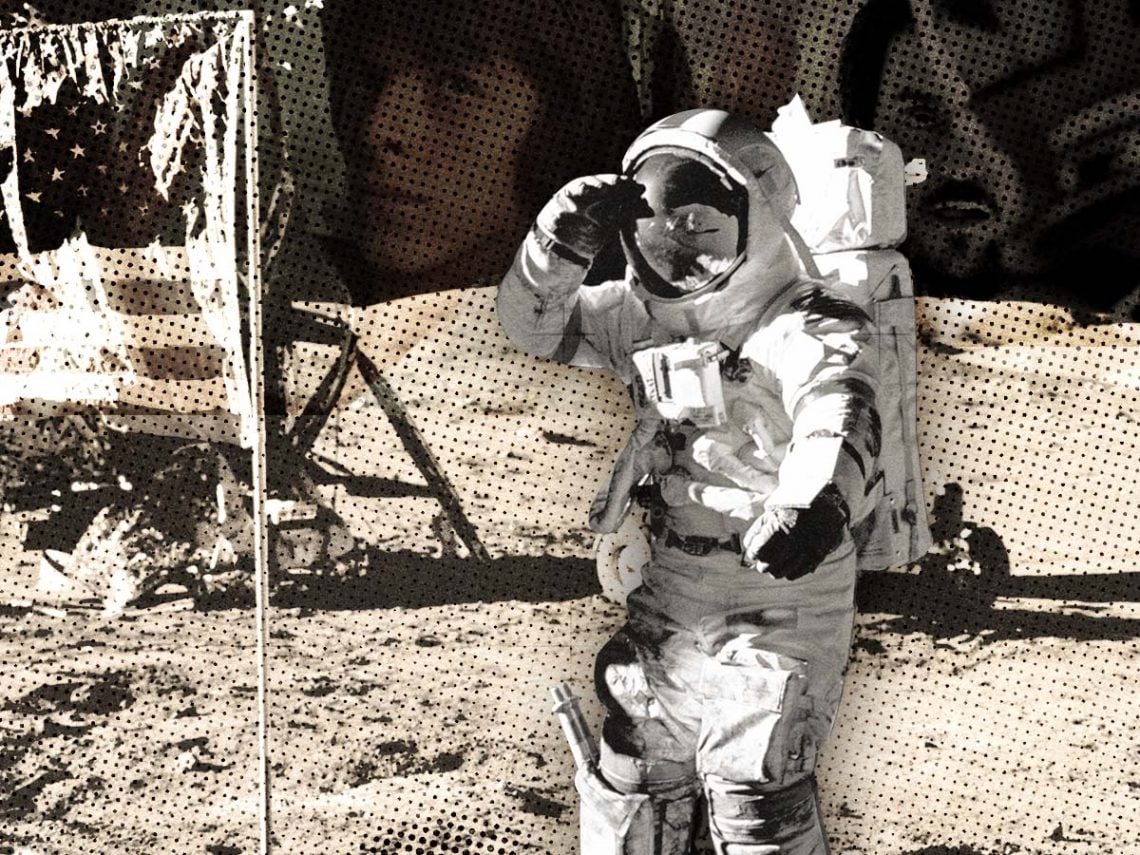
Beginning in the mid-1950s, the Soviet Union and the United States engaged in a 20-year race to achieve superior space exploration. The Soviet space program successfully launched the first artificial earth satellite, Sputnik 1, in 1957, and one of their cosmonauts, Yuri Gagarin, became the first man to enter space four years later. By 1969, American astronauts became the first humans to land on the moon in what was a significant turning point in history.
With seismic cultural events taking place, people were left questioning the potential of space travel and inhabitation in the future. Both excitement and fear were prominent as the two superpowers raced to explore space, which ultimately bled into pop culture. From interior design and fashion to film and music, artists and designers channelled their feelings towards space exploration into their work. This pioneering era was exhilarating for many, marking an unprecedented move away from post-war gloominess and traditionalism. You only have to look at the space-inspired fashion that took the 1960s by storm to see how technological advancements affected a new generation of creatives. Fashion designers such as Andre Courrèges, Pierre Cardin and Paco Rabanne incorporated futuristic elements into their clothes, such as metallic headgear and chainmail dresses.
The streamlined, space-age aesthetic soon made its way into cinema and television. Most prominently, Stanley Kubrick’s groundbreaking 1968 film 2001: A Space Odyssey depicted space travel in style. Yet, his film isn’t so optimistic about technological advancements; instead, the director fears that our progressions into new territory will destroy us. In the movie, HAL, a supercomputer aboard a voyage to Jupiter, becomes sentient and kills human crew members. According to David Schwartz, the chief curator of the Museum of the Moving Image in New York, 2001: A Space Odyssey “was really the most ambitious space travel movie to come out of the 1960s. And Kubrick himself was really in a space race with NASA. He worked on this film for years. And it was very important to him to get his movie into the theatres before we actually landed on the moon.”
Schwartz described the film as representing “this new kind of cosmic vision. It was a very technologically advanced movie.” Alongside 2001: A Space Odyssey, the 1960s harboured plenty of other space-themed movies, such as Barbarella, Planet of the Apes, and Countdown, as well as heaps of sci-fi B-movies. However, Schwartz argued that one unlikely man inspired the space-themed media phenomenon before the Soviet Union’s Sputnik had even launched – Walt Disney.
According to Schwartz: “What Disney did that was really important was he teamed up with the scientist Wernher von Braun, who was really the most prominent scientist of the United States and was trying to promote the idea of space travel. Disney had something to promote himself, he was trying to build Disneyland theme park in California. And so in 1955, they teamed up and created a TV show called Man in Space.” Disney’s portrayal of space travel represented the idea of outer space as “this frontier that was really just an extension of the west and this whole idea of American expansion.” With increased technological advancements, space travel became the height of modernity.
But it wasn’t just cinema and fashion bearing the influence of space exploration. In music, early electronic instruments such as the theremin were being used to create space-inspired sounds, which composers such as Bernard Herrmann adopted for soundtracks such as The Day the Earth Stood Still, all the way back in 1951. In the early 1960s, the Doctor Who soundtrack encapsulated people’s perception of space sounding electronic and metallic. Many jazz musicians were inspired by the space race, such as Sun Ra, who described his music as “cosmic jazz” and claimed to come from Saturn. Meanwhile, many British bands, such as Pink Floyd, also channelled interest in space via psychedelic sounds.
However, one of the most well-known songs to emerge from the Space Race was ‘Space Oddity’ by David Bowie. The single was quickly released to coincide with the Apollo 11 mission in 1969, landing just nine days before the astronauts. The song, inspired by 2001: A Space Odyssey, follows an astronaut named Major Tom and was used by the BBC as backing music whilst covering the moon landing. That was just the beginning of Bowie’s space-inspired career – he soon went on to release tracks such as ‘Life on Mars?’, ‘Starman’ and ‘Moonage Daydream’.
By the 1970s, ‘space rock’ was its own genre – a testament to the enduring impact of cosmic travel, which represented something both exciting and terrifying. The domination of the space race completely transformed pop culture, birthing new genres, sounds and styles that are vital to the current pop culture canon.
