


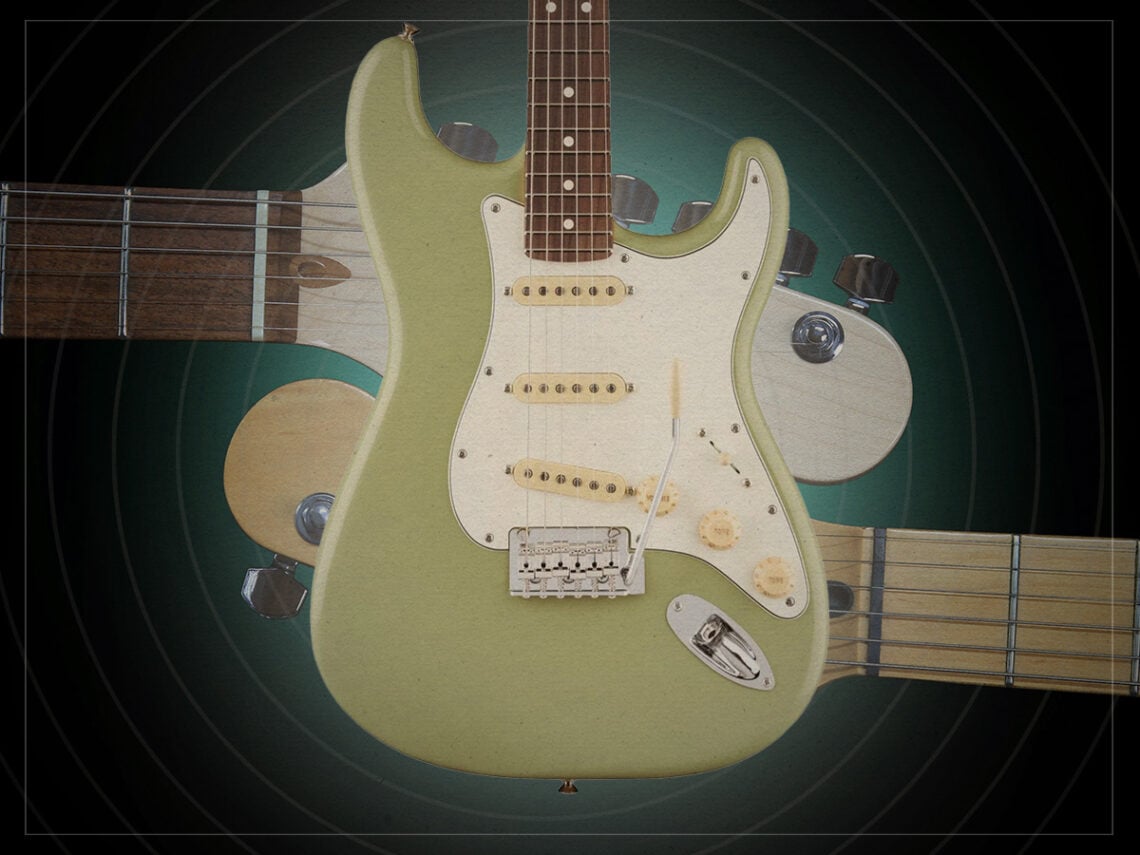
Who was the first guitarist to popularise the Stratocaster?

An enduring symbol of rock and roll rebellion, used and abused by everybody from Jimi Hendrix to Nile Rodgers, the Fender Stratocaster is not only a design classic, but it is a guitar which changed the landscape of music forever, following its initial introduction way back in 1954.
It took two long years for Fender – a company still in its relative infancy at the time – to develop the Stratocaster, and when it debuted, it was the first guitar ever to feature three pickups, which – any guitar player will tell you – was a huge step forward. Perhaps more importantly than its technical aspects, though, the Stratocaster looked cool. During the black and white age of the mid-1950s, nothing looked quite as new, exciting, or inherently revolutionary as the Strat. It is no surprise that it came to dominate the rock airwaves.
Exactly who was bestowed with the honour of being the first person to ever play the Stratocaster is debated, but the likelihood is that it was between Leo Fender and Freddie Tavares, both of whom were core components of the team that developed the instrument. Meanwhile, the first recording artist to adopt the model was Eldon Shamblin, the king of Western swing jazz and one of the very first people to introduce the electric guitar into that scene.
Shamblin’s output, while certainly important, hardly had the widespread, global appeal that would popularise the Stratocaster as the weapon-of-choice for rock and rollers, though. Indeed, if you look at the guitarists who ushered in that first age of rock and roll, none of them were holding Stratocasters.
Chuck Berry, as the prime guitar hero of that age, seemed glued to his Gibson ES-355, while Elvis’ axeman, Scotty Moore, also opted for that particular brand. Meanwhile, Bo Diddley had his own homemade guitars, which formed an entirely different kettle of fish.
Bizarrely, then, the Fender Stratocaster struggled to gain any kind of foothold in the early rock landscape, despite being arguably the perfect instrument for the genre. Without the pioneering efforts of one man, the model might have faded away into obscurity, never making it into the rock mainstream and depriving a litany of all-time greats of their signature sound. That man, of course, was Buddy Holly.
One of the greatest rock songwriters to ever enter a recording booth, Holly completely changed the game during the late 1950s – not just as a result of his incredible discography, but also as a result of his relatable image, and while otherworldly figures like Berry or Muddy Waters might as well have been on a different planet, as far as young musicians like Eric Clapton or Keith Richards were concerned, Holly, with his youth, spectacles, and Stratocaster, was certainly within reach.
During his tragically short career, then, Holly spawned an entire generation of future guitarists and songwriters, all of them aiming to mimic the same sound and image as their ultimate hero – a core part of that image, of course, was Holly’s famous Fender Stratocaster.
If any one person popularised the sound and image of the Stratocaster, it was Buddy Holly, who was rarely seen without the distinctive contours of the solid body in his palms. More prevalent Strat devotees emerged in later years, of course, with both Hendrix and Clapton being key advocates for the instrument, but it was the pioneering rock stylings of Holly which first opened those essential floodgates.
