


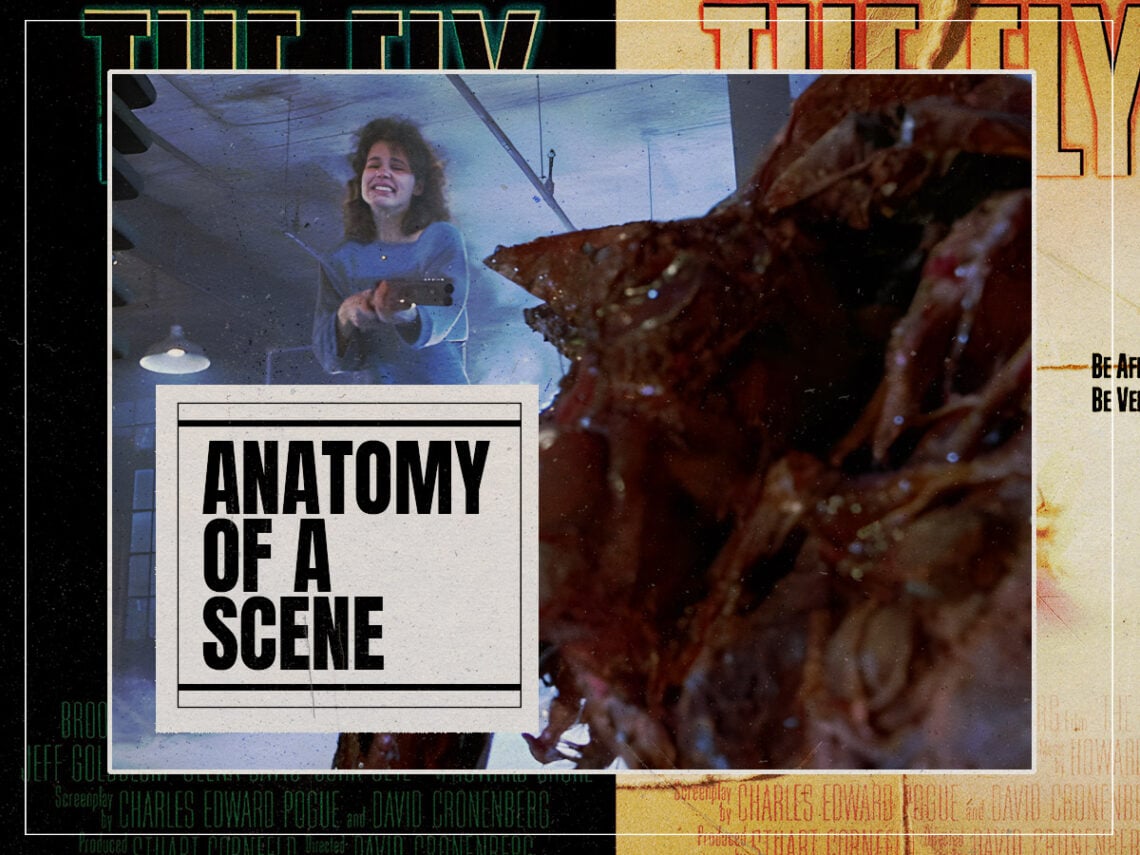
The horrific final moments of David Cronenberg’s ‘The Fly’

As far as filmmakers go, no one does the hideous and abhorrent quite like David Cronenberg. The master of body horror would surely take that as the compliment it’s meant to be.
And so, when we’re looking for perhaps the most ghastly ending in film history, it’s no surprise that it’s Cronenberg who delivers. His 1986 adaptation of George Langelaan’s short story The Fly ends with a scene which somehow leaves us utterly revolted, traumatised, amazed and moved in equal measure.
Apparently drawing inspiration from Ingmar Bergman’s only real horror film Hour of the Wolf, Cronenberg wanted to make a version of The Fly which demonstrates the emotional anguish of the titular character as physically as possible.
The previous 1958 film adaptation of Langelaan’s story remains faithful to it in showing an immediate physical transformation in the scientist who mixes his atoms with a fly’s. Cronenberg, on the other hand, altered the story to make the transformation a gradual synthesis of human and fly. Or “Brundlefly”, as Seth Brundle, the scientist undergoing the transformation, calls it.
This way, we get to know the character, played by Jeff Goldblum, throughout the course of the film. As Cronenberg told Time Out at the time, he is “crazed and visceral and funny and intellectual and sinister”, all at once. Above all, he is human, but we see his humanity gradually being taken away from him as the fly takes over.
And so, when it comes to the final scene, it packs the emotional punch internally that its vomit-inducing prosthetic effects do externally.
The role of Geena Davis in The Fly
We’re invested in the relationship between Brundle and Geena Davis’ character Ronnie. So when Brundlefly, with what little human facial features he has left, grabs Ronnie and makes his final dark joke of the film that he’s “more human” with her than he is “alone”, it’s as poignant as it is horrifying.
He begins to pull her towards one of the telepods that merge him with a fly. As she pushes him away, his jaw comes off altogether, and the hand holding her sprouts claw-like fly hairs. His limbs then mutate completely, and, most gut-wrenching of all, the rest of his face splits open to reveal a fly head.
Brundlefly throws Ronnie into the telepod and seals himself in the other. There is a shot of his fly head inside the telepod with its labellum and mouth parts animated to appear terrifyingly real. Goldblum had something to do with this, adding some of the twitching movements that typify his performance throughout the film to puppeteering directions for the rubber fly head model.
Just in time, Ronnie’s other love interest, Stathis, manages to shoot the wires connecting the two telepods, disabling the one containing Ronnie. This intervention feels like a bit of a cop-out to save Ronnie. However, it does leave us as the audience at least secure in the knowledge that, ultimately, only Brundle will truly suffer from his dangerous science experiment.

What happens to Brundlefly in the ending of The Fly?
Because Brundlefly can’t get out of its own telepod in time, it transforms into an even more hideous, disfigured cross-mutation combining its own atoms and the telepods. The trapped, despairing, inhuman but still-living cry that Goldblum emits from beneath a full rubber body suit as this new monstrous mutant falls out of the telepod is almost as horrific as the creature itself. A flesh-coloured metal cable trails behind its body, an additional detail that just elevates the physical horror that little bit extra.
The final shots mirror the climax of Kurt Neumann’s 1958 film version, as the monster Brundlefly has become asks Ronnie to put him out of his misery. Except somehow, Cronenberg’s telepod-fly hybrid involving a rubber model controlled by a puppeteer moves us more. Close-ups on the monster’s oversized pleading eyes as it moves the gun barrel to the side of its head underline the human tragedy of the situation.
When Ronnie shoots, the explosion of gore that results tests our stomachs to the limits. Never has the anatomy of any scene featured so much anatomy.
