


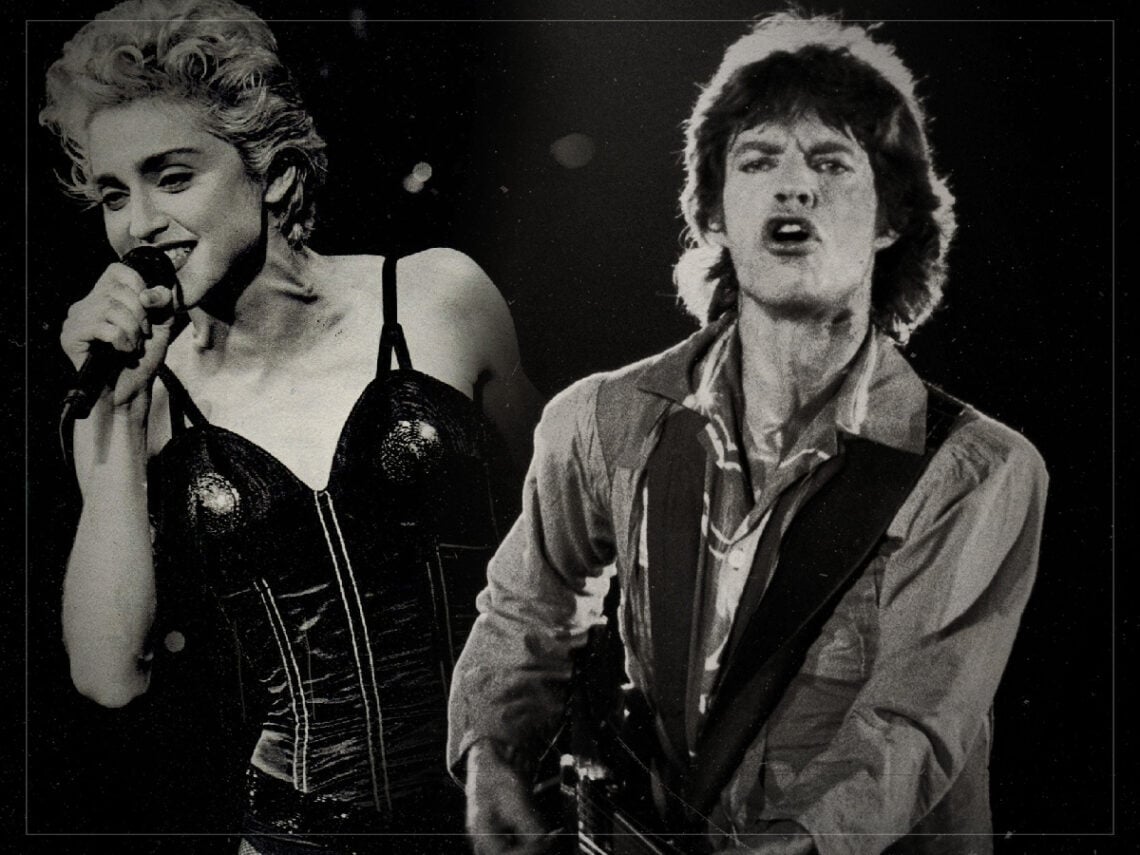
The feud between Madonna and Mick Jagger: “Feeling my threat”

No matter how visionary they are, no matter how talented, no matter how iconic, female pop artists always ended up being characterised as dumb by someone, and in the 1980s, it was Madonna who was underestimated.
In an industry that is still so historically male-dominated and oriented, women are still scrapping for respect in the music world, and hence, at the root of this ongoing issue is simply misogyny, with the dividing lines between pop and rock often feeling like the frontlines of this. Male rock stars, especially, are treated as musical gods, and when reflecting on the best artists of all time, people will likely rattle off a list of several men in rock before they land on a woman, as the mythologised world of ‘sex, drugs and rock and roll’ is built in the shape of the male ego.
On the other side, women in pop, despite being some of the most defining artists in all of musical history, always end up being put down. In recent times, Charli XCX wrote about exactly that, stating on her Substack, “Another thing about being a pop star is that you cannot avoid the fact that some people are simply determined to prove that you are stupid”.
Charli’s theory is that this all comes down to people who want to be seen as going against the masses and standing out from the mainstream, explaining, “Sometimes people don’t like to be lumped in with general consensus, they like to go against the grain of public opinion and that’s when a totally opposite defiant stance is born,” thereby stating how that turns into this historic bashing of female artists who typically capture that mass-attention. “Instead of ‘she’s a sex symbol’, it becomes, ‘she’s a whore’. Instead of ‘she’s anarchic’, it’s ‘she’s a fucking drug addict’. Instead of ‘she’s intelligent’, it’s ‘she’s pretentious and said a whole load of nothing’, and so on and so on,” she elucidated.

In the 1980s, there was no greater example of that than Madonna; it’s hard to think of a pop star on her scale as she truly epitomises that power, taking one name and making it a phenomenon, but musically, she also perfectly exemplifies that limiting and minimised view of ‘pop’ that a lot of music fans indulge in.
They try to see her work as stupid or vapid or simplistic, as if it could never dare to live up to the complexity of rock, but when listening to her evolution from ‘Borderline’ to ‘Like a Prayer’ to ‘Ray of Light’ and beyond, any suggestion that Madonna is musically weak or inferior falls completely flat as she was, and always has been, an innovator.
That’s why it didn’t really touch the surface when Mick Jagger randomly started bashing her in the ‘80s. His words were harsh, though, which said that she was merely “a thimble of talent in an ocean of ambition”, and that she was characterised by a “central dumbness”, noting at one point that she sounded like “Minnie Mouse on helium”.
“I got some thoughts I wouldn’t say on television,” Madonna relayed in response, following it up by saying that there wasn’t even a need to forgive Jagger because she claimed “I don’t really think he felt that way when he said it”.
Given that realistically, Jagger was also a pop star by the 1980s, and that The Rolling Stones’ hits often veered far into the realm of pop, the singer likely didn’t feel that way at all, but was perhaps a touch jealous as Madonna became the ultimate star of the moment. Given also that she had spent her youth dating Jean-Michel Basquiat and revolving around New York’s cool art scene, the very one Jagger had spent the late 1970s trying to cosy up to with Andy Warhol, the jealously was likely palpable.
“I think he was feeling my threat,” Madonna said back in the day, and it’s all she needed to say as Jagger’s comments were as eye-roll-inducing back then as the classic ‘dumb’ argument about pop music remains today.
