


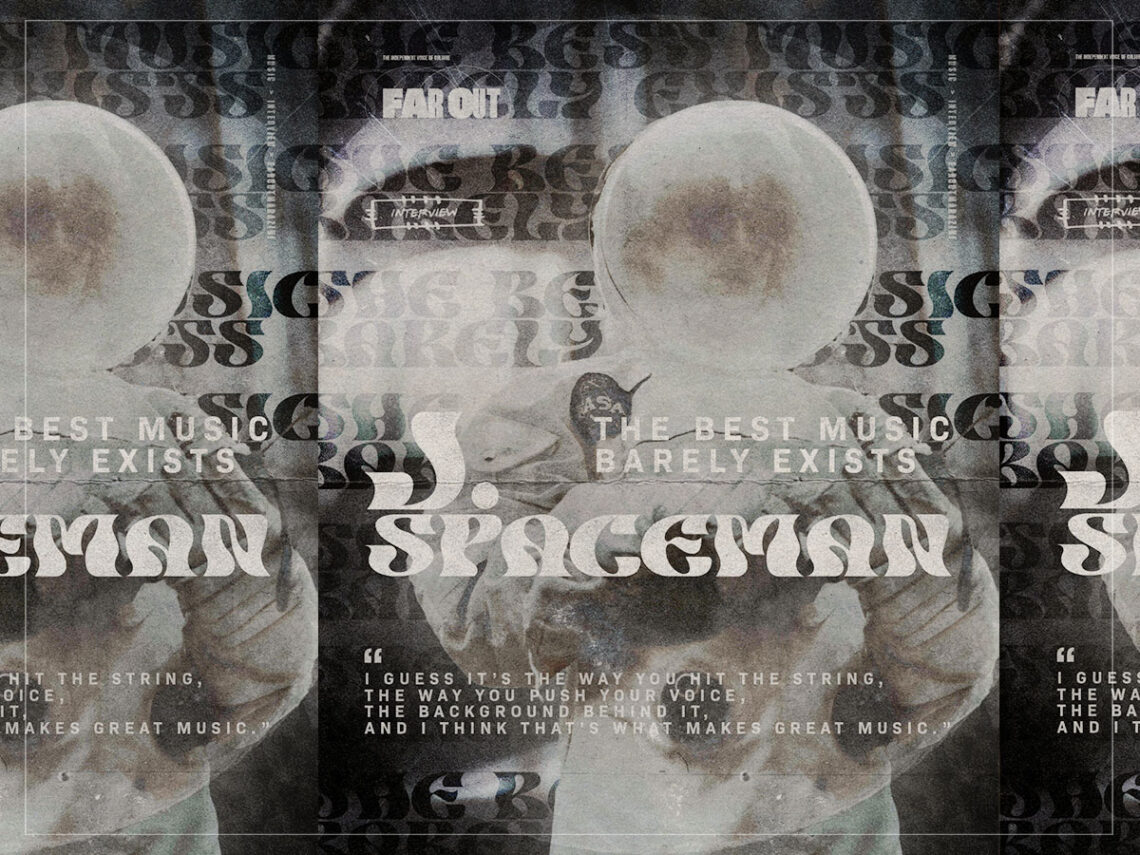
The best music barely exists: Far Out with J Spaceman

“Spaceman, are your dreams three sizes too big?” It’s an ambiguous question, and in 1986, when it was posed, if you were to take it literally, it was aimed at very few people; however, to music lovers, outcasts and the curiously minded, nothing could have been more appealing. Those estranged punters walked through the venue door that night expecting something outlandish; what they were actually privy to was the future of music, experimental and languishing, and the most beautiful thing? It barely existed.
At the heart of the question was Spacemen 3, and the heart of that was J Spaceman (real name Jason Pierce). Whether you’re a fan of his, the band, or his later musical outfit, Spiritualized, so long as you partake in even a shred of modern music, you’ve dabbled in his work. Those undersized dreams were never meant to be slept in, as he made music that was constantly questioning what music could be, both as a sonic and a physical medium.
In our interview, one of the first things we discuss is an album that has since been released, Stranded In Canton, an unofficial soundtrack to William Eggleston’s movie of the same name. The original film was released in the 1950s, J’s soundtrack wasn’t recorded until 2015, and even that wouldn’t see the light of day until the 2020s.
“We were asked to put it together, but I kind of knew that what we had was something special, which was the reason why I thought it should be recorded, like, multi-tracked,” said J. “In the end, it wasn’t multi-tracked; it was just recorded into a stereo, and we kind of made the best of that when we remixed it, but nobody would buy it, you know?”
He continued: “We kind of knew it was something special; it was just, I guess sometimes things slip through […] There’s so much else going on, I guess, and it just kind of slipped through. I heard it by accident about a year ago and said, ‘Look, we should put this out’.”

The album’s concept seems somewhat out of character for J. This is a man who found melody in electric razors and made a career out of persistently pushing the boundaries of sound. When listening to his work, regardless of what point in his career he’s at, it’s clear that convention isn’t something he bothers with. Any creative restrictions seem to have been discarded, and therefore, the plight of moving images, beats to hit and tones to adhere to would seem like a burden. After speaking to J, though, his ethos becomes clear: it’s not about intentionally being experimental; instead, music is best when it barely exists in the first place.
“The things that slip though, they don’t age, it doesn’t demand that it’s released now […] Other things seem to have one moment, you know? If they’re not released on the coattails of something else that’s similar, they’re going to lose any chance they have in the world,” he said, “But I knew that [Stranded In Canton] was always special […] A lot of things rely on being part of a fashion or trend or whatever, and this is kind of outside of that.”
This ethos isn’t new. Some music was always meant to be: a marketing plan is put together before a tracklist, a name is decided upon before a theme, and the intention of the record is to capitalise on a working formula. This kind of music has never been what J set out to make; he likes music that you can count yourself lucky you’re hearing, music that was made in the heat of the moment, has emotion behind it and that only ever came to fruition because of a serendipitous set of circumstances.
In an interview with Uncut, he said something similar when discussing the Spaceman 3 album Dreamweapon. The record was made because somebody brought recording equipment to their show. What you hear is what was created within that moment, not replicated since, by themselves or anybody else. J said it’s one of his favourite albums because of all these reasons, or as he put it, it exists “by the skin of its teeth”.
He elaborated on this further: “So much music is like that. Most of what’s considered the start of rock ‘n’ roll and the whole recorded history of Western music is just somebody with an interest in recording folk music. Like, all of the early Muddy Water’s recordings, all of it, it relied on somebody’s love of the medium of recording, more so than the music itself,” he said, “It’s the randomness that allows it, almost outside of the commercial realm of music, where people are making records specifically to make money.”
He continued: “I was talking to someone about music last night and this idea of songs, the great songs, and how they exist outside of themselves… I disagree. Otherwise, every cover version would be fantastic, every cover version would be the greatest thing you’ve ever heard, if the song itself was that good, but that’s not the case. I think with all great music, it’s the intention behind it. I can’t explain. I guess it’s the way you hit the string, the way you push your voice, the background behind it, and I think that’s what makes great music.”
When you stop thinking about how something actually sounds and start thinking about the intention behind those sounds, you begin to realise why J has had such a significant impact on modern music. Looking back at that first poster and those punters who believed they dreamed too big, what was special about the music Spaceman 3 made was the fact that people were bold enough to make it in the first place. It’s not a sound; it’s a philosophy, one that tells artists the only boundaries that surround them are those that they put there themselves. With that in mind, it’s hardly surprising that J’s music is still widely celebrated.
Of course, that wasn’t always the case. As well as releasing Stranded In Canton, J was beginning to start rehearsals for Spiritualized’s upcoming gigs, which mark the 30th anniversary of their debut album, Pure Phase. Scorned at the time, the album has aged like the finest of wines, and people are lining up to take a sip.
“I haven’t really been monitoring it,” said J, “I think in a way it was one of those that slipped through, it never really got any kind of press. When we were doing Ladies and gentlemen [we are floating through space], there were so few shows we could do because they cost so much, it was a 30-piece band. We talked about that at the time, like, ‘Yeah, of course we can do Ladies and gentlemen, but Pure Phase was always the one that shimmered, it was the one that feels like a soundtrack.”
J knew the album was something special, and once again, it was the by-product of sounds that could only come together by chance. The listener hears two separate mixes when they play the record, meaning things don’t often align, but the by-product of that is music in its rawest form, something which is equally perfect and flawed simultaneously.

“It was two records, there was a couple of attempts to mix it. In the end the decision was made to use both mixes, so there’s one mix in the left channel and another completely different mix in the right,” explained J. “The words are different; some of the backing vocals we’d done between the two mixes changed […] So some things only occur on the left side, I don’t know which side, but some things occur on one side that don’t occur on the other.”
Despite J’s enthusiasm for the record, some of the initial negative feedback it received would have been a blow to the most rigid of egos. “I was really proud of it, and then just to have it slip through… I mean, the reviews were very poor; I think it got a one out of ten in one of the nationals at the time,” he said, his voice dropping at the memory, “It seemed like a huge disappointment at the time, to put that amount of work into something that I still think is beautiful. I’d describe it as driving as fast as you can through rain; it feels like the most beautiful, beautiful-sounding record.”
Hindsight is a wonderful thing, but these days, when you listen to the experimental music being made and the overlapping of genres that occurs throughout the industry, it’s all a by-product of an ethos championed by J. The ones that slip through the cracks are timeless, but it’s not because of how they sound; it’s because of the fact they exist in the first place (by the skin of their teeth, sure) but by having them come into being, you are permitting other artists to also experiment beyond what might sell. Regardless of this clear impact, J is reluctant to acknowledge any kind of influence he might have had on music, no matter how big or small, as he stares at the endlessness of sound and has an issue seeing where he fits in it.
“I think the world would get on fine if it wasn’t there. There’s so much music out there, people would just find something else to fall for, or to be moved by,” he said, “It’s a weird thing music, isn’t it? Because it’s vast. As soon as you dig through, you find something else. I used to think things like dub or Northern Soul, that once you heard the classics, the kinds of things that were at the top of the pile if you like, the rest of it got weaker, and the further you dug into it, the weaker the results, but it’s not the case.”
He concluded, “I can still find beautiful bits of music and think ‘How the hell have I not heard this before?’ So, yeah, I don’t know, I don’t really know how to answer that.”


Never Miss A Beat
The Far Out New Music Newsletter
All the latest New Music from the independent voice of culture.
Straight to your inbox.