


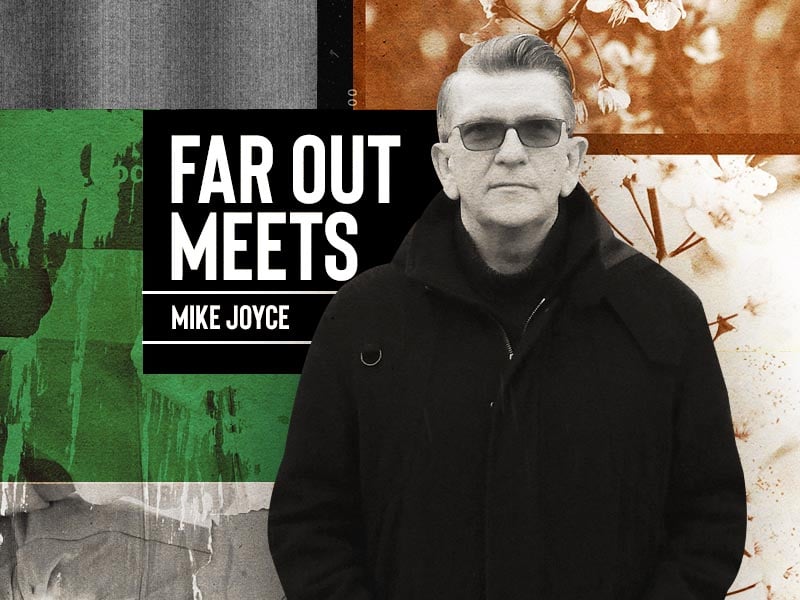
Far Out Meets: The Smiths’ Mike Joyce discusses Morrissey, Marr and modern music

The Smiths’ candle was brief yet so pivotal in the progression of popular music throughout the 1980s and beyond, that it would be difficult to picture the modern musical landscape had they never existed. The band resembled both continuity and originality at a time when the new romantics were trading guitars and toms for synthesisers and drum machines. The Smiths held the flame for guitar-based rock music, but with influences so vast and varied, very few could decipher a tangible link to any prior rock artists.
This fresh foursome from Manchester were going places from the off. Morrissey, the vulnerable, twirling poet with a bunch of flowers protruding from the back of his Levi’s, had found the perfect conduit to express the palpable angst of post-industrial Manchester. Meanwhile, Johnny Marr, the innovative guitarist and genius composer, found his niche in cutting against the grain of an era as one half of a decidedly peculiar songwriting partnership.
Last week, I had the enormous pleasure of speaking to Mike Joyce, the drummer and backbone of arguably the most important band of the 1980s. Alongside bassist Andy Rourke, he provided the vital structure and punctuation for Marr and Morrissey to adorn with intriguing themes and embellishments.
After the customary technical difficulties, I finally found Joyce’s voice on our video call at 10:30 on a Wednesday morning. The former Smith told me he had been to see John Cooper Clarke and Mike Garry at New Century in Manchester the evening before and was feeling a little hungover. “They were both absolutely brilliant,” he beamed. “I got VIP, free bar and all that. It’d be rude not to… So the Champagne was flowing, and it was a bit of a late one. But apart from that, I’m feeling great!”
One certainly couldn’t blame Joyce for having a big one on a Tuesday night. Frankly, I would give my dominant arm for a few bottles of bubbly with John Cooper Clarke. All the same, a Wednesday morning with a strong cup of tea, all limbs intact, and the legend that is Mike Joyce was a more than agreeable substitution.
Beginning, quite logically, at the beginning, I asked Joyce who or what had spurred his dream to become a drummer. “I remember playing with two files in a metal work room when I was about 13-14 in school,” he recalled. “I remember really enjoying it. And getting told off, obviously – ‘Put those files down!’”
After this industrial introduction to percussion, Joyce found his first drumming hero. “Then I went to see Buzzcocks play in Manchester when I was about 14-15, and that was it. I fell in love with the whole thing because it was the first gig that I’d seen that I was absolutely blown away by. And it was the first gig that I’d seen where I was completely transfixed by John Maher and his playing.”
“I was transfixed by everything actually, the fact that he had a red kit, the fact that the toms were in a certain position and his cymbals were all flat playing cymbals, and it just looked like a fantastic… visual,” Joyce continued. “I also obviously fell in love with the music, as well, that they were producing. So yeah, that was a catalyst. I think for me to go and hound my mother for a little Beverly drumkit.”
After a few loud years at the Joyce household, the young drummer found his knack for beat-keeping with a local band called The Hoax before falling onto the radar of Marr and Morrissey in the early 1980s. Having released four highly influential studio albums in just five years with The Smiths, I was interested to find out what Smiths track Joyce enjoyed playing the drums to the most.
“I don’t actually play a lot of Smiths tracks [these days],” Joyce admitted. “But I suppose I did some work with Craig Gannon, the ex-Smith, for a short while, and we did play a couple of Smiths tunes. I think it would have to be [1984 single] ‘How Soon Is Now?’, just for the groove.”
“For a lot of The Smiths tunes, I wouldn’t say they’re very complex, but I don’t really sit on a groove with a lot of them because there’re a lot of guitar changes. So, in terms of sitting on the groove, ‘How Soon Is Now?’”, he pondered. “In fact, Donald Johnson – one of Manchester’s finest drummers, from A Certain Ratio – he said to me, about that drumbeat, ‘Mike, I don’t think you realise just how cool that drumbeat is.’ I said, ‘Well, you know, I just played drums for what I thought worked for the track, and that’s all I can do.”
Agreeing that ‘How Soon Is Now?’ has a fine rhythm, I was intrigued to know whether it was Joyce’s overall favourite from his Smiths days. “No. And I’ll use that old adage of, you know, ‘Which is your favourite son or daughter?’” Joyce said, highlighting the difficulty of the question. “I think there’s been certain moments during The Smith’s career that I’ve just thought, ‘Wow, this is it!’ (…) If push comes to shove, I think it has to be ‘Hand in Glove’, just because that was the first time I’d heard The Smiths on record. It was the first time we’d all heard The Smiths.
“Obviously, we’d heard ourselves in the rehearsal room and playing live, but it’s just not the same as listening to the record. Because obviously, Johnny could put a harmonica on, Johnny could put an extra guitar on, which we couldn’t do in rehearsals or at gigs. It wasn’t run-throughs, and it wasn’t overdubbed.”
Joyce added that The Smiths’ debut single also introduced the band’s unique style. “It doesn’t have a style,” he said. “It doesn’t have a genre. You can’t pigeonhole it. [Late BBC DJ] John Peel said the same thing. When he first heard The Smiths, he couldn’t work out for the life of him who our influences were. So, yeah, ‘Hand in Glove’, just because it sounded pretty magnificent, if I may say so. I’d never heard anything like it, and it sounded pretty good. So, I suppose ‘Hand in Glove’ is my favourite-ish.”
Joyce made the headlines earlier this month after announcing charitable plans to celebrate the 35th-anniversary of The Smiths’ fourth and final album, Strangways, Here We Come. As patron of the Manchester-based charity, ‘Back On Track’, Joyce decided to part with his original silver disc, which was issued back in 1987 to celebrate UK sales of over 60,000 copies.
In our conversation, Joyce told me he has been a patron for ‘Back on Track’ for about “four or five years.” “What can I offer that can help in some way?” He thought to himself when asked to become a patron. “I hadn’t heard of the charity before they asked me to become a patron. So I thought, well if I can try and make people aware of its existence, I suppose that would be a starting point.”
Over his first couple of years as a patron, Joyce helped to raise awareness of the charity on social media and attended some of its open days. ‘Back on Track’ raises funds to help people to manage drug and alcohol addictions, lead a crime-free life, improve their mental health and find stable housing.
During visits to the charity’s open days, Joyce could see first-hand how the charity looks to help struggling communities in Manchester. “It was pretty upsetting sometimes because some of these people have been in very desperate situations. Whether it’s, through their own wrongdoing or not, whether they’ve been in abusive relationships or had problems with drugs, alcohol or mental health.”
“I was listening to these testimonies, and I just thought, ‘My goodness, it’s so brilliant that they’ve mustered enough courage and willpower to want to get out of the situation that they’re in. So, the first thing they do – or ‘Back on Track’ do – is try to get them back on the ladder of society… of things that we take for granted and just accept as the norm.”
Later on, after identifying Strangeways, Here We Come as Joyce’s favourite Smiths album, I asked whether the record conjures bitter-sweet memories, given that it marked the end of the road for The Smiths. Joyce revealed that he only has fond memories of the album now there are 35 years in between. “I’ve got my peace with The Smiths, and I think we all have – speaking for the other guys here though, maybe I’m speaking out of turn – but what we’ve created between ’82 and ’87 was pretty damn good.”
“I like the fact that there’s that idea of ‘leaving them wanting more’,” he opined. “Well, maybe that’s exactly what we did because we didn’t even play it live. I think that would have sounded pretty damn good. But in terms of what we created, in terms of our legacy, every box was ticked.”
On the subject of the band’s legacy, I wanted to know how heated things got between Morrissey and Marr in the final days of The Smiths. Joyce told me that as far as he and Rourke were aware, everything was fine until Marr announced his departure.
“I think 99.9 per cent of it was kind of generated in the minds of Johnny and Morrissey. It was such a shock when Johnny said that he wanted to leave the band. Nobody saw it coming. Nobody. And then, if there would have been some fighting in the studio or sounds checks, or in hotels or gigs, then I think it wouldn’t have been such a shock. It might have been a bit easier for me to swallow that pill.”
Over the past few years, Marr has been further distancing himself from Morrissey in the wake of some of the singer’s controversial comments regarding his political and ethical alignment. I was curious to know whether Joyce felt Morrissey had become more opinionated since the ’80s and if his views had become more radical.
“He’s always said things that were pretty controversial,” Joyce remembered. “After the Brighton bombing [in 1984], I think one of his quotes was – this isn’t verbatim – ‘The only problem with the Brighton bombings was that they didn’t kill [Margaret] Thatcher.’ So, this isn’t new, these views. And I think I’ve got respect for him in terms of him saying what he thinks. Because, in this day and age, that’s a very dangerous thing to do. If people disagree with you, the pitchforks come out. But his political views are his political views. They vary quite differently from mine, kind of polar opposites, yet I have no problem with the guy. I don’t know him… I worked with him over 30 years ago.”
After revealing that he hadn’t crossed paths with his former frontman in over three decades, Joyce revealed that he “didn’t really know him” back in the ’80s. “I don’t think anybody really knows him apart from himself.”
“He’s entitled to all those views,” Joyce said, elaborating on Morrissey’s controversial quotes.
“I don’t agree with some of them, but I’ve never actually seen him sit down and explain all of his beliefs. It’s just a quote here and a quote there. But I think that’s what Morrissey does, he throws those maggots in the water for the journalists to grab hold of.
“I remember a quote from Morrissey where he said that reggae music was vile. If I was asked for my opinion on reggae music and said it’s not really for me, it wouldn’t make any copy. I don’t think Morrissey was saying that people of colour are vile; he just doesn’t like reggae. But, of course, journalists will pick up on a quote like that.”
Towards the close of our time together, I wanted to get an idea of the sort of music Joyce was enjoying these days. There was one band clearly a cut above the rest. “Fontaines DC. Absolutely in love with them,” Joyce revealed. “I went to see them live a number of years ago and just fell in love. It was the first time that I’ve had that experience since the Buzzcocks. There are a lot of great bands, but this was the one that really got me in the heart. Absolutely stunning records, stunning live… faultless, as far as I’m concerned.”
“There aren’t any bad Fontaines DC tracks; it’s just that I prefer some more than others,” he continued. “As far as I’m concerned, they can do no wrong. I’ve become a bit obsessed with them. I was quite nervous when I went to see them live because I just thought, ‘Are they going to be able to come up to my expectations after listening to the album?’ And they certainly did, more than that. So Fontaines DC are right at the top of the pile.”
“The best thing to come out of Ireland since my mam and dad,” Joyce jovially concluded.
After this comment, I recommended that Joyce should check out Just Mustard, another blossoming Irish alt-rock band that perhaps wouldn’t rival his mam and dad but could certainly give Fontaines a run for their money.
Finally, we had just enough time to look to the future. I asked Joyce whether he would find any time, amid his ongoing radio work and patronage, to get back behind the drums in a studio setting. He told me that he had recently begun working with his old friend, Rick, in a band called Love Temple.
“I’ve known Rick, who’s a guitarist, for 30 odd years,” he said. “He was living down in London doing session work, but he moved up to just five miles away from me a couple of years ago.”
Over the past year or so, Joyce and Rick have been exchanging some ideas, and having met a singer from San Francisco – whom Joyce refrained from naming – they are now looking to record some new music in the not-too-distant future. With a mystery singer thrown into the mix, this project is certainly one to keep a finger on the pulse for.
As with any good thing, our conversation flew by and reached a conclusion just as my mug ran dry. I would like to wish Mike Joyce all the best in his future endeavours, both in his charity work and music.
