


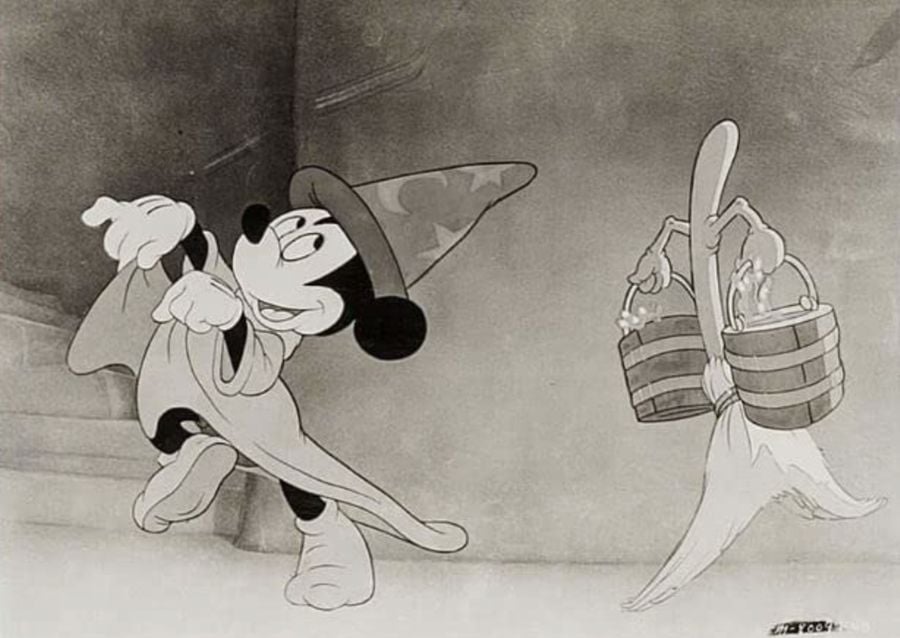
‘Fantasia’: the first film to use surround-sound

Advancements in technology coincide with that of cinema to create the most atmospheric and compelling experiences for audiences. Anything that can accentuate a film’s visuals and audio in terms of quality is always sought after, making for historical landmarks in cinematic construction and execution, such as surround sound, a feat first achieved by Disney.
Surround sound emphasises a viewing experience by enriching the sound’s depth and fidelity using multiple speakers to surround the audience. From this placement and number of devices, the audience’s perception of sound is elevated using sonic localisation, the ability to determine the direction and distance of a detected sound.
The first documented use of surround sound was for the Disney studio animated film Fantasia, the third Disney animated feature released on Wednesday, November 13th, 1940 and cites the animation as a monumental ‘film first‘. Fantasia presents eight animated segments directed by 13 collaborative directors, accompanied by classical music conducted by Leopold Stokowski and performed by the Philadelphia Orchestra.
According to Andrew R. Boone’s book, Mickey Mouse Goes Classical, the studio’s vision of the sound composition and execution included “music emerging from one speaker behind the screen sounds thin, tinkly and strainy. [They] wanted to reproduce such beautiful masterpieces … so that audiences would feel as though they were standing at the podium with Stokowski.”
The studio achieved this using Fantasound, a pioneering sound system developed by Disney. The film’s soundtrack was recorded between 1938 and 1939, after over 100 musicians gathered at California’s Culver Studios to record the initial short film, The Sorcerer’s Apprentice. Following this, Stokowski signed an 18-month contract with Disney and immediately became immersed in the richness of the studio’s sound. However, Walt Disney felt the studio’s sound system needed to be improved for his vision for Fantasia, leading to the new system’s development.
The studio’s first act was to build the illusion of sound “moving” across partnered speakers. By placing two speakers roughly 20 feet apart, the music could appear as though it was moving. After including a three-circuit differential junction network to combat volume control, Disney conquered one sound development. Next up was perfecting the difference in volume between the loudest and quietest sounds, achieved by increasing the volume during loud passages and reducing it during quiet ones, to which the dynamic range would increase.
The studio also used Togad, a device that varies the volume of played sounds by varying the amplitude of a tone. Automated mixing systems like this were the precursors of modern studios.
When adjusted for inflation, Fantasia stands as the 23rd highest-grossing film in America, despite an initial failure to turn a profit as World War II had made cuts in the European market’s distribution, showing the payoff for the studio’s extensive and focused effort. The film upholds a legacy regarding its visuals solidifying Disney’s brand and score. In 2019, it was reported that Disney+ would release a project updating Fantasia’s material and style. “It’s unclear if these will be in the form of shorts, a series or full-length movies,” What’s On DisneyPlus reported. “And what type of animation style Disney would use.”
