


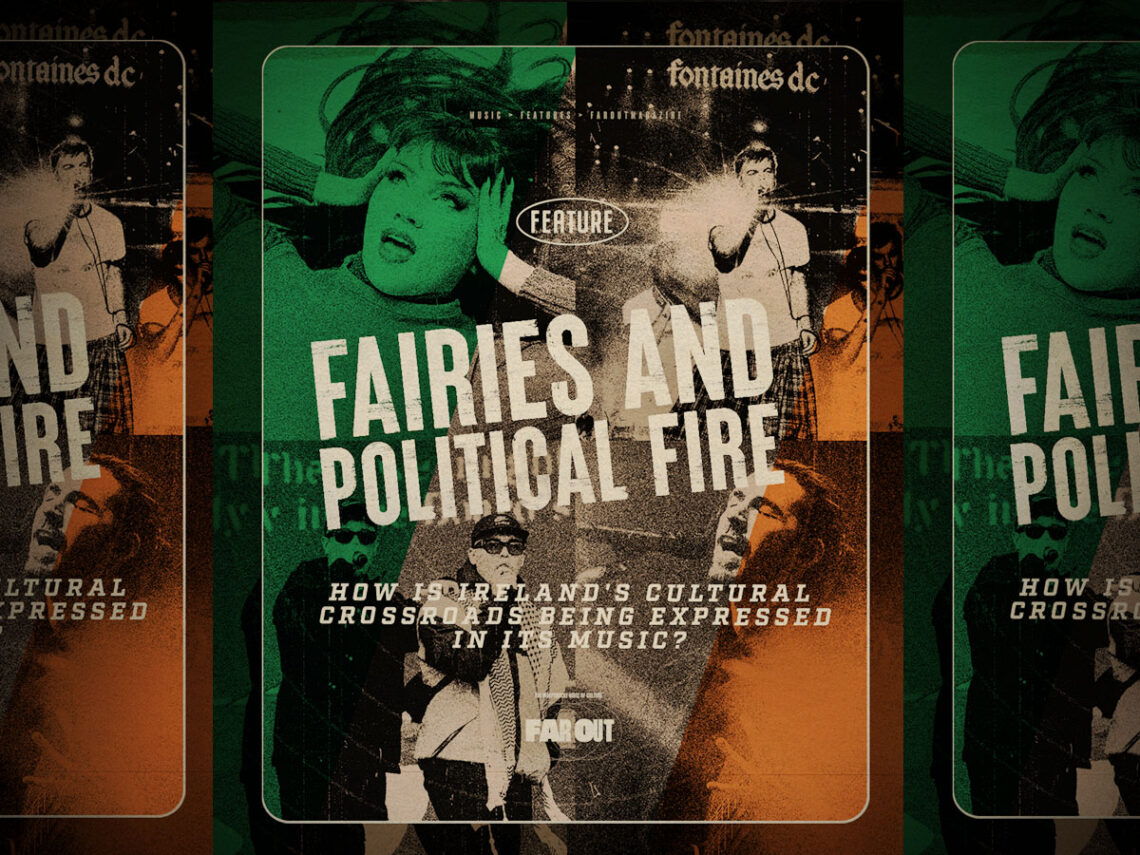
Fairies and political fire: How is Ireland’s cultural crossroads being expressed in music?

On one hand, Ireland is stereotypically painted as a mystical land of nymphs and fairies, leprechauns, nature and a cold pint of the black stuff. On the other, there’s the stark reality of politics that palpate its streets, with past events continuing to shape the functioning of its society well into the present day. It’s a contrasting portrait of a country undeniably brimming with culture, albeit from opposing ends of the spectrum.
But what also emerges from this is a rich history of music which has both represented the landscape of Ireland in all its vast, rugged glory, but is also completely unafraid of addressing the vitally important politics and history which has raised these artists from the environments they hailed from. The litany of Irish folk that persists to this day, paying homage to a deep-rooted tradition of families, kinship, and natural environment, is undoubtedly still significant, but a much fierier force is currently being paired with it.
The current landscape of Irish popular music that is taking over the charts is an interesting situation to consider. Although this has existed in equally prominent capacities in the past – taking the likes of U2, Sinéad O’Connor, The Pogues, and many others into account – the past few years have given way to a particular resurgence of Irish bands and artists commanding the mainstream, ranging from a purely radio-play shiny sonic brand, all the way to a renewed political rebellion.
At the more romanticised end of the spectrum, it’s clear that entrenched tropes and stereotypes still fuel a massive commercial machine when it comes to the popularity of Irish musicians. If it means they need to adopt an earthly look and act as if they’ve just emerged from a rugged swamp before they rocked up on stage to perform that night in order to be more appealing to a cultural zeitgeist, then they seem more than happy to do it, even if it risks harmful imagery in the long run.
The obvious offender in this respect is Hozier, and although this is not a criticism of him and his music as a whole, the brand he perpetrates does raise some questionable ideas around the notions of stereotype and fetishisation. It was best summed up by singer CMAT, who said during a recent podcast appearance: “[There is a] current cultural moment that the country of Ireland finds itself in, where Ireland is suddenly exoticised and people love it.”
Explaining this, she added: “You’ve got people in southeast London wearing Pelidor jerseys, and they’re like, ‘Yeah, I’m splitting the G’. And then Americans are like, ‘I love Hozier, he just crawled out of a bog and he’s like a fairy.’ There is a weird veneer that Ireland has been cast through in the last five years that I’m not comfortable with,” and in this respect, she is bang on the money. The Irish pop canon is somehow increasingly being rooted in tropes and aged stereotypes, which is arguably far more reductive than it is celebratory.
But then, at the other end of the issue, a political vehicle has completely caught alight, and there’s no sign of dousing the fire anytime soon. Through artists like CMAT, as well as Fontaines DC and obviously Kneecap, the notions of protest and rebellion are suddenly being cast back into the heart of the mainstream, just as they were in the 1980s and ‘90s. In some ways, it is almost like the second half of the story being completed, with the fallout and lasting impact of The Troubles and other moments of political violence only being fully sonically realised now.
Of course, there is an extension of this into further areas, such as the support for Palestine, which is rightly and wholeheartedly worthy of its own separate discussion. But beneath the outer layers of mysticism and folkish allure, the protesting musical spirit of Ireland decades ago has well and truly restarted its engines, although the final destination for this is still admittedly unclear.
So, ultimately, what’s the point in outlining all of this? Put simply, Ireland has edged its way into the heart of the cultural zeitgeist once again, with its artists proudly flying the flag of their homeland, as the rest of the world practically trips over its feet to run after them.
Yet there’s no way of knowing which side of the sword will strike the defining blow that cements how this era will be remembered – whether the leprechauns and nymphs will reign supreme, or whether the expose of truth on mental health, politics, and history will stand the test of time. It’s up to the rest of us – those capitalising on the culture for our own entertainment – to decide which one is more important.
