


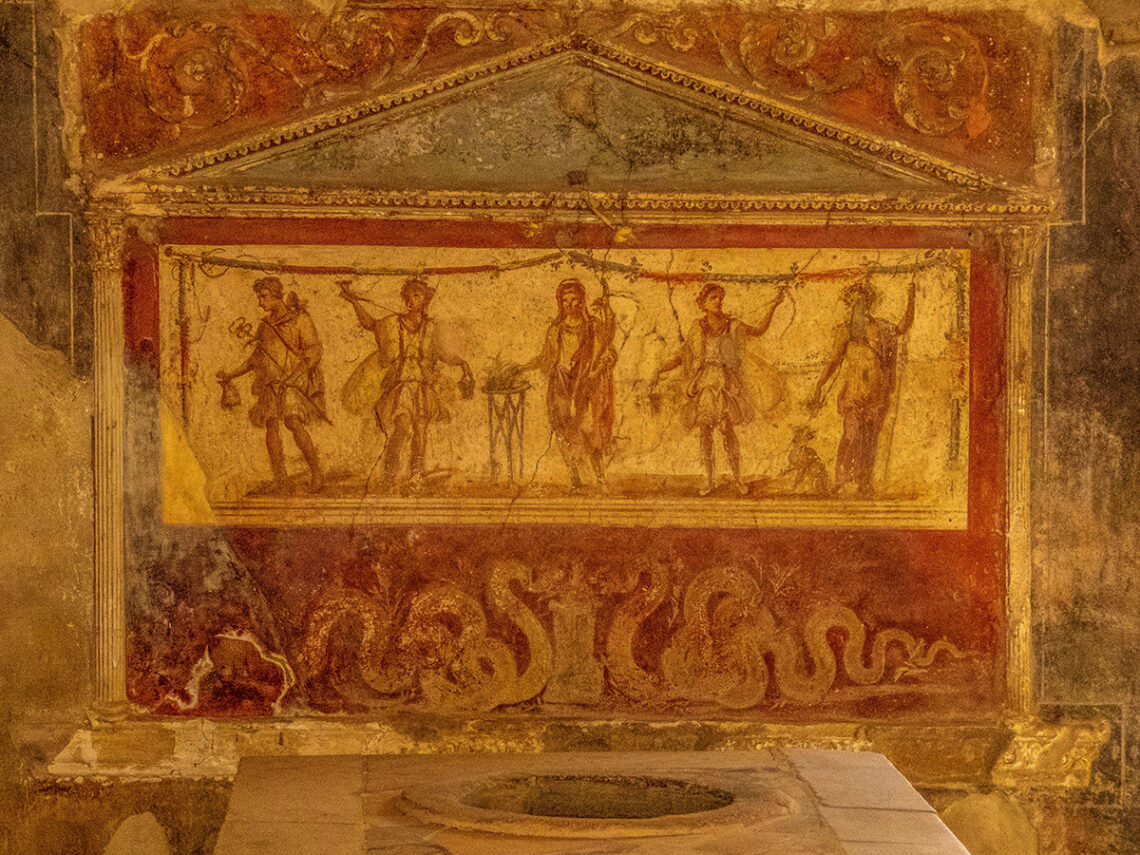
Extraordinary paintings discovered in the lost ruins of Pompeii

Impressive new paintings have been discovered in the buried ruins of Pompeii with a new excavation revealing art pieces depicting mythological figures such as Helen of Troy and the god Apollo.
The large frescos on the high, dark walls of a large banqueting hall are said to have once been owned by a high-status politician. One of which depicts Helen of Troy, the Greek figure was believed to have been the daughter of Zeus and Leda and the most beautiful woman in the world.
According to Gabriel Zuctrica, director of Pompeii archaeological park, it’s likely that the paintings were used to tell stories during get togethers and parties in the evenings as a means of entertainment, with the contrasting colours used to mask smoke deposits from lamps.
“In the shimmering light, the paintings would have almost come to life,” he said. The god Apollo is attempting to seduce the priestess Cassandra in another of the recovered paintings. According to the legend, his failure and her rejection result in her prophecies being dismissed.
The tragedy of that rejection is depicted in a second painting that was recovered, which shows Prince Paris meeting Helen, an alliance Cassandra knows will result in the Trojan War and doom them all.
The new excavation began a year ago, a project that will be broadcasted in full on the BBC and Lion TV later in April. Chief restorer Dr Roberta Prisco told the BBC that harsh conditions and the ease of collapse means “the responsibility is enormous.” To extract the paintings without damage, restorers inject a plaster glue to the rear of the paintings to prevent them from coming away from the walls.
“We have a passion and a deep love for what we’re doing,” explained Dr Roberta Prisco, adding that their work will contribute to the “joy” of the “generations that come after us.
Pompeii is viewed as a window into the world of the Roman Empire, which is said to have been preserved under the ash of Mount Vesuvius, which erupted over 2,000 years ago in AD79. Archeologists believe that the newly discovered paintings once belonged to Aulus Rustius Verus after they found his initials carved into one of the walls.
After the eruption, the banqueting hall was left without a roof or ceiling, leaving nothing but tall, black walls. These walls were decorated with paintings.
