


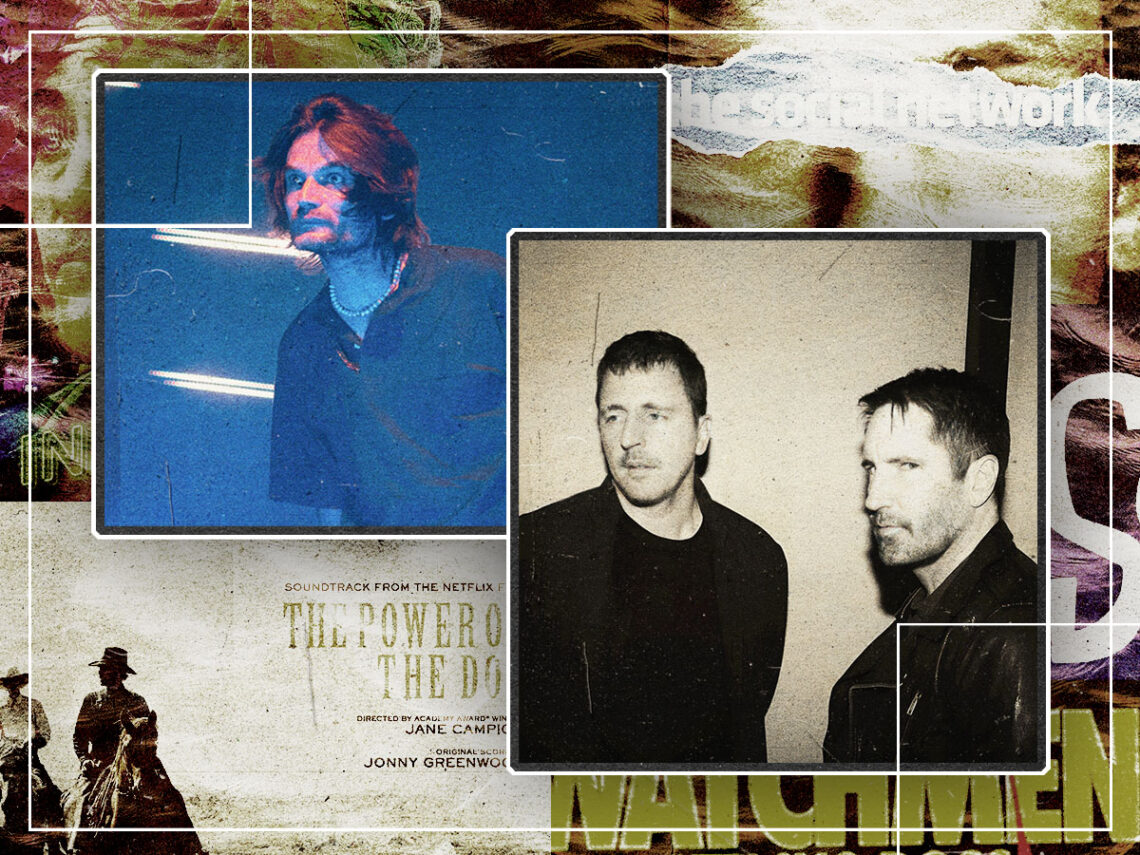
From Reznor to Radiohead: Exploring the overlap between rock music and movie scores

In 2010, David Fincher approached Nine Inch Nails frontman Trent Reznor about creating a soundtrack for his fast-talking Facebook film, The Social Network. At the time, Reznor was fresh off the back of touring with Nine Inch Nails and looking to redefine his creative focus, so he politely declined the offer. But after some time away from live shows and a chat with Nine Inch Nails collaborator and film composer Atticus Ross, Reznor decided to give film scoring a shot.
Reznor and Ross worked together to create a non-traditional score made up of lonely piano refrains and ominous, whirring synths. By choosing to create an electronic score combined with classic elements, Reznor and Ross perfectly encapsulated the film’s themes of ambition, betrayal and technology. The soundtrack is sparse and distant, melancholic and tense, a perfect reflection of the plot and characters. It’s able to match the pace of Aaron Sorkin’s dialogue, and it increases the intensity of a film that, without the score, would just be people talking in board rooms talking about social media.
A year later, at the 83rd Academy Award show, Reznor and Ross won an Oscar for ‘Best Original Score’, beating out genre stalwarts Hans Zimmer and Alexandre Desplat for Inception and The King’s Speech, respectively. Since then, Reznor and Ross have collaborated on over ten more projects in film and television for the likes of Disney’s Soul and HBO’s Watchmen. Together, they built up an ongoing working relationship with Fincher, scoring three more of his projects, including Gone Girl, and Ross has also worked on scores with the likes of Nick Cave and Mogwai.
A number of other alt-rock artists have also ventured into film scoring. Radiohead’s Jonny Greenwood has famously formed a long-term collaboration with acclaimed filmmaker Paul Thomas Anderson, and Greenwood soundtracked PTA’s 2007 epic There Will Be Blood and Phantom Thread in what is Daniel Day-Lewis’ final performance.
Greenwood’s bandmate and Radiohead frontman Thom Yorke has also dabbled in film composition, creating the haunting score for Luca Guadagnino’s remake of Suspiria in 2018. Karen O of the Yeah Yeah Yeahs, meanwhile, soundtracked Spike Jonze’s fantasy adaptation of Where the Wild Things Are. She also collaborated with Arcade Fire on the soundtrack for Jonze’s later film Her.
So why are rock musicians turning to film scores and forming long-term collaborations with directors, and why does it work so well?
Film composition appears to be a welcome change of pace for many rock artists. For Reznor, it provided a creative outlet away from the pressures of touring. He also recalled that it was refreshing to contribute to a wider project rather than being at the helm of one. He told the Los Angeles Times: “Looking back on how we did this, the smartest thing we did was gather as much information from David. Unlike a Nine Inch Nails record, the music is in a supporting role that’s serving the picture”.
He continued: “It was exciting for me to work under somebody. I am the top of the pyramid in the Nine Inch Nails camp. I found it very refreshing to serve another master. It was inspiring and challenging, but refreshing.” A move into film scoring not only removes logistical pressures like touring and promotion but can also serve as a creative release for artists, allowing them to venture into unexplored territory.
Yorke has echoed this sentiment, telling NPR: “I was really excited when I discovered that what Luca had done was push me into these odd places, and that I was going to somewhere darker than I realised. In the context of what I’ve done before, that was a blessing – a way to find something new, that you didn’t know existed”. Working from a source, often a first cut of the film, provides artists with a new kind of muse that forces them to push themselves creatively.
Some of the appeal also seems to come from the relative ease of a career in film composition. A successful first foray into film scoring can provide a path of opportunity, particularly if an artist is already an established name in the industry. Reznor has noted that after his work with Ross for The Social Network won an Academy Award, the duo were offered a number of other films. He told Variety: “And you start to wonder – should it be ‘F— rock and roll! I’ve got a new lease on life that doesn’t have quite the age limit restrictions that playing in a rock band does? Should I put all my eggs in that basket? Should I take every film that comes around?’”
But careful collaboration seems to be at the heart of this movement and its success. Karen O, Yorke, and Reznor were all approached by their directors to contribute to their vision. This direct, auteur approach has spawned some of the most coherent examples of recent cinema. Suspiria, The Social Network and Her are all beloved masterpieces in their genre, with cult followings in the film community. Part of this success is down to the accompanying film scores, particularly the director’s choices to collaborate with alternative artists. Their careful selection of music to fit their intended vision and audience only serves to enhance each film’s themes, atmosphere and, consequently, success.
Perhaps the reason rock artists are able to be so successful in their move to this craft comes from their very distance from it. From Reznor and Ross’ dissonant electronica to Thom Yorke’s piano-based ‘Suspirium’, musicians who come from an alternative sphere are able to provide a different, contemporary spin on film composition.
Far from the orchestral arrangements of industry names like Hans Zimmer and Alexandre Desplat, they are able to utilise alt-rock influences and techniques to create unique, non-traditional accompaniment for films that are a little more off-kilter. After winning the ‘Best Original Score’ Oscar in 2011, Reznor recalls that his award season rival Zimmer told him, “In a lot of ways, I hope you win because it’s helped open the field a bit for texture of what film scores can be”.
From Reznor to Radiohead, rock musicians are pioneering a new kind of film scoring.
