


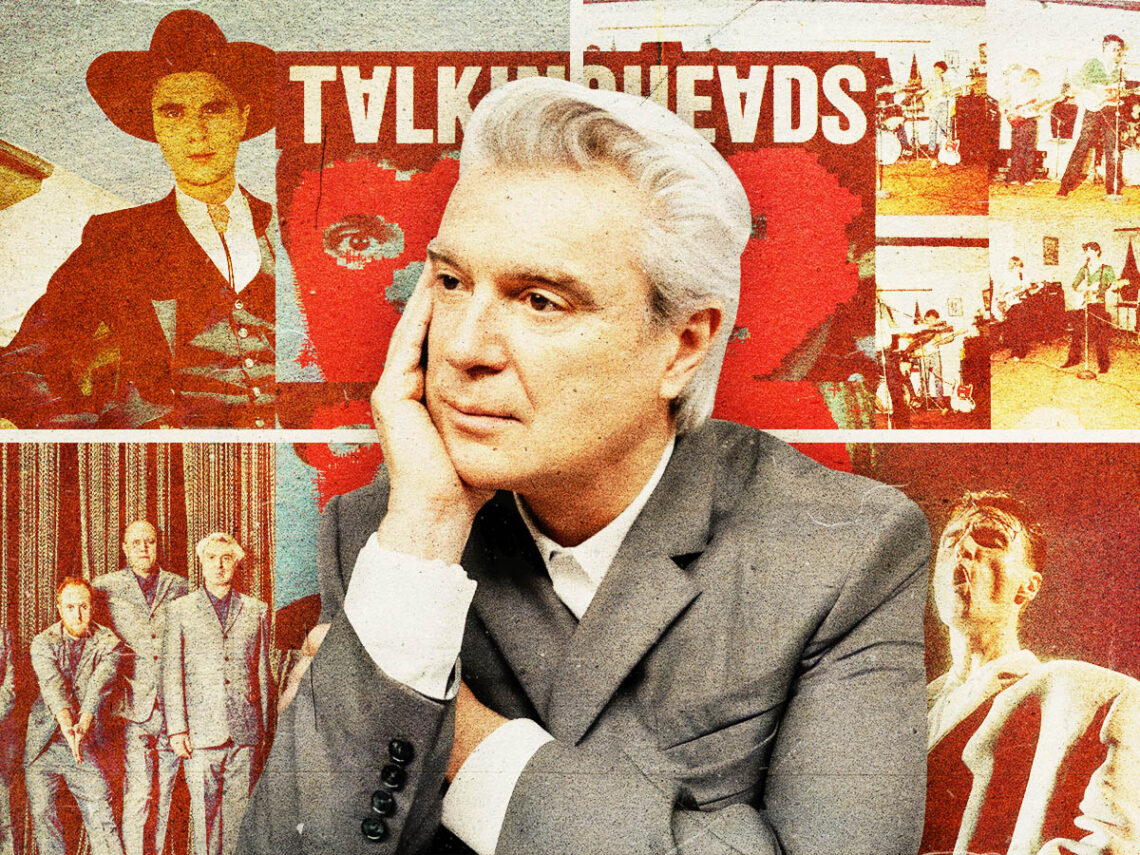
Exploring David Byrne’s mammoth impact on popular culture

David Byrne spent the early years of his life in multiple different countries, moving from his native Scotland to Canada before settling in the United States. Paired with the discovery that he is on the autism spectrum, Byrne found it difficult to assimilate with his peers. He told BBC Radio 4, “When you have trouble expressing yourself socially through the normal channels, you find other ways to do that.” Music was Byrne’s method of expression, using it to cope with feelings of otherness. By the mid-1970s, he had assembled Talking Heads with Chris Frantz and Tina Weymouth, quickly becoming one of the decade’s most influential outfits.
Although the band began performing within New York’s punk scene, securing their first gig as the support act for the Ramones at CBGBs, they soon became better associated with the post-punk and new wave movement. However, Byrne’s band demonstrated that they could not be pigeonholed into one category, taking as much influence from funk, Afrobeat and burgeoning hip-hop artists as they did from punk, experimental and classic rock groups.
Talking Heads released their debut single, ‘Love → Building on Fire’ in 1977 before sharing their first album, Talking Heads: 77, a few months later. The record was a bold blend of a wide array of influences, untethered from one genre. Byrne and his bandmates turned their backs on the simplicity of punk’s three-chord structure. Instead, the album blended African influences seamlessly and embraced genres that typically clashed with punk and classic rock, resulting in a spellbinding and game-changing collection of songs.
The band’s genius was recognised even further when Byrne proved himself to be one of his generation’s most enigmatic and captivating frontmen. There was no pretence to his performance style, which contrasted with the hyper-masculinity of certain contemporary rock acts. Byrne was naturally awkward and tense, using this to his advantage to create a stage persona that expressed what he couldn’t off-stage. He told the BBC, “I couldn’t talk to people face to face, so I got on stage and started screaming and squealing and twitching.” These movements matched the intensity and unconventional nature of the band’s music and lyrics, seemingly embodying the discordant rhythms or the ineffably danceable beats.
Jonathan Demme captured the influential brilliance of Talking Heads’ live shows in the concert film, Stop Making Sense. The performance begins with Byrne singing an acoustic version of ‘Psycho Killer’, accompanied by a boombox before each member slowly joins the stage with added set pieces. Byrne commands the stage with his magnificent presence, dancing in his signature oversized suit. Stop Making Sense is arguably the greatest concert film ever made, partly down to how Byrne throws himself around the stage without the slightest hint of self-consciousness.
Throughout Byrne’s career, he has continued to centre his creative curiosity, stemming from his ability to hyper-fixate and entirely dedicate himself to exploring new sounds and ideas. With Brain Eno, he made the 1981 album, My Life in the Bush of Ghosts, which is regarded as a monumental feat in the world of sampling and electronic music. The pair pushed the boundaries of what it means to create music with pre-existing sounds, blending experimental rock with funk, avant-garde, electronica and more.
Moreover, in 1986, he released his directorial debut, True Stories, a collection of vignettes about Texan citizens anticipating the ‘Celebration of Specialness’. Byrne starred in the film and performed music with Talking Heads and other cast members for the soundtrack. His foray into filmmaking was yet another example of Byrne’s boundless creativity, allowing himself to spread his ideas into new mediums, subsequently becoming a significant inspiration to other musicians and artists by demonstrating the interconnectivity of different art forms.
Although Byrne didn’t invent the idea of interweaving music, performance and filmmaking, he took these ideas to astounding heights and continues to do so. In 2019, he adapted his album, American Utopia, into a Broadway show, redefining what it means to perform music for an audience. Rather than play the songs with a conventional band, he chose a group of musicians to play wireless instruments, allowing them to move around the stage with him freely. The show was even released as a Spike Lee-directed film, showcasing the uniquely choreographed performances of songs by Talking Heads, Byrne, and a few other artists, like Janelle Monae.
Since Talking Heads disbanded in the early 1990s, their influence has been monumental, infiltrating a wide variety of artists due to their own eclecticism. One of alternative rock’s biggest names, Radiohead, have a lot to thank Talking Heads for, from providing significant inspiration for their 2000 album Kid A to influencing their name (‘Radio Head’ appears on True Stories). Moreover, innovative artists such as LCD Soundsystem are hugely indebted to Talking Heads, highlighting the impact of Byrne’s band on new generations of acts that are influential in their own right.
Byrne’s uncompromising creativity, which charts music, films, live performance and writing, reflects a man whose pioneering ideas are truly one of a kind. He has never fallen into complacency, continuing to inspire others for decades with his consistently unique approaches to art.
