


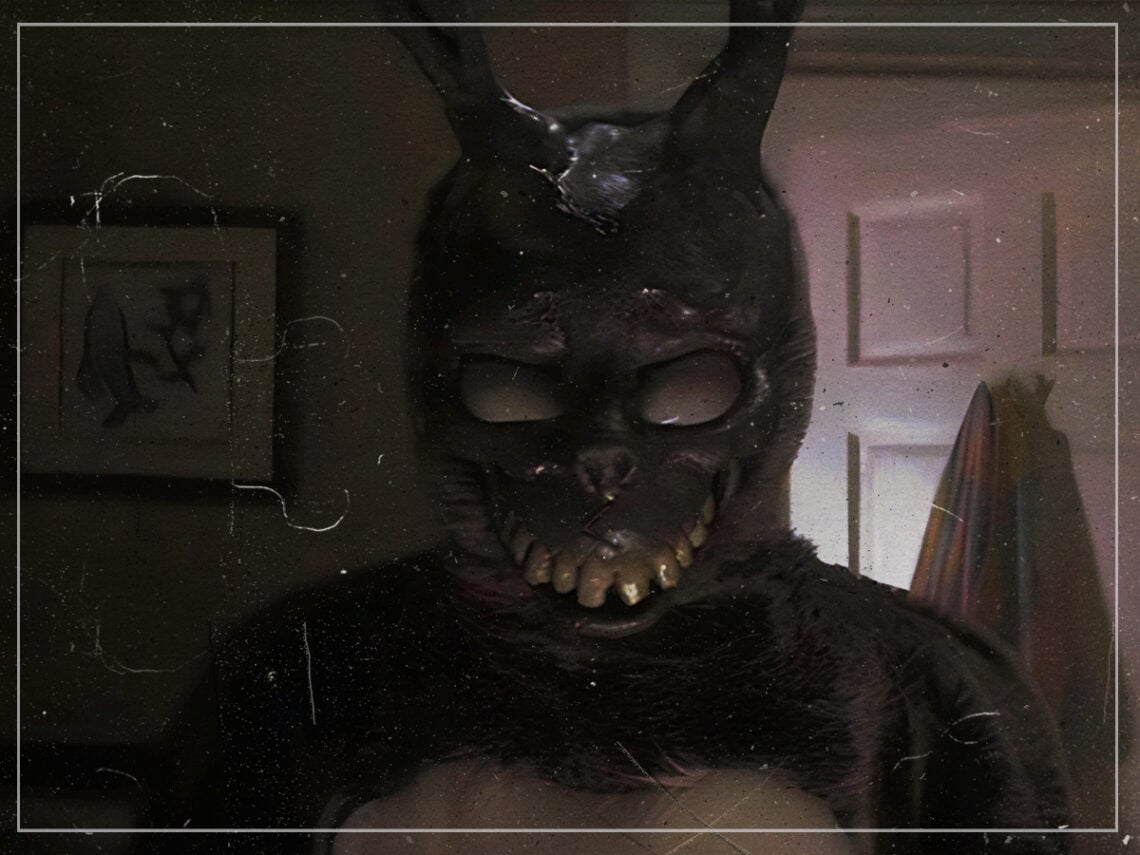
Explaining the end of ‘Donnie Darko’

Since its debut in 2001, Donnie Darko has sparked many discussions regarding its intricate philosophical depth and divided critics and audiences regarding its standing within its genre. Even two decades after its release, the movie continues to perplex viewers by surpassing conventional genre classifications, continuing to intrigue and mystify the many that encounter its eery realm.
At its core, Donnie Darko follows the titular character, portrayed by Jake Gyllenhaal, a troubled teenager dealing with mental health issues and grappling with the concept of fate and time manipulation. The film takes a surreal turn when Donnie encounters a mysterious figure in a rabbit costume named Frank, who introduces him to the concept of time travel and forewarns of an impending apocalypse.
As the story unfolds, the narrative becomes increasingly surreal, blurring the boundaries between a tangible reality and a dreamlike state. Donnie’s actions and interactions with various characters raise questions about whether events are predetermined or subject to his own choices.
The film’s climax presents a mind-bending sequence of events that intertwine parallel universes, time loops, and the characters’ interconnectedness. In the final moments, Donnie faces a pivotal choice that seemingly leads to his demise but paradoxically saves others and resets the course of events.
While that may seem to raise more questions than it answers, the movie’s ending can be explained if we journey through it chronologically. In the concluding sequence, Donnie, prompted by Frank, sets fire to Jim Cunningham’s house, which leads to Cunningham’s arrest due to the discovery of owned child pornography. Concurrently, Donnie’s family members pursue their respective plans — his sister heads to LA with a dance troupe, while another celebrates university acceptance.
Donnie, attempting to locate the author of a time travel book given to him by a science teacher, faces bullies and witnesses his friend Gretchen’s accident involving Frank. In a moment of distress, Donnie shoots Frank, leading to a time-loop where he ends up at the film’s first moment, choosing to sacrifice himself. By doing so, he averts future events, preventing the tragedy involving his family.
Although much of this may seem like an over-complicated attempt at allegorical time travel, it was ultimately the director, Richard Kelly, who sought to offer fertile ground for speculation about its conclusion intentionally. While the specifics of the ending remain subject to interpretation, the lasting impact of Donnie Darko lies in its ability to provoke introspection and ignite discussions about the nature of time, fate, and the intricacies of the human experience.
