


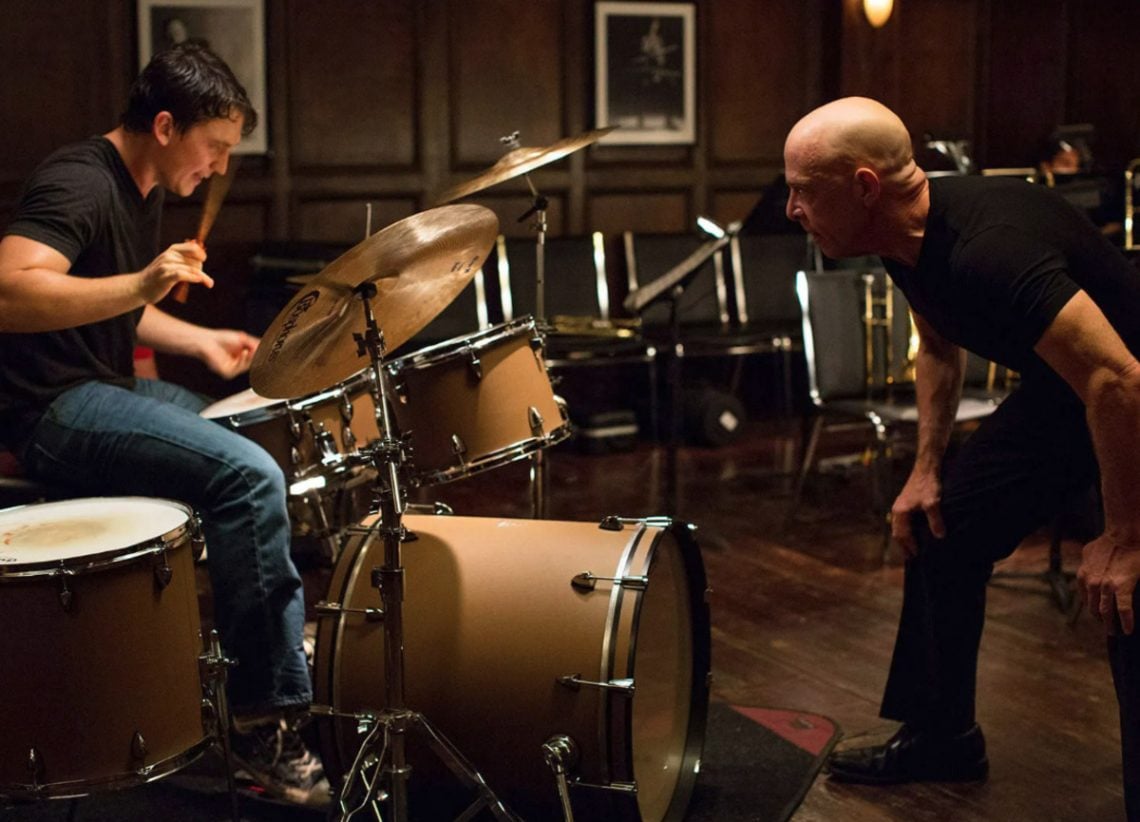
Explaining the ending of Damien Chazelle’s incendiary ‘Whiplash’

Few films in recent memory have made palms sweatier than Damien Chazelle’s Whiplash, which constantly builds unbearable levels of tension throughout the story before a final scene that either redeems or torpedoes its protagonist, depending on the interpretation.
The filmmaker’s second feature follows Miles Teller’s Andrew Neiman, an aspiring jazz drummer seeking to make the most of his opportunity to attend the prestigious Schaffer Conservatory, although a significant obstacle to success is presented through J.K. Simmons’ formidable Terence Fletcher, a force of nature with a mean streak a mile wide.
At the end of the film, Fletcher invites his former student to participate in an upcoming jazz festival as part of his band, guaranteeing him it’ll be a cakewalk when the setlist is comprised of songs he learned at Schaffer. When the time comes, Andrew discovers that he’s been lulled into a false sense of security, with his ex-mentor leaving him high, dry, and humiliated after tuning up a completely different track.
After walking offstage in embarrassment, Andrew gets back on the stage, takes over, and cues up the band for a song he knows inside out, with Whiplash ending on the protagonist drumming like his life depended on it, all while his adversary looks on approvingly.
The ambiguity opens the finale up to a number of interpretations, of which Chazelle holds the bleakest of all. It can either be viewed as Andrew’s moment of redemption that proved Fletcher wrong or one final act of tough love from his teacher that spurs his protégé onto greatness, establishing mutual respect between the two despite all they’d been through up until that point. Either way, it’s redemptive for at least one of them, although perhaps not for long, given the filmmaker’s own perspective.
What does Terence Fletcher “know” was Andrew?
Setting Andrew up for a fall, Fletcher menacingly leans in and whispers “I know it was you” into his ear, with the realisation dawning upon the former that the latter didn’t invite him to play with his band for the express purpose of extending an olive branch.
Earlier on in Whiplash, Andrew had agreed to testify against Fletcher regarding the death of Sean Casey, another former student of his. Fletcher had maintained that he’d died in a car accident, but it was shown that he’d committed suicide due to the pressures, depression, and anxiety allegedly induced by the teacher’s methods.
Even though Andrew chose to remain anonymous to contribute to the legal action that cost Fletcher his job, he still finds out somehow, adding extra tension and dramatic heft to the final scene.
Is Whiplash based on a true story?
Whiplash isn’t based on a true story, but it is an adaptation of sorts. The narrative was inspired by Chazelle’s own time spent playing in his high school band, with Fletcher based partly on one of his instructors but heightened and embellished for the sake of cinema.
That served as the basis for his 18-minute short of the same name that starred Simmons as Fletcher, as was the case with the film, but Andrew was played by Johnny Simmons the first time around, and the story unfolded over the course of a single practice session.
