


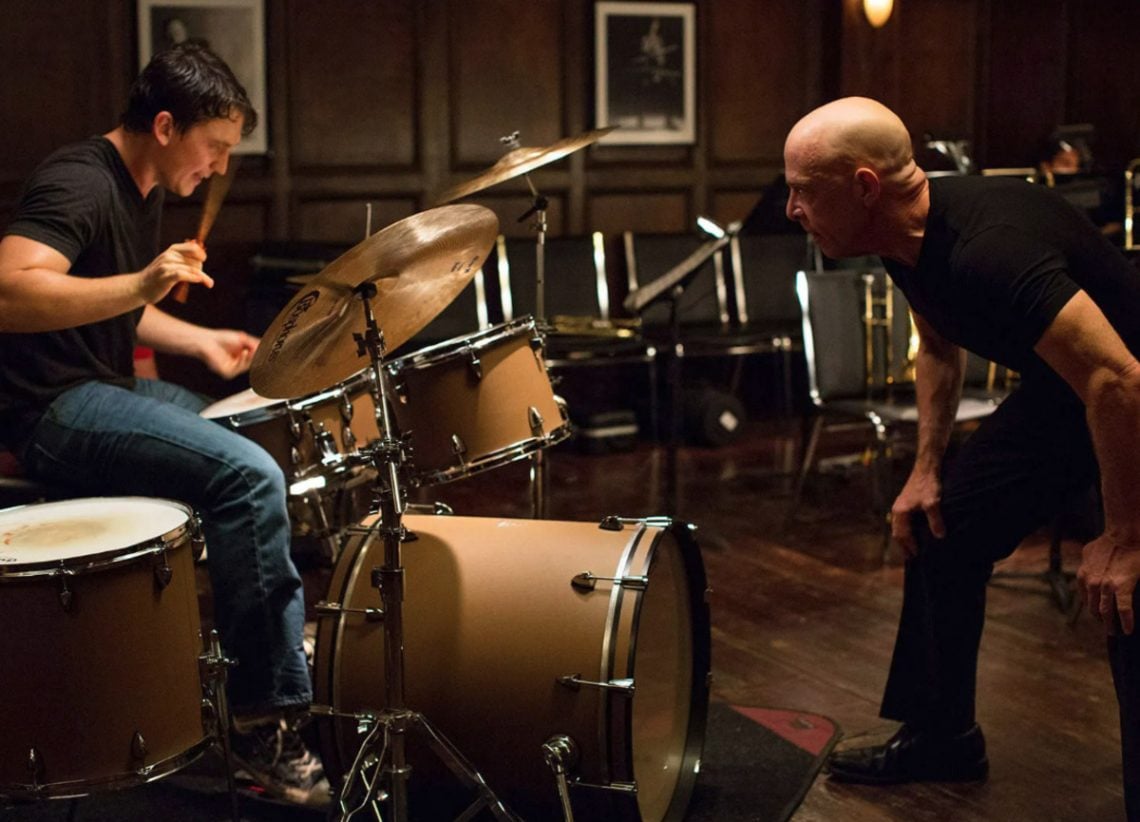
“I have a very dark view of where it goes”: Damien Chazelle’s downbeat interpretation of ‘Whiplash’

The notion of a drama about an aspiring drummer simultaneously existing as an in-depth character study, nerve-shredding thriller, and borderline horror movie all at once sounds like a preposterous juggling act that couldn’t possibly be pulled off, but that’s the beauty of Damien Chazelle’s Whiplash.
It may not have been his first feature – an honour that belongs to 2009’s revisionist romantic musical Guy and Madeline on a Park Bench – but it was definitely his breakthrough. Turning his 2013 short film of the same name into a feature, Whiplash brought plenty of eyeballs to Chazelle, marking him out as having the potential to emerge as one of his generation’s finest filmmaking talents.
As well as earning a ‘Best Picture’ nomination and a ‘Best Adapted Screenplay’ nod for expanding his own concept, the film took home Academy Awards for ‘Best Sound Mixing’ and ‘Best Film Editing’, while J.K. Simmons was the runaway favourite to take home the ‘Best Supporting Actor’ statue from the second his ferocious performance as Terence Fletcher was unleashed, which is precisely what happened.
Taking several notable tropes from the sports flick and the underdog story, Miles Teller’s Andrew Neiman knows no bounds in his ambition, seeking to become the star pupil of the elite music conservatory he attends. Standing in his way is the indomitable Fletcher, who pushes the bright-eyed and bushy-tailed prodigy to both new heights and uncharted depths in his ruthless pursuit of perfection.
Things reach a head in the final scene, a staggering rug-pull that leaves it entirely up to the viewer over what does or doesn’t come next. Fletcher and Andrew reconnect after the former has lost his teaching job over allegations of abuse, extending an olive branch by inviting the latter to perform with him at an upcoming jazz festival.
Andrew takes the stage before Fletcher drops the bombshell. He knows that Andrew played a part in his professional demise by testifying against him. To exact revenge, he gave him sheet music for the wrong song. Embarrassed in front of a crowd, he refuses to cow under the pressure and returns to the stage after storming off, bursting into a manic solo before the screen cuts to black. Was there a standing ovation? Bemused silence? Did Fletcher lose his shit and pummel the young upstart? Nobody knows; theories emerged, but Chazelle opted for the bleakest of all.
There are multiple ways to interpret what the closing shots of Whiplash mean, from Fletcher’s tough love approach indicating that he never truly gave up on Andrew, to Andrew returning to live performance to prove a point and rub it in his mentor’s face that despite so much urging to the contrary, he really did have what it took to succeed. The biggest unanswered question by far is what comes next, but anyone hoping the writer and director would espouse a positive outlook will be left crushingly dismayed.
As he nihilistically explained to Screen Crush, Chazelle is of the opinion that Fletcher will always maintain he won the psychological battle, while “Andrew will be a sad, empty shell of a person and will die in his 30s of a drug overdose.”
Rather understatedly, then, the filmmaker admitted, “I have a very dark view of where this goes.”
While nine times out of ten, the audience is inclined to side with the outcome decided upon by the creator of the material, Whiplash was exhausting enough without having to contemplate a future where Andrew’s dedication and skill gets him nowhere other than an early grave, making his traumatising pursuit of achieving his dreams an utterly pointless exercise destined to end in squalor and ruin.
