


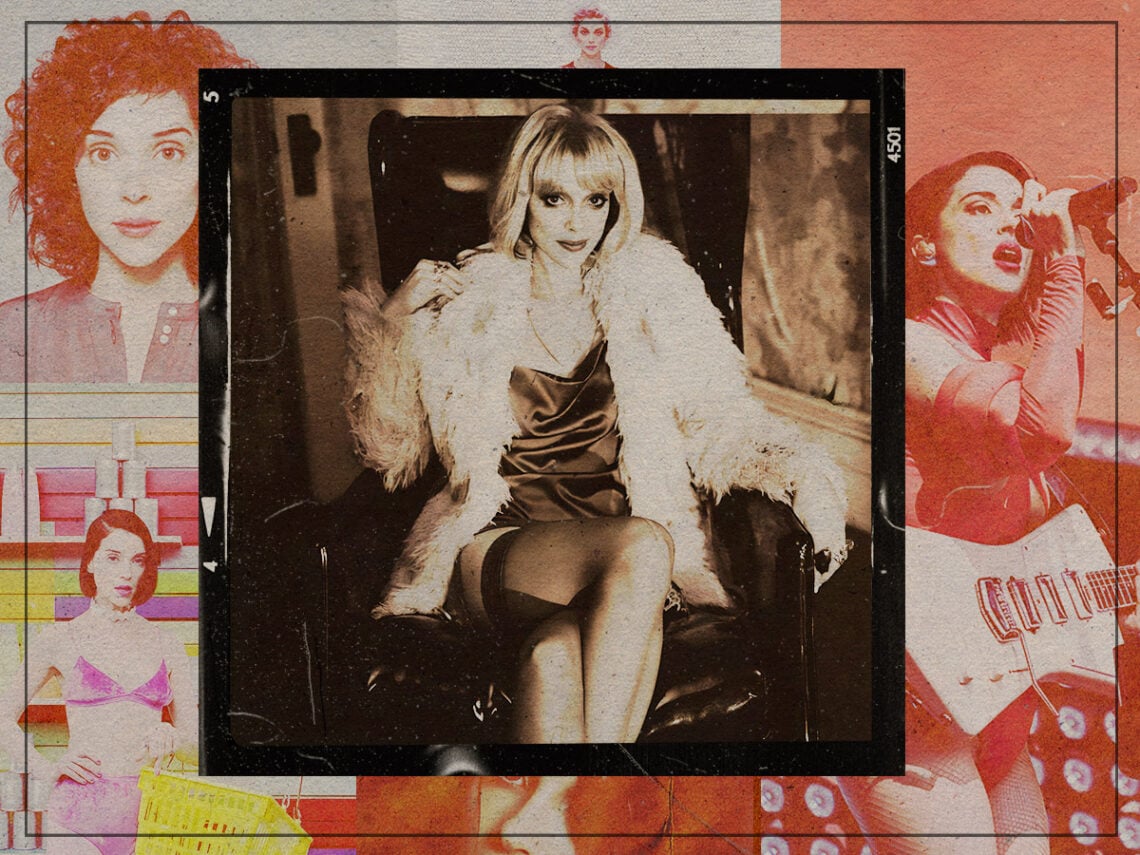
A guide to every St. Vincent persona

She’s not called the modern-day David Bowie for nothing. Across nearly two full decades, Texas-born singer-songwriter Annie Clark has become the dictionary definition of an indie rock chameleon. Through her stage name, St. Vincent, Clark has the freedom to try on any guise, genre, or style that she pleases. Over her career, she’s done just that, transforming herself with every new release and stage show.
Originally a guitar wizard who threw her Berklee College of Music education out the window in favour of playing with noise rock acts like Skull Fuckers and Glenn Branca’s legendary 100-guitar orchestra (the same performance collective that laid the groundwork for Sonic Youth nearly 30 years earlier), Clark began to establish her own musical identity in the mid-2000s. After a brief stint as a touring musician with Sufjan Stevens, Clark decided to make a name for herself as St. Vincent, a persona that could be anything.
By adopting a new moniker, Clark was given the space to be anything she wanted. As her sound evolved from baroque pop to indie rock to synth-pop, Clark revealed an entirely new side of herself in her music. She also decided that an aesthetic change should go with every new album, with a series of different looks and styles that matched the feeling of her music.
Here is a deep dive into how St. Vincent’s personas have changed across 15 years of music.
A guide to every St. Vincent persona:
2007: “Not Annie” Annie
It was the perfect way to kick off her career. The first song on Clark’s first album, ‘Now, Now’ lists a litany of things that Clark (and by extension St. Vincent) aren’t going to be. Nestled in there is the repeated “I’m not any, any, anything” that purposefully sounds like “I’m not Annie”.
The funny thing is that Marry Me sees Clark at her most normal and human, not yet able to reach beyond herself into the realm of different guises and visuals. There is an explosion of characters to come, but this is probably (and ironically) the closest we’ll get to the real Annie Clark.
2009: The Birth of the Actor
Actor is all about performance. The deconstruction of the human form, the fake face that we all put on in public, the disappointment that comes with taking the silver medal in life.
With a new layer of theatricality, Clark also takes a subtle look under the hood and wonders why people feel the need to be someone other than themselves. At this point, there aren’t any wild haircuts or costumes, but it’s clear that Clark is embracing the possibilities of what St. Vincent can be.
2011: Housewife on Pills
Her words, not ours. As Clark embraced her future as a guitar god, she disembarked to Seattle in order to write her third album, Strange Mercy. While there, a new sense of indie rock sleaze began to filter into her work, along with more noticeable electronic influences.
But according to Clark herself, Strange Mercy was a lyrical dive into the female form and the pressure that comes along with it. Songs like ‘Chloe in the Afternoon’, ‘Cheerleader’ and ‘Surgeon’ make that connection more or less explicit, and Clark responded with a more dolled-up look onstage and in press photos.
2012: David Byrne Desciple
Clark didn’t seem much for hero worship. Apart from her appearance at Nirvana’s Rock and Roll Hall of Fame induction ceremony, she hasn’t done much in the way of paying direct tribute to her influences.
When David Bryne came calling in 2012, the pair decided to record an entire album of new material together, Love This Giant. Clark was clearly enamoured with Bryne’s off-kilter persona, and it just might have had something to do with her next incarnation.
2014: Alien Cult Leader
For 2014’s St. Vincent, Clark went into her most overtly theatrical phase yet: fully dyed hair, wacky clothing choices, and an album purposefully removed from most of her personal feelings.
While tracks like ‘Prince Johnny’ and ‘Birth in Reverse’ seemed to have their roots in Clark’s real life, other songs like ‘Bring Me Your Loves’ and ‘Digital Witness’ in the position of a leader, commander, and button pusher. The transformation was now complete: St. Vincent had become a monster in a truly amazing way.
2017: Robotic Dominatrix (and Confessional Pop Star)
Coming back to earth for 2017’s Masseduction, Clark was confronted with some of the most personal songs that she had ever written. ‘New York’, ‘Young Lover’, and ‘Happy Birthday, Johnny’ were all true to life, but tracks like ‘Savior’ and ‘Sugarboy’ saw plenty of the dominating figurehead persona of St. Vincent carry over.
Visually, Clark was at her boldest, opting for plastic fetish outfits and razor-sharp bob haircuts. But underneath the pulsating synth-pop and lingering cult ideas, Clark had actually crafted one of her most insightful and emotionally stirring albums.
2021: Street Smart ’70s New Yorker
The most recent version of Annie Clark that we’ve seen is the closest to a pastiche that we’ve ever gotten: a pure 1970s nostalgia trip that takes its cues from David Bowie’s Young Americans as well as New York icons like Lou Reed, Candy Darling, and Edie Sedgwick.
The music and the visuals worked hand in hand, with Clark embracing a throwback style as she attempted to make sense of her father’s incarceration and subsequent release from prison. It’s paradoxically the strangest and most familiar guise that Clark has worn as St. Vincent; where she chooses to go from here is anyone’s guess.
