


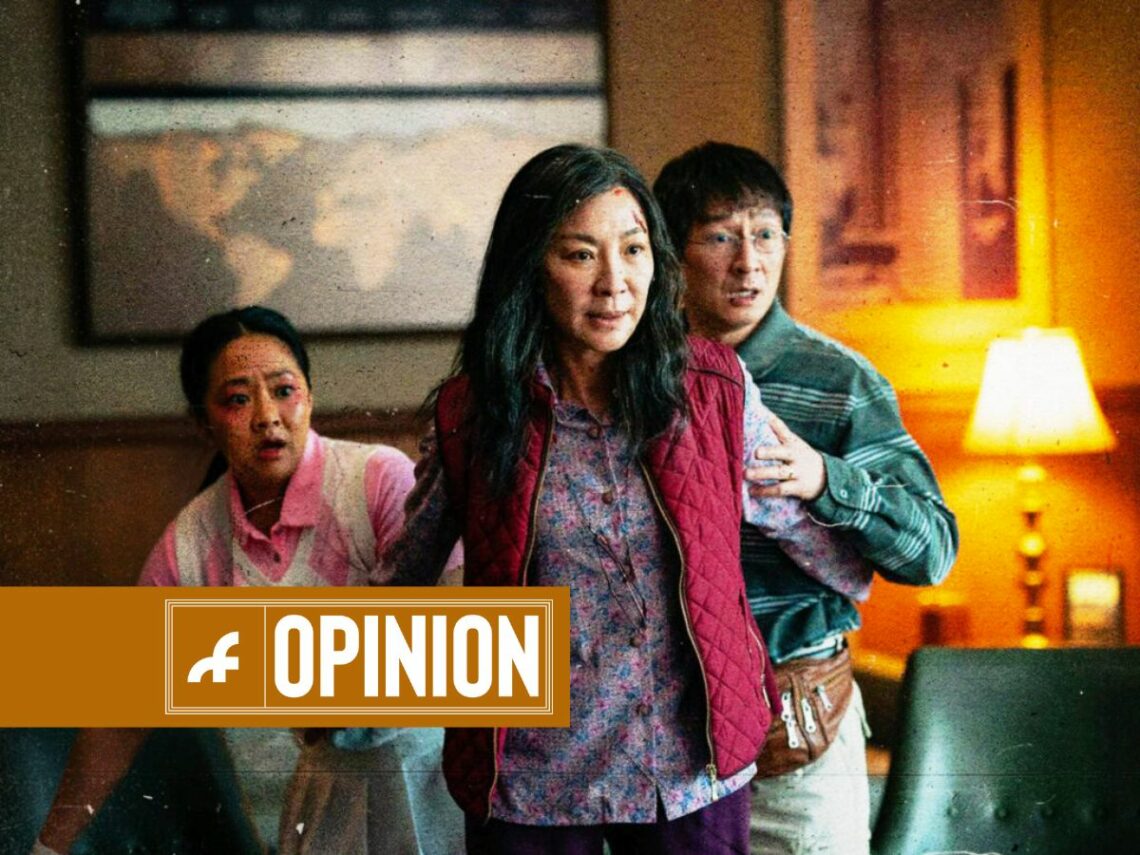
Oscars 2023: ‘Everything, Everywhere All at Once’ Oscar win shows hope for cinematic diversity

The extraordinary critical and commercial success of the Daniel Kwan and Daniel Scheinert sci-fi bizarro Everything, Everywhere All at Once has culminated in a long-rumoured Oscar win for ‘Best Picture’. As well as a public affirmation that multiverse stories are here to stay, prompting superhero franchises Marvel and DC to lick their jagged, dry lips, the win for the internationally beloved tale of familial connection amidst nihilistic dread is a beacon of hope for the future of big-budget cinematic diversity.
Inspired by the contemporary fixation with the movie multiverse, which has arguably emerged as a result of ‘fake news’ and raging modern conspiracy theories that suggest different versions of perceived reality, as well as the success of recent superhero hits such as Spider-Man: No Way Home and Loki, Everything Everywhere All at Once inverted the timey-wimey nonsense of its peers to tell a story that toys with the philosophical implications of such separate universes.
Diversifying the multiverse narrative, the story follows a middle-aged Chinese immigrant named Evelyn (Michelle Yeoh) who contends with increasing debt and estranged relationships with her husband, Waymond (Ke Huy Quan) and daughter, Joy (Stephanie Hsu). When she is sucked into another timeline, however, where another version of herself with very different sets of skills exists, she learns to reconnect with the ones she loves after undergoing a bizarre cinematic odyssey of physical and emotional turmoil.
Keen to distance themselves from the loud and vapid storylines of the Marvel universe, Kwan and Scheinert, known collectively as Daniels, told The Ringer that they were “frustrated with multiverse narratives” when they began writing their ‘Best Picture’ winner. Continuing, the duo explained: “If every single choice branches off into another universe, there should be an infinite number of universes, which means narrative doesn’t matter; choices don’t matter. Why should you care at all?”.
Part of the way in which Daniels makes the audience care for Evelyn, Waymond and Joy is by taking the multiverse narrative as far as it can go before grounding it back in some sort of tangible reality, contextualising the madness in a very real story of human connection and comforting nihilism. The result is an incredibly competent film that boasts countless artistic styles and technical mastery, showcasing just how innovative and visually marvellous cinema can be when genuine creative mavericks are given free rein.
With a budget of just over $14million, Daniels’ epic sci-fi exploration put the extortionate big-money ventures of Disney and Warner Bros to shame, demonstrating that with diverse voices behind the camera, commercial and critical success is merely a case of creative liberation. Such can be said for the stars on screen, too, with Michelle Yeoh leading the film with a fierce performance after decades on the industry sidelines, whilst Ke Huy Quan’s resurgence from 1980s child star to 2022 Oscar winner has become the glittering headline fairytale of the 95th Academy Awards.
Arguably, both Todd Field’s Tár and Martin McDonagh’s Banshees of Ishernin contained a little more artistic nuance than Daniels’ sci-fi epic, but it is the pertinence of Everything, Everywhere All at Once that makes it such a deserved ‘Best Picture’ winner. Coming to represent the hysterical insanity of the frenetic modern world, 2023s Oscar victor teaches us to part the immaterial nonsense of life and embrace that which matters the most.
