


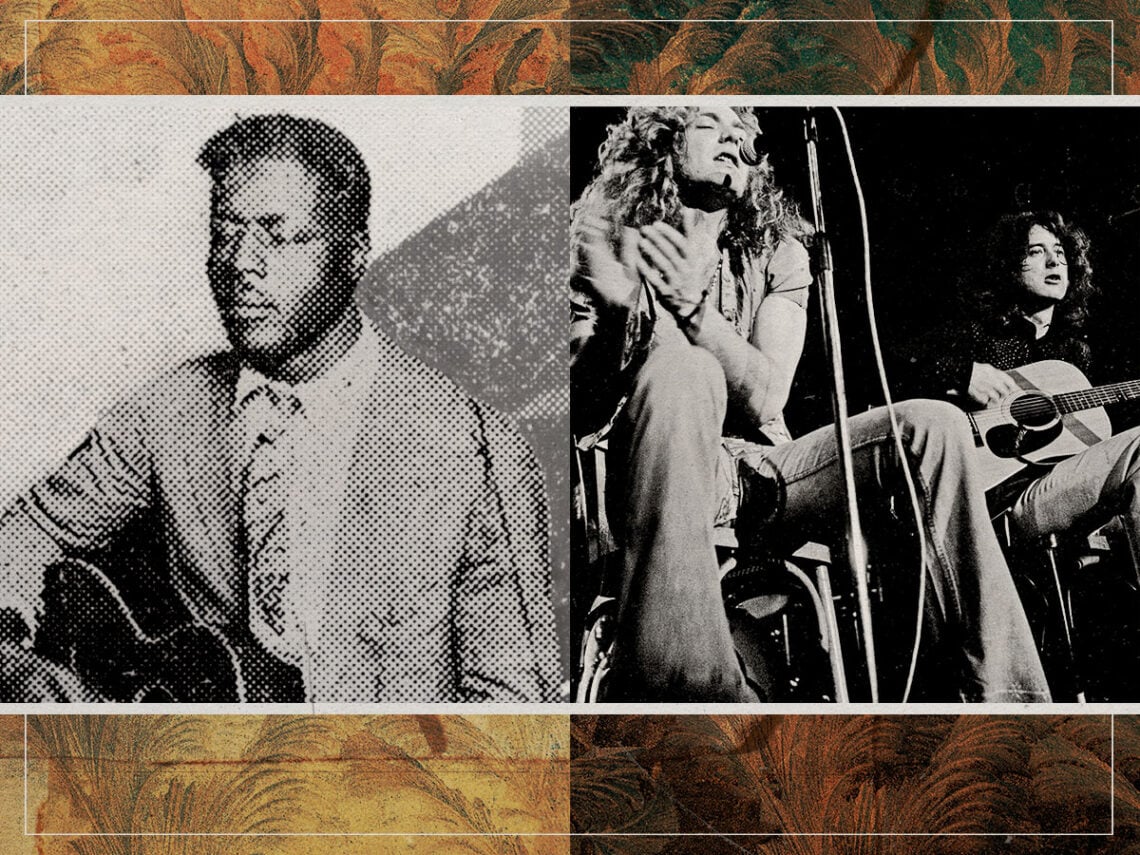
Every Led Zeppelin song inspired by Blind Willie Johnson

It’s well known that Delta blues music was a key influence on Led Zeppelin, just as it was on the entire British blues rock movement that spawned them in the second half of the 1960s. In fact, Zeppelin can trace their lineage back to the Delta directly, through the electric blues of Mississippi emigrants Muddy Waters and Howlin’ Wolf.
The Mississippi Delta gets paid plenty of lip service from Robert Plant, who’s emphasised repeatedly the seminal influence that Robert Johnson’s 1961 compilation album King of the Delta Blues Singers had on his band. What’s less well-known is the role of a blind, homeless Texan church singer, whose music predates his namesake Robert’s by a decade, played in Zeppelin’s reimagination of the blues.
Blind Willie Johnson lost his sight at the hands of his stepmother at just seven years old, as she threw a bucket of corrosive lye water across the room at his enraged father during a domestic argument. This event effectively put an end to the young boy’s dream of becoming a Baptist minister in his home village of Pendleton, Texas; such as the stigma against blindness among poor communities in the southern United States at the time.
Nevertheless, Johnson continued singing on the cigar box guitar he’d received from his father as an infant, taking inspiration from the blind gospel singer Madkin Butler. In his early 20s, he followed his slightly older contemporary, Blind Lemon Jefferson, onto street corners, developing his signature growling vocal style and building up a repertoire of his own songs.
It was then that he was scouted by Columbia A&R man Frank Buckley Walker and brought to nearby Dallas for the first of five recording sessions. Over the course of three years, Johnson recorded a total of 30 songs, which became some of the most influential compositions of the 20th century, forming an essential part in the musical education of everyone from Elvis Presley to Stephen Stills, Jerry Garcia and Jack White.
But what did Zeppelin take from Johnson?
The extent to which Blind Willie Johnson had inspired Led Zeppelin didn’t become obvious until the release of their sixth studio album, Physical Graffiti, which includes a spectacular 11-minute rendition of Johnson’s song ‘In My Time of Dying’. The recording features some of Jimmy Page’s most underrated guitar work, a stunning display of slide guitar mastery that Johnson himself would have been proud of.
For their next album, Zeppelin decided to take on Johnson’s haunting composition ‘It’s Nobody’s Fault But Mine’. Aside from the titular chorus line and the broad structure of the song, though, their version has little to do with the original. Instead, it borrows heavily from Robert Johnson’s ‘Hellhound on My Trail’, which itself seems to have lifted elements from older Delta blues player Johnny Temple’s music.
To most ears, ‘In My Time of Dying’ and ‘Nobody’s Fault But Mine’ are the only two instances in which Led Zeppelin have appropriated Blind Willie Johnson’s songs for their own records. Yet there’s a third on their landmark debut record.
One of Zeppelin’s best-known tracks, ‘Dazed and Confused’ was famously nicked from ‘60s folk singer Jake Holmes when he opened for Jimmy Page’s Yardbirds in New York’s Greenwich Village. However, Zeppelin’s lyrics are radically different from Holmes’ original version. Most notably, the lines “Lots of people talking, few of them know / that the soul of a woman was created below” appear to be an invention of Robert Plant’s.
They’re actually based on a Blind Willie Johnson lyric, however. His 1930 song ‘The Soul of a Man’ includes the lines “I saw a crowd stand talking” and “Won’t somebody tell me, just what is the soul of a man”. Plant flips the motivation of Johnson’s song – to search for the meaning of a man’s God-given soul – into its reverse. A rueful expression of the (misogynistic) claim that a woman’s soul belongs to the devil.
Ironically, despite being one of the most important figures in the history of the Devil’s Music, Blind Willie Johnson had no truck with devil worship. He sang to and for God, no matter how desperate and hopeless his own personal situation became. He died of pneumonia at the age of 48, destitute, shivering in the ruins of his burnt-out house, with no hospital willing to admit him due to the colour of his skin and his status as a blind pauper. Upon his death, he was thrown into an unmarked grave.
But his legacy is far greater than a simple tombstone. It’s some of the most powerful blues ever produced, a body of work worthy of its place alongside the likes of Robert Johnson, Muddy Waters, Bob Dylan and Led Zeppelin in the history of modern music.

Never Miss A Beat
The Far Out Led Zeppelin Newsletter
All the latest stories about Led Zeppelin from the independent voice of culture.
Straight to your inbox.