


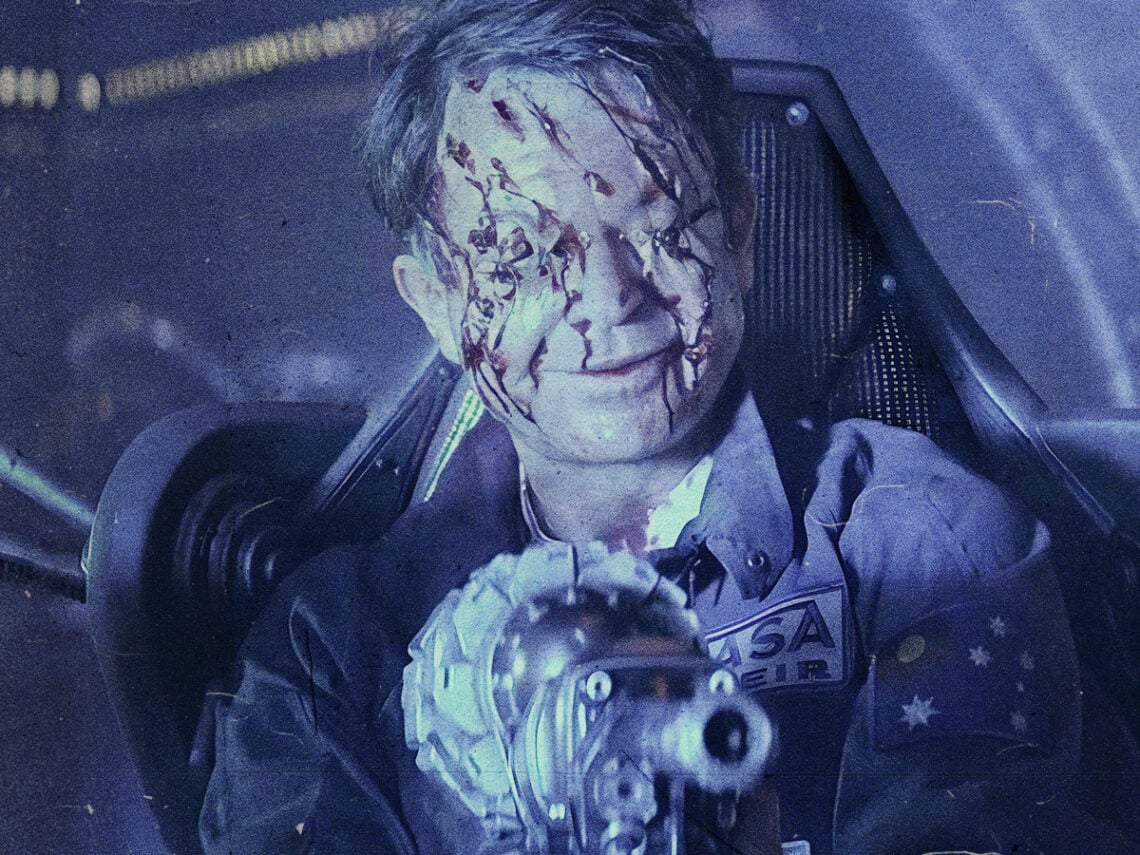
Defying the critics: why ‘Event Horizon’ is a Lovecraftian gem

Some movies just seemed destined to fail. As far as the science fiction genre goes, there are only a few that have suffered as bad a critical and commercial misfortune as Paul W.S. Anderson’s 1997 sci-fi horror film Event Horizon, starring Laurence Fishburne, Sam Neill, Kathleen Quinn and Joely Richardson.
The movie takes place in 2047 and tells of a group of astronauts sent out on a rescue mission after the titular spaceship, pronounced missing, suddenly reappears orbiting Neptune. However, the rescuers quickly discover that the ship has brought back an evil force from wherever it has disappeared and become locked in a journey to discover its mystery and a battle to survive.
So far, so standard for a sci-fi horror movie, but with an impressive cast and crew involved, it’s remarkable that the film flopped so severely, grossing just $42million at the box office from a $60m budget. It’s worth pointing out that the production of Event Horizon was as hellish as its narrative motifs, and the budget was quickly used up, meaning that several cutbacks had to be made.
In addition, Anderson was granted around half of the usual ten-week editing time after being pressured by Paramount. A first cut, which was poorly received by test audiences, was deemed too long, but then the final cut came out too short, with much of the film’s most gory moments cut out to appease a wider audience, despite the precise horror angle of the story.
Still, since its release, Event Horizon has gained a cult following, showing that the initial critical perception of the film was somewhat unwarranted. The truth is that Anderson’s movie really isn’t half as bad as many figures made out, nor is it as good as it could have been with a proper production schedule. Negative reviews of the sci-fi horror are rather unfair because it does at least an admirable job of bringing the cosmic horror writing of H.P. Lovecraft onto the screen in a modern context, which has often proven difficult.
For starters, in discovering that the Event Horizon has been past the unknown boundaries of outer space and has come back possessing an evil force, Anderson’s film details cosmic horror under the guise of science fiction and in the shadows of Lovecraft. The ‘weird fiction’ author had often written of the fragility of the human mind when it experiences the horrors from beyond their usual rational perceptions, and as the astronauts of Event Horizon face up to the hellish reality of the spaceship, their deepest fears and desires are exposed through nightmarish visions.
In that light, Anderson’s film borrows from Andrei Tarkovsky’s Solaris as well as Lovecraft’s works, which famously include ‘The Call of Cthulhu’ and The Shadow over Innsmouth. This confrontation of the limits of the human mind is no short feat for a piece of cinema, bringing to mind the existential dread of Lovecraft’s most psychologically tormented characters.
In addition, the very nature of forbidden knowledge is at the centre of Event Horizon’s narrative, and the naïve curiosity and hubris of humanity are exposed every time the film’s protagonists active the ship’s gravity drive, bending time and space and revealing to them the true horrors of the Event Horizon. This inevitably leads to their physical torture and descent into insanity, though, as is often the case in Lovecraft, such a hellish fate might have been spared were it not for humanity’s endless inquisitiveness.
Let’s not forget, of course, the actual visual aspect of Event Horizon, which was known to be so gory that it caused some members of the test audience to pass out, which is certainly in line with the kind of horrors perceived in Lovecraft’s fiction. Sickening dread lingers through the mechanical hallways of the Event Horizon, and while the production budget was used to its last penny, Anderson’s crew still did an admirable job of making a horror movie that’s claustrophobic, innovative and actually downright scary.
With all that in mind, Event Horizon, though admittedly lacking in some regions of quality but forgiving for its production hell, actually does a commendable job of exploring new frontiers in the science fiction horror genre. Truly visceral and terrifying imagery, a dedication to psychological examination, and a homage to some of the great cosmological works of cinema and fiction combine to create a genuinely enigmatic film, showing that perhaps the original critics were quick to fire their opinions the first time around.
