


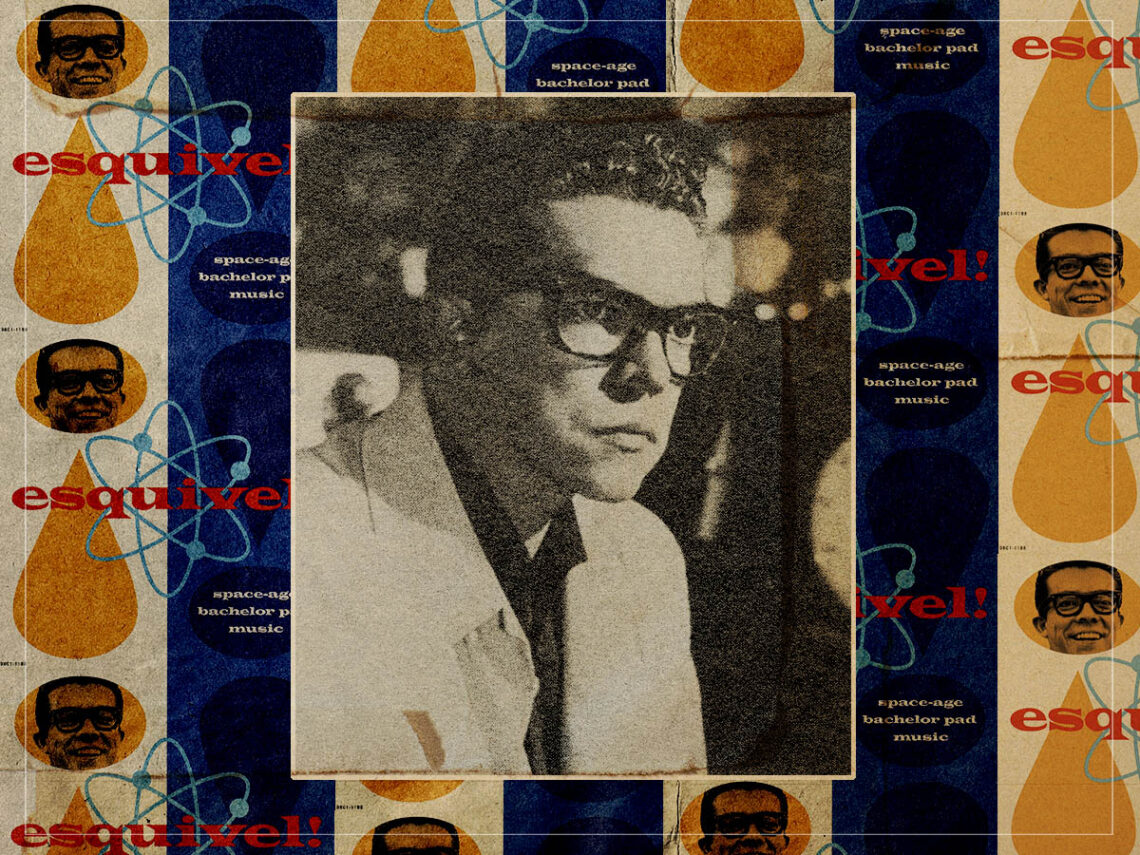
Esquivel: the strange story of the ‘Space-Age Bachelor Pad Music’ pioneer

‘Space Age Bachelor Pad’ music may just sound like the last few Arctic Monkeys albums, but they weren’t actually the first to combine lounge lizard antics with retro sci-fi concepts. The truth is that when Turner and Co were singing about Tranquillity Base Hotel And Casino, they were doing so in tribute to Esquivel, a band whose influence on 2000s indie knows no bounds.
Shockingly enough, it’s not on his birth certificate, though. Esquivel was born Juan García Esquivel in Tampico, Tamaulipas, before his family relocated to Mexico City when Juan was ten. By this point, the young Juan was already becoming something of a musical prodigy, taking up the piano at six and eschewing formal training in favour of a more practical curriculum of listening to music and working out the songs himself.
By the time he was a teenager, he was already a local hero in Mexico City, performing piano recitals and conducting the orchestra of his local radio station. Crucially, though, he also pursued a degree in electrical engineering. While he continued to write music professionally, his background in engineering shaped the way he recorded, arranged and produced music, which the world at large would only come to see a few decades later.
During this time, he developed what would later become known as lounge music—a stylish, poppy, and unmistakably modern take on jazz filled with wordless singing, exotic percussion, and his own dazzling piano fills. Esquivel himself never took to the ‘lounge’ term, referring to it instead as ‘space-age pop’.
By the 1950s, the ambitious Esquivel saw no future for himself in his home country. He left Mexico in 1959 and parlayed his record contract with RCA Mexico into one with their Hollywood counterpart the same year. With a bigger audience, his space-age pop became a national hit, with several records released and a slot in Las Vegas as Frank Sinatra’s opening act by the mid-1960s.
These concerts saw the scope of Esquivel’s vision for his music. He was among the first musicians to combine his live show with a full-on light show to reflect its sci-fi nature. Considering that puts him alongside visionaries like Andy Warhol with his Exploding Plastic Inevitable concerts, that’s not bad company. Unfortunately, once the demand for pop and rock bands increased, Esquivel’s brand of lounge music was seen as hopelessly passe.
By the 1970s, he had moved back to Mexico, where he continued to write, record, and perform music until his passing in 2002. While Tranquillity Base Hotel and Casino may be the most overt tribute to his work, though, his music has been revived in popularity several times over. He was a key part of the swing revival in the late 1990s, and a remix album of his work was hugely popular in his native Mexico in the 2000s.
It just goes to show that sometimes being ahead of your time, while a mixed blessing, is a blessing, nonetheless. Sure, you may not be hailed in your time as much as you should, but you’ll find your audience. Then afterwards, you’ll be hailed as a genius long after you’re gone. A legacy that we’d all be grateful for, I’m sure.
