


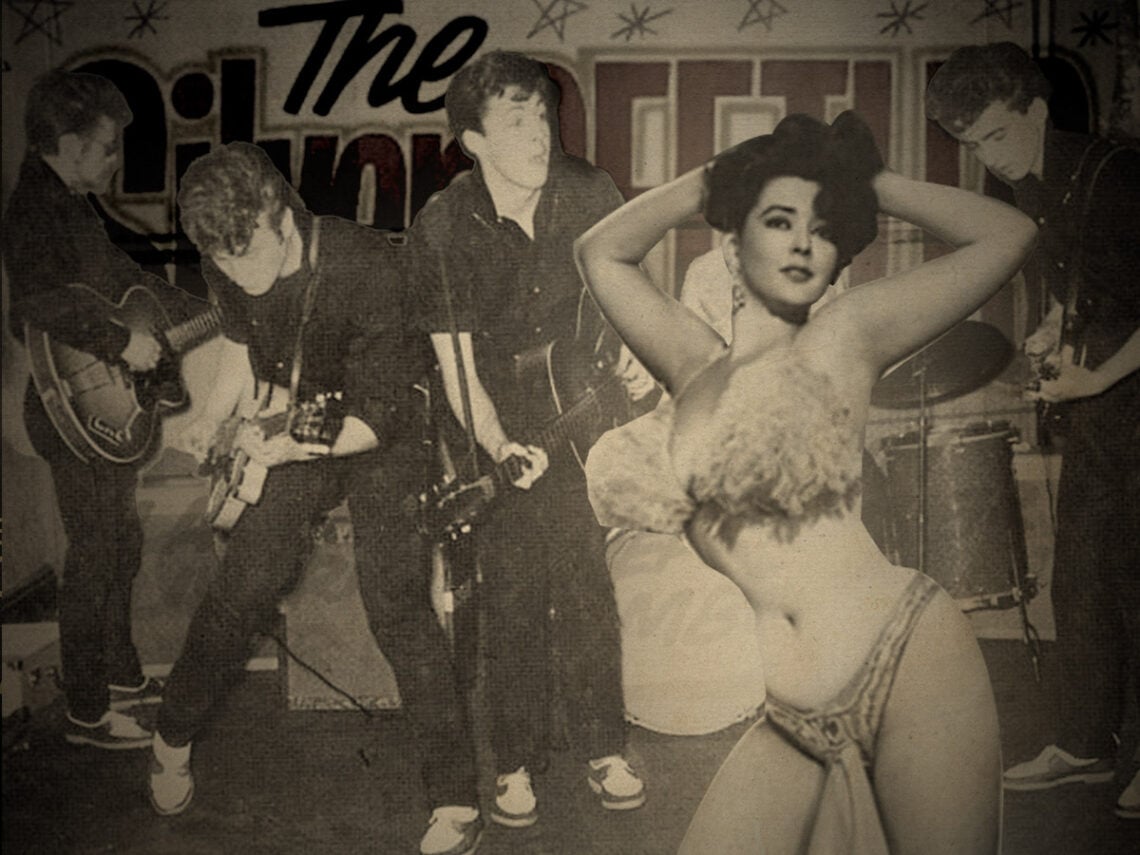
Janice the Stripper: the erotic dancer who fronted The Beatles in 1960

A lot can change for a hungry young band swept up in pop’s dizzying catapult. In four hectic years, The Beatles were selling out shows in Australia after having cracked America, a long way from scoring a strip show back in their Liverpool hometown.
Long before Beatlemania, the future Fab Four were donning leather jackets and pompadours, cutting their teeth as The Silver Beetles and backing rock and roll hopeful Johnny Gentle across Scotland in May 1960. It was respectable graft for lads who were mostly still in their teens, and beat having a day job. Yet, despite such a promising trajectory, needs on occasion still must, and the offer of a fat paycheque held major sway on the band’s road to stardom.
In comes Allan Williams. Before Brian Epstein and his marketing genius, the proto-Beatles were under the managerial wing of one of Liverpool’s key promo bigwigs, Williams, rising as a key figure of the area’s bustling Merseybeat and forging professional connections with Gerry and the Pacemakers and Rory Storm and the Hurricanes, the latter featuring one Ringo Starr on the drum kit.
He was also an associate of Lord Woodbine. A Trinidadian musician and fellow promoter who played at the early Beatles haunt, the Jacaranda Club, as well as performing with them in Hamburg, Woodbine expanded his business operations in Liverpool, running the Cabaret Artists Social Club in Upper Parliament Street. Jump to June 1960, and one night’s event needed some game musicians to provide a backing score for Janice’s titillating strip show. Williams had just the band.
There was some resistance, but the Silver Beetles finally agreed to the show after some firm financial negotiations from the then bass player, Stuart Sutcliffe. “Why so much?”, Williams reportedly asked, Paul McCartney, quipping back, “For the indignity. The bloody indignity of it all!”
As agreed, Sutcliffe, John Lennon, and George Harrison took to the tiny stage with McCartney on drums, playing a ‘cleaner’ matinee show in the afternoon before the main event down in the club’s seamy basement. A roll call of strippers pushed The Beetles to play slow songs, a tempo not to their liking or repertoire, except for one whose hula-hooping skills demanded the awkward backing band play some sped-up numbers.
Janice was the star of the show, however. She also carried enough clout to push for a specific live soundtrack. Arriving at the club with sheet music tucked under her arm, Janice was clear in her expectations of Beethoven and Manuel de Falla’s ‘Ritual Fire Dance.’ Eddie Cochran, it wasn’t. The Beetles were an amenable bunch, frankly admitting their inability to read music and instead offering ‘The Harry Lime ha-Cha’, the old ‘Moonglow’ jazz standard, and Kurt Weill’s ‘September Song’ Broadway number.

Ever the professional, Janice was able to work with the material she was given, putting on the show without breaking a sweat and bowing to the audience on full display, as well as returning the gesture to the young Beetles behind her.
“Well, we played behind Janice, and naturally, we looked at her, the audience looked at her, everybody looked at her, just sort of normal,” McCartney would recall in a letter to Mersey Beat journalist Bill Harry. “At the end of the act, she would turn round and, well, we were all young lads, we’d never seen anything like it before, and all blushed, four blushing red-faced lads.”
Wheels in motion were set. The “red-faced lads” would adopt the final Beatles moniker, and be whisked away to the heart of Hamburg’s red-light district, where performing and socialising with the company of sex workers became routine. It would take another five years before the Fab Four would ever feature a stripper in their creative orbit, roping in Jan Carson to play her saucy cabaret act while The Bonzo Dog Doo-Dah Band play ‘Death Cab for Cutie’ in the Fab Four’s surreal Magical Mystery Tour TV movie.

Never Miss A Beat
The Far Out Beatles Newsletter
All the latest stories about The Beatles from the independent voice of culture.
Straight to your inbox.