


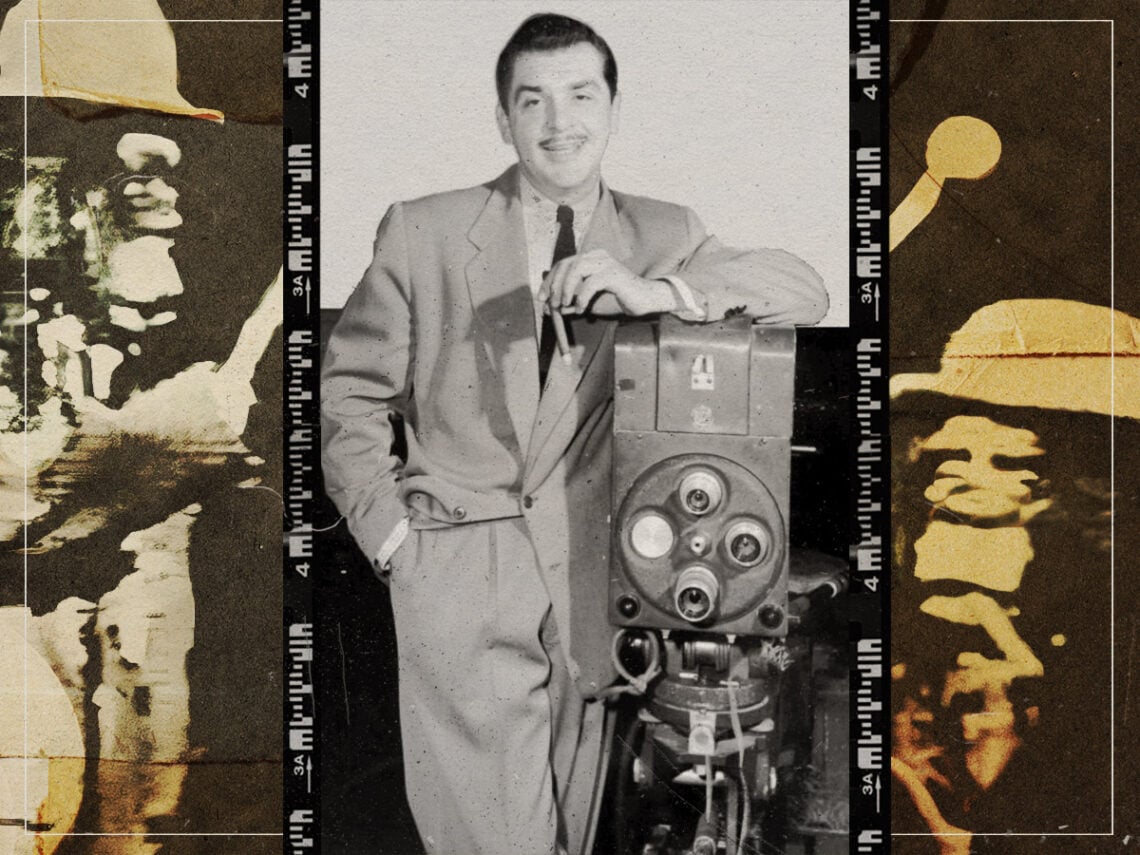
For better or worse: The forgotten legacy of Ernie Kovacs and ‘The Nairobi Trio’

In an episode of Friends from season four, Chandler gets up in the middle of the night to catch a rerun of The Ernie Kovacs Show, and for a brief moment, the once-popular sketch The Nairobi Trio appears on the screen. For younger generations, Kovacs is almost forgotten. This isn’t necessarily a bad thing, considering that to the unfamiliar viewer, the sketch might seem uncomfortably close to what some would describe as stereotypical American blackface.
Throughout the 1950s and 1960s, Kovacs gained a reputation as one of the most innovative and groundbreaking comedians on television. At the time, he was considered incredibly experimental, but in a way that drew audiences in from far and wide. His material was unconventional and strangely fascinating, if even a little unsettling and morbid at times.
Overall, his work felt immensely ahead of its time, especially considering the ways he utilised metafictional tropes and broke down barriers in professional and corporate broadcasting. Instead of appearing rigid, Kovacs became celebrated for his ad-libbing and television special effects and played on serendipity to surprise audiences and keep them engaged.
The Nairobi Trio, however, is perhaps one of his most difficult sketches to digest with the modern eye, especially as, before we even delve into its history and how it came to be, it immediately looks offensive. The characters you see are people wearing gorilla suits, whose identities varied but were portrayed by some notable names, including Kovacs himself, alongside Edie Adams, Jack Lemmon, Frank Sinatra, Bobby Lauher, and Barbara Loden.
The premise was pretty simple: nearly all of the skits played out in a similar manner, with the gorillas playing instruments as ‘Solfeggio’ plays, with one playing drums on the other’s head, leading to an inevitable outburst of irritability. It’s incredibly easy to watch and even easier to perform, and the predictability of the skits often played into its appeal as viewers waited for the eagerly anticipated explosion of emotion.
Chandler might have initially warmed to the concept due to its overt simplicity, not to mention its potentially nostalgic edge, but this provides an interesting lesson in the trajectory of mass comedy over the years. While there seems to be something soothing about the ways the gorillas move to the rhythms of the Robert Maxwell song, most of the humour arises from the gorillas’ deadpan expressions, which could be seen as problematic when faced with the notion of stereotyping.
On the surface, The Nairobi Trio could be considered suitably slapstick, something that was famously popular at the time but with the added allure of tension. Usually, comedy was categorical of one or the other, but The Nairobi Trio merged various aspects of humour to create something that audiences kept coming back for.
This approach to comedy became incredibly influential among many names and shows who followed suit, including Max Headroom, Chevy Chase, Monty Python, Sesame Street, The Muppet Show, Saturday Night Live, and talk show hosts like Jimmy Kimmel and Conan O’Brien. It even inspired Harry Nilsson when creating the video for his song ‘Coconut’, which features a similar setup to the Trio.
However, while many things are left to the shadows of history, forgotten unless dredged up once again, it seems as though Kovacs lives on only in the way he influenced others’ comedic brands rather than his specific sketches. The Nairobi Trio, for instance, looks and feels incredibly controversial to the modern viewer, making its absence from memory seem entirely necessary.
Whether Kovacs intended to or not, The Nairobi Trio would be completely unacceptable by today’s standards due to the way he uses gorillas as what seems to be stand-ins for racial caricatures and stereotypes. Their mechanical movements, too, mimicked the minstrel-type mannerisms of blackface actors, who offensively stereotyped Black people as slow, unintelligent, and animalistic.
While The Nairobi Trio isn’t exactly remembered among the everyday consumer, whenever anyone stumbles across it by chance, it likely leaves a bad taste in their mouth. Audiences today have generally grown to understand the insensitivity of such content and, by extension, the reasons for its blacklisting from modern viewing, but the ways in which it has transformed from merely harmless absurdist comedy to a problematic relic highlight the evolving standards of cultural sensitivity and awareness in contemporary society.
