


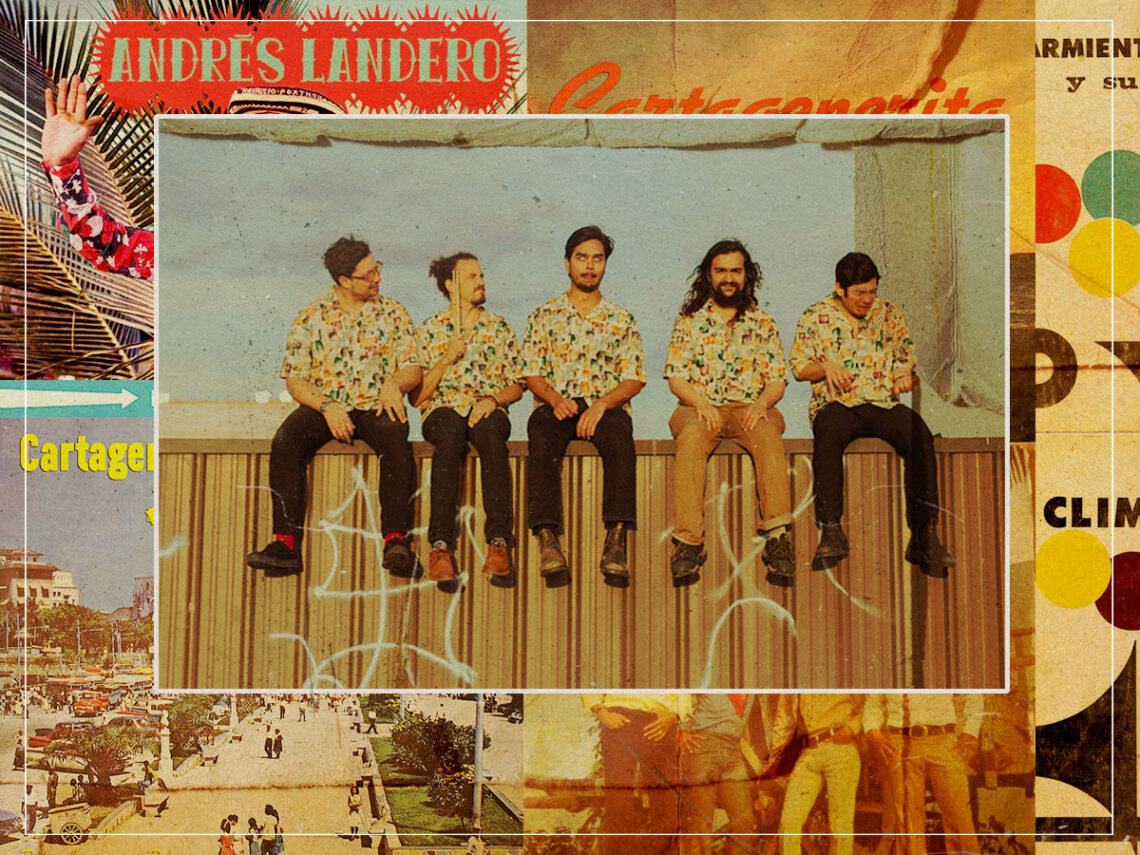
Colombian Sounds: Empanadas Ilegales recommend five Cumbia masterpieces

There is a very good reason why cumbia music sounds like an assegai of sunshine bursting through the clouds. Its origins date back to the slave trade in Colombia. From this hardship came a defiant marriage of Spanish instrumentation and West African rhythms as unity was sought. Thus, the resultant sound is a melee of vibrancy that speaks to human communion with just a hint of a sombre note that stands to highlight the importance of celebration.
On top of this unique history is the evident impact of sunshine. So, as we head into summer, we hooked up with Empanadas Ilegales to get our playlist ready. The Vancouver-based cumbia-psych hybrid stays true to the genre’s tradition of blending styles with their latest album, Creepy Mambo: Rooftop Sessions. The sound they produce with the stirring record is at once as immediate and visceral as a samba party while delivering a hint of something mystical in the mirage of Beefheart-like guitars that swirl depth into the sound.
“This is our homage to an old school cumbia song from the 1980s by Sonido Verde de Moyobamba,” the band’s guitarist and vocalist Ricardo Perez explains. “Whenever we travel, we go digging to find music that you can’t hear anywhere else, and when Danny went back to Colombia, he found this record [‘La Danza Del Vampiro’].”
This set off a wellspring of inspiration. “It has a very happy vibe with African beats and a calypso feel that’s not directly a cumbia,” Perez continues. “Jaime and I always like to have conversations with our guitar solos, so we decided to switch back and forth with different tones and then come together with the new melody we wrote that ends the song. It’s not a conversation anymore because we’re talking at the same time.”
That whirlwind of summer typifies the sound on the new record, which is, in many ways, a homage to the modern pastime of crate-digging. Eras, genres and emotions collide to create a punchbowl of brilliance. And with that classic vinyl sentiment in mind, we asked them to tell us about five cumbia masterpieces that have inspired them along the way.
We’ve whipped up their recommendations into a playlist at the foot of the piece. Enjoy…
Empanadas Ilegales recommend five Cumbia albums
Por Ahi Es Que Va La Cosa – Andres Landero y Sus Cumbiamberos del Pueblo (1983)
Empanadas Ilegales: “This first record is by one of our favourite Cumbia composers, Andres Landero from San Jacinto, Bolivar, Colombia. It was released in 1983 on the Folkor label.
“Our bassist Daniel Hernandez Pinto is from Cartagena, Colombia. He is an avid vinyl record collector, and through his journeys between Cartagena and Barranquilla, he unearthed this rare original copy of this record. Landero is a very special composer due to his unique approach to compositions on accordion. His Sabanero musical style features a distinctive cadence, rhythm and melodious feel in each of his notes, evoking a very deep sentimental mood”.
Some highlight tracks include ‘Virgen de la Candelaria’, a homage to the “patrona de Cartagena” or patroness of Cartagena, to which there is a yearly celebration. Noemi, speaks of taking a romantic message of Cumbia to a lady and her family.
Landero’s sound deeply influenced our approach to Cumbia.
Cartagena Alegre – Pedro Laza y sus Pelayeros (1961)
Empanadas Ilegales: “A fantastic, mostly instrumental album recorded by bassist, composer and Orchestra leader Pedro Laza. Laza was one of the most influential musicians and composers of his time in Colombia in the mid-1950s, the golden era of Colombian music. During this period, Laza began experimenting in orchestral-Caribbean groups featuring trumpets, trombones and sax.
“Cartagena Alegre features a mosaic of unique Colombian rhythms, including Cumbia, Fandango, Porro, Gaita, Paseo amerengao, and Pilele.
“The instrumental approach with horns and lively ‘descarga’ feel is deeply ingrained in our DNA and influenced our music, even if subconsciously.”
Cartagenerita – Lucho Bermúdez (1961)
Empanadas Ilegales: “Lucho Bermúdez is considered to be one of the most important performers and composers of Colombian music in the 20th century. He adapted traditional Colombian musical styles such as cumbia and porro into modern rhythms that would become symbols of national identity from the 1930s.
“His work had a substantial impact around Latin America. His musical work was influenced by the porros and fandangos of the Sabana de Bolívar and the coastal towns of northern Colombia. A fun fact is that one of the lead vocalists, Bobby Ruiz, is our drummer Dani Ruiz’s grandfather.”
Los Pakines – Los Pakines (1973)
Empanadas Ilegales: “Los Pakines is a Peruvian cumbia and instrumental rock musical group from Lima, Peru that was formed in 1972. Their particular style, melodic and sober, is known as Sonido Elegante or ‘Elegant Sound’.
“At the beginning of the 1970s, after the late ’60s, the Peruvian cumbia boom began. It is at that moment that the brothers José ‘Pepe’ Torres Liza and Alejandro ‘Pakin’ Torres Liza, together with Oscar Bellido Ríos and Wilberto ‘Beto’ Mena, decide to form a musical group, initially instrumental due to the influence of groups like Los Belkings, The Shadows, The Ventures, Los Jaguars, Los Hollys, The Jhokers and Los Destellos.
“The director and owner of the Infopesa label, Alberto Maravi, convinced them to venture into cumbia, a genre that brought them success, along with the recognition from a wider audience, the press and fellow musicians. They were celebrated as a band with sound and musical prowess that is both sober and elegant in its sound.”
Climaco Sarmiento Y Su Orq – Climaco Sarmiento Y Su Orq (1962)
Empanadas Ilegales: “Clímaco Sarmiento founded his own orchestra in 1959 and became the arranger for Pedro Laza y sus Pelayeros with whom he collaborated on albums such as Navidad Negra, Esperma y Ron, Rito Esclavo and the famous Candela that Daniel Santos recorded with Laza.
“It was precisely with Pedro Laza (and others like Rufo Garrido) with whom Clímaco Sarmiento put together a powerful creative key that contrasted strongly with the stylised sound of the orchestras of Lucho Bermúdez, Pacho Galán and Edmundo Arias. Sarmiento’s work was visceral, strident and with a hard and almost primitivist rhythmic line, an imitation of the wind bands of the Bolívar savannahs. This sound is present in Bombo y Maracas and Clímaco Sarmiento y su Orquesta, two of the albums that the clarinettist recorded for Fuentes between 1961 and 1962.”
